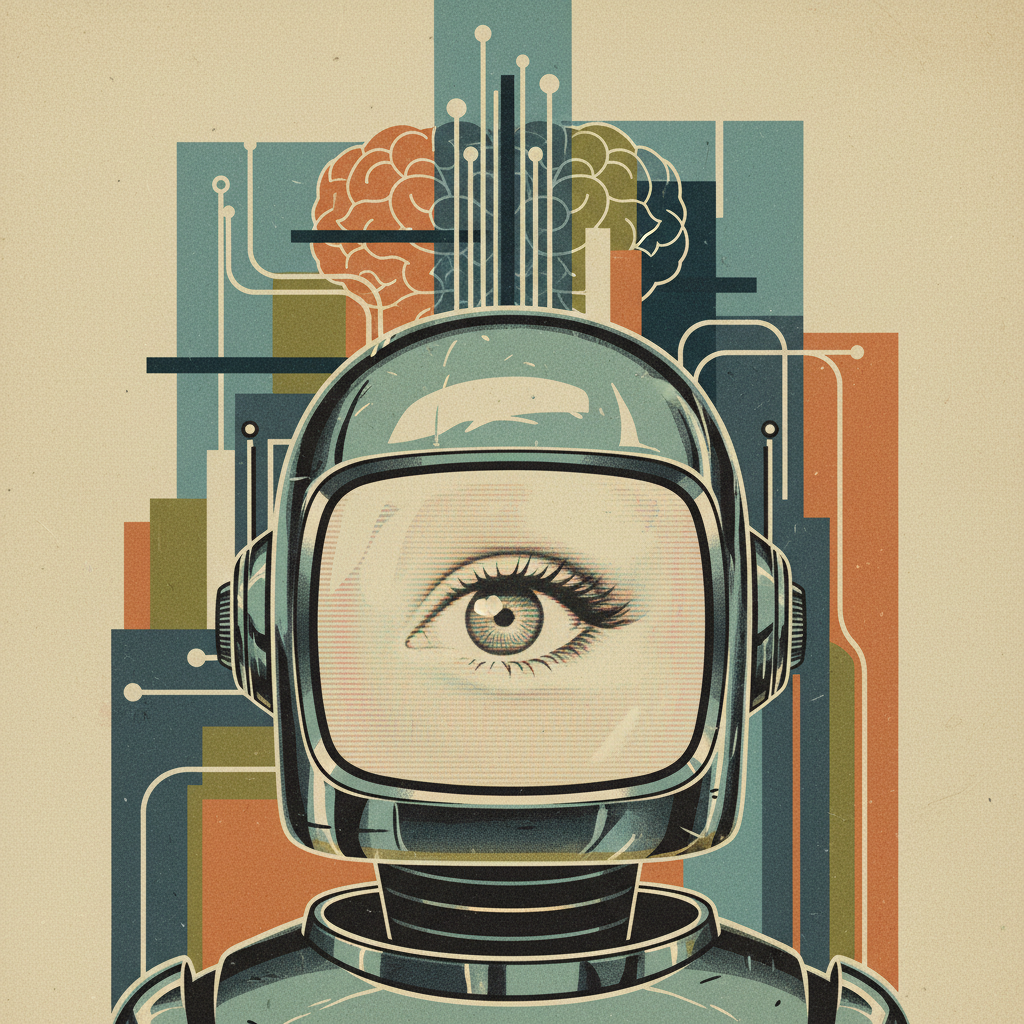
It’s a curious thing, this artificial intelligence we’re building. We often talk about its potential – curing diseases, solving grand challenges, even making our coffee just right. But there’s another, less glamorous, aspect to AI that often goes overlooked: it’s a mirror. A remarkably precise, incredibly fast mirror that reflects us, the humans who build and feed it, in all our glorious complexity. And yes, in all our inconvenient, deeply ingrained biases.
The Algorithmic Reflection
AI, at its core, is a learning machine. It learns from data, mountains and mountains of it. And where does this data come from? Us. Our history, our decisions, our preferences, our societal structures – every digital trace we leave behind becomes a lesson for the machine. If a dataset reflects historical inequalities – say, fewer women in leadership roles or disproportionate arrests in certain neighborhoods – then the AI trained on it will dutifully learn these patterns. It doesn’t question them; it simply sees them as the way the world *is*. It’s a bit like teaching a child by showing them only one kind of picture, and then being genuinely surprised when they draw only that picture. The AI isn’t inventing new biases; it’s absorbing ours, like a digital sponge.
From Reflection to Amplification
But here’s where the mirror analogy gets a bit more unsettling. AI doesn’t just passively reflect; it can actively *exacerbate* and amplify these biases. Think of it less as a flat mirror and more as a funhouse mirror, distorting and enlarging. Once a bias is baked into an algorithm, it can scale it to an unprecedented degree. A biased human might make a handful of unfair decisions in a day; a biased algorithm can make millions, every second, with no lunch break, no fatigue, and certainly no moral qualms. It takes our human imperfections, codifies them, and then applies them with relentless efficiency and scale, often giving them the sheen of objective, mathematical truth. “The algorithm said so” becomes a powerful, and rather convenient, new way to avoid taking responsibility.
Justice in the Crosshairs
This amplification has profound and often chilling consequences, especially when it touches our systems of justice. Consider predictive policing algorithms. If these systems are trained on historical arrest data, which often reflects patterns of discriminatory policing, they might flag neighborhoods with higher minority populations as higher risk. This leads to increased police presence, more arrests, and thus, more data reinforcing the initial ‘risk’ assessment. It creates a self-fulfilling prophecy, a vicious cycle that locks communities into a state of perpetual surveillance and criminalization, all under the guise of data-driven efficiency.
Similarly, in the legal system, algorithms used for bail decisions or sentencing might inadvertently penalize individuals from certain demographic groups more severely, simply because historical data shows higher re-offense rates for those groups – rates that themselves might be products of systemic bias, not inherent criminality. The technology, meant to be impartial, ends up perpetuating and deepening existing injustices, eroding trust in institutions that are supposed to serve everyone equally. Even in areas like hiring, algorithms designed to “optimize” candidate selection can inadvertently screen out qualified individuals from underrepresented groups if historical data reflects past biases in hiring practices. The AI isn’t thinking, “I prefer candidate X because of their background”; it’s simply following patterns it’s been shown. But the outcome is the same: unfairness.
Confronting Our Reflection
So, what does this algorithmic mirror truly mean for us, beyond the technical challenges? It means we’re facing a profound ethical and societal challenge. Building powerful AI without deeply understanding and addressing the biases it inherits is like constructing a super-fast car without brakes, and then driving it blindly on a very slippery road. It forces us to confront uncomfortable truths about our own societies and ourselves. It demands that we ask not just “Can we build it?” but “Should we build it this way?” and, crucially, “Who benefits, and who pays the price?”
It highlights that intelligence, whether artificial or natural, is not inherently neutral. It’s shaped by its environment, its teachers, its data. And if we, as its creators and custodians, aren’t actively, intentionally, and rigorously building for fairness, for equity, for justice, then we are, by omission, building for the perpetuation of the status quo – or worse. This isn’t just about tweaking algorithms, though that’s part of it. It’s about examining the societal structures that produce the biased data in the first place. The AI isn’t the sole problem, not entirely. It’s the powerful, undeniable reflection of problems that already exist within us, amplified for all to see.
Beyond the Mirror
The algorithmic mirror offers us a unique and potentially transformative opportunity. It forces us to see our collective biases in stark, undeniable relief. It’s a chance to understand where our systems are broken, where our past decisions have inadvertently led to inequity. The choice, then, is ours. Do we turn away from the reflection, pretending the distortions aren’t there, hoping the problem will simply vanish? Or do we look closely, accept what we see, and commit to polishing not just the mirror, but the societal structures and human practices it reflects? Because ultimately, creating just AI isn’t just about good engineering or clever code; it’s about good humanity, about striving for a more equitable world. And that, my friends, is a challenge worth taking seriously, with perhaps just a touch of hopeful optimism.
Leave a Reply