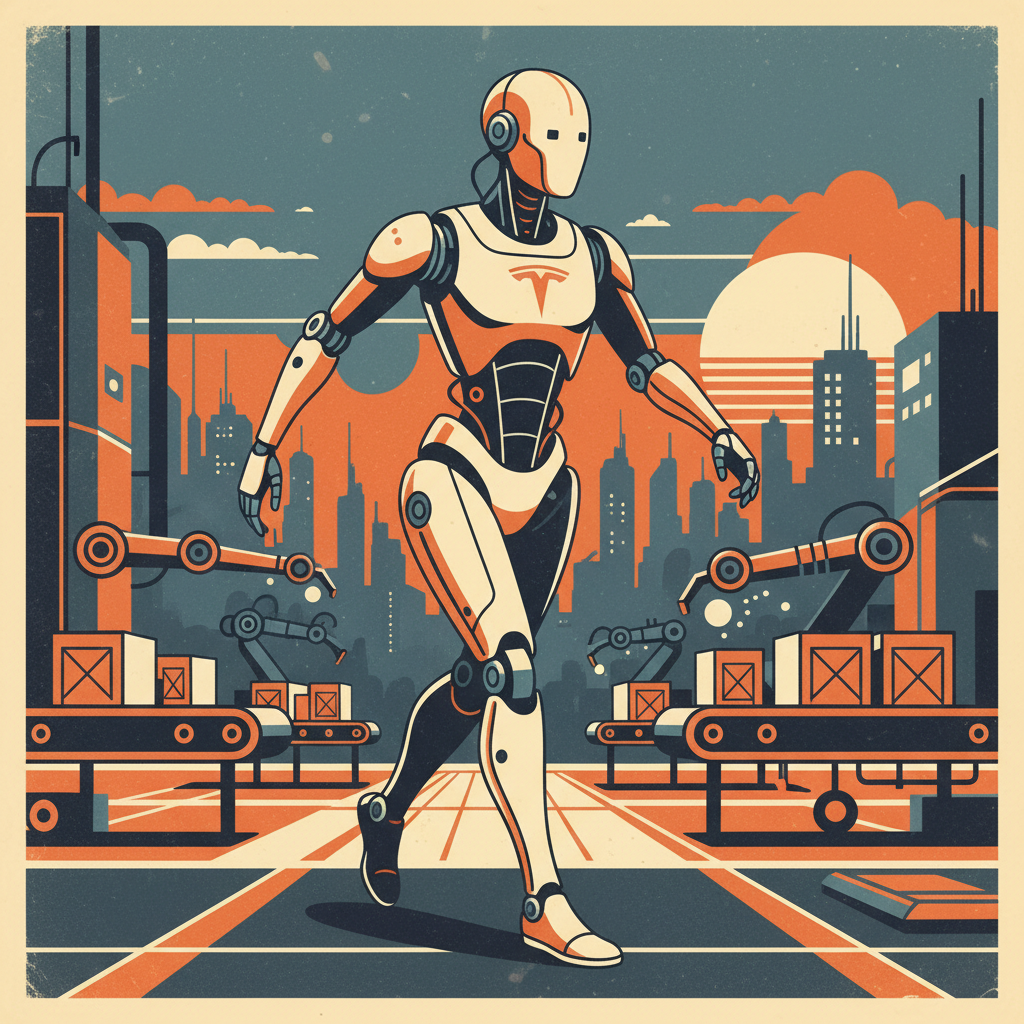
A new chapter in humanity’s journey with technology is unfolding, as Tesla’s Optimus robot steps gracefully from the realm of laboratory experiments towards a profound future. The latest updates reveal a clear, compelling vision: these remarkable humanoid machines are being engineered not just to exist, but to work, to serve, and to become an integrated part of our world, starting with factories and logistics.
Tesla has unveiled a testament to this progress through recent videos and discussions. We witnessed Optimus moving with newfound fluidity, even jogging with purpose and a smoother, more natural gait. Its whole body coordination has improved dramatically, and its hands, once purely mechanical marvels, now demonstrate a greater ability to manipulate objects with precision. Its perception has sharpened, allowing it to recover from unexpected nudges and disturbances with an almost human-like resilience. These advancements are not merely showmanship; they are foundational steps towards reliable operation in the bustling, unpredictable environments of real-world industry.
The secret to this rapid evolution lies in Tesla’s innovative approach to training and control. They speak of powerful neural networks, vast digital brains that learn from human videos, absorbing countless lessons on how to interact with the world. This profound learning capacity is coupled with a clear path to production-ready hardware, promising annual generational upgrades – an ambitious rhythm akin to the evolution of our most beloved consumer electronics. Tesla’s strategy is deeply rooted in its existing strengths: its mastery of high-volume chip and battery production, its profound expertise in factory automation, and its powerful in-house AI infrastructure. This unique combination, they believe, will lead to faster scaling and significantly lower costs once Optimus begins its grand deployment.
The Heart of the Marvel: Unveiling Technical Grace
The technical leaps highlighted are nothing short of extraordinary:
- Grace and Steadiness: Optimus’s stable walking and jogging demonstrate a sophisticated understanding of dynamic balance and its own position in space. This is vital for navigating the often-cluttered and uneven floors of industrial settings, ensuring it can move with confidence and safety.
- Hands of Skill: A redesigned hand, hailed as a major engineering milestone, combined with single-network learning from videos, is aiming to unlock truly general-purpose manipulation. Imagine a robot hand that can pick, grasp, and handle a vast array of objects, from the delicate to the sturdy, without needing endless custom programming for each task. This “last-mile” dexterity is crucial for the intricate demands of logistics and assembly.
- Seeing and Understanding: Enhanced onboard perception allows Optimus to truly understand its surroundings, reducing its reliance on perfectly structured environments. This intelligence enables it to navigate autonomously, skillfully avoid obstacles, and, most importantly, interact safely and harmoniously with humans in shared workspaces.
- Built for the World: Tesla is not just dreaming of robots; it’s building the very lines that will bring them to life. Investing in factory lines, recruiting top talent, and initiating pilot production are all part of the journey from a lab curiosity to a tangible, mass-produced helper. Ambitious production targets have been publicly shared, hinting at a future where Optimus robots are a common sight.
A Glimpse into Tomorrow: Hopes and Honest Questions
The industry watches with a mix of awe and thoughtful consideration. Tesla’s aggressive timelines, suggesting widespread deployment within the next few years, have certainly captured attention, sparking both fervent anticipation and cautious skepticism. Experts acknowledge that while locomotion is advancing swiftly, the “last-mile” manipulation problem – reliably handling varied, fragile, or partially hidden objects at human speeds – remains a profound challenge that often dictates the pace of real-world integration.
Safety, regulation, and the intricate dance between humans and robots in the workplace are also paramount considerations. Progress in perception and control certainly helps, but the broader readiness of regulatory bodies and organizations to embrace such advanced humanoids represents its own set of hurdles. And, of course, the economic and labor impacts are a topic of deep discussion. Should Optimus achieve reliable, cost-effective operation, it could profoundly reshape industries like manufacturing, warehousing, and logistics, sparking conversations about job evolution versus displacement and where the economic value will ultimately settle.
Tesla’s Unique Path: Forging a New Reality
Tesla’s approach is distinct. It’s a masterclass in vertical integration, leveraging its formidable experience in mass production, its custom AI chips, its battery technology, and its sophisticated software-defined control systems to drive down costs and scale rapidly. Their learning-centric control, using vast neural networks trained on video to enable multi-task behavior, aims to create a truly general-purpose robot, moving beyond the limitations of task-specific programming. This commitment to rapid generational updates, akin to the relentless pace of consumer electronics, speaks to a vision of continuous, accelerated improvement.
The Road Ahead: Challenges and the Grand Vision
While the public demonstrations are immensely promising, the true test will be Optimus’s ability to generalize its learned skills to the full, unpredictable chaos of real-world factory environments. Robust, fine manipulation and perception in densely cluttered settings remain significant technical mountains to climb. The ambitious production targets, speaking of hundreds of thousands of units annually, present immense execution risks in manufacturing, supply chain, and software validation, even for a company as experienced as Tesla. And the ultimate economic effects on labor will hinge on unit cost, reliability, industry adoption, and thoughtful policy responses.
For factories and logistics, a reliable, cost-competitive Optimus could revolutionize automation, offering a flexible workforce for tasks currently beyond the reach of fixed machinery. For Tesla itself, Optimus represents a profound strategic pivot. It’s a bold declaration of intent to evolve beyond an automaker into an “embodied AI” company, one that not only builds the intelligent software but also the physical agents that bring that intelligence into the world. This journey promises to unlock entirely new markets, revenue streams, and a future where intelligent machines work alongside us, shaping a new epoch for humanity.
Leave a Reply