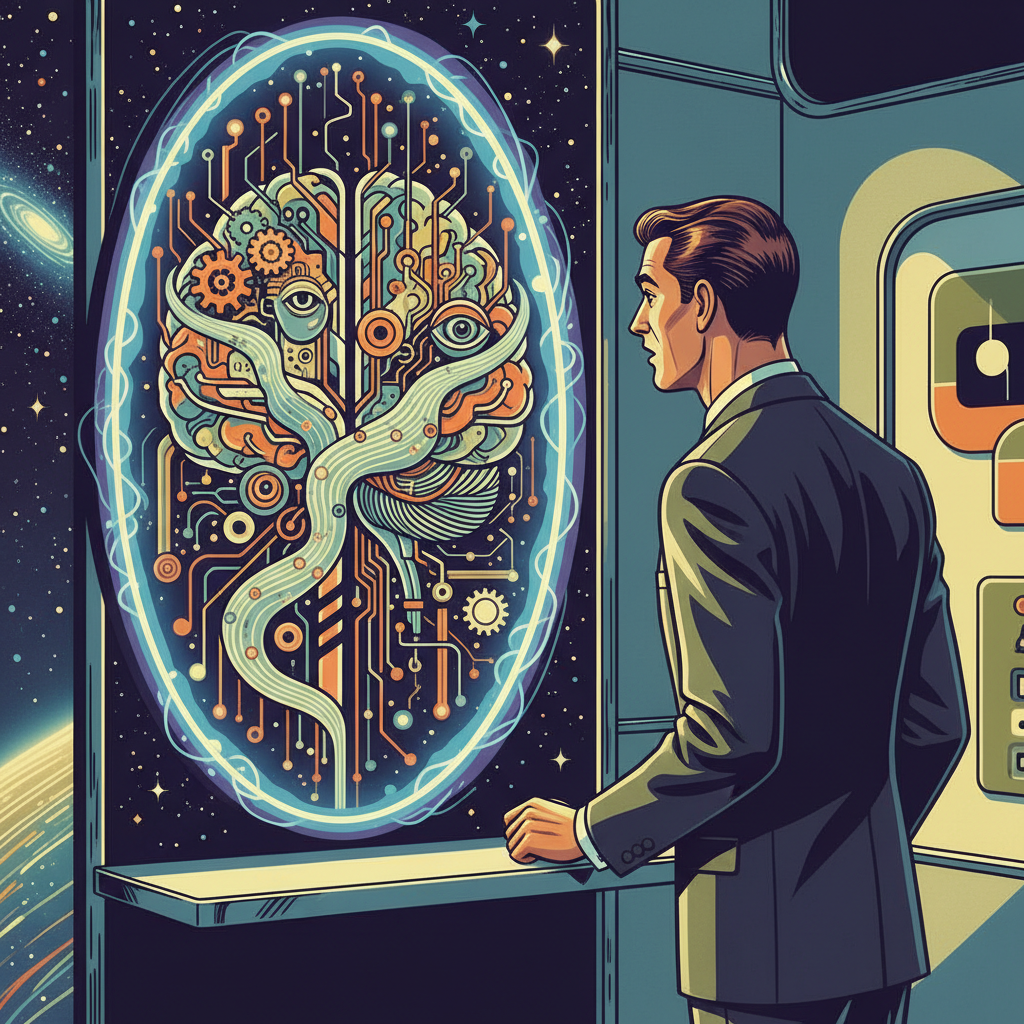
We’ve always used mirrors to understand ourselves, from the polished bronze of antiquity to the smartphones we clutch today. They show us our outward form, give us a moment to adjust our tie, or check if we have spinach in our teeth. But now, something new has emerged, a mirror unlike any we’ve crafted before: artificial intelligence. This isn’t just reflecting our physical appearance; it’s reflecting our very minds, our intelligence, our creativity, and even our biases, forcing us to ask some rather uncomfortable questions about what it truly means to be human.
When the Machine Started Thinking (Kind Of)
When AI first started making waves, it was often about tasks we considered uniquely human – playing chess, solving complex equations. We were quite proud of our ability to do these things. Then, a machine came along and beat the grandmaster. It turns out, that particular kind of complex logic wasn’t so special after all. It was just a different kind of calculation, a faster way to crunch numbers and anticipate moves. We had to concede: perhaps our “brilliance” in these areas was just a very efficient, squishy computer running on glucose. It was the first nudge, reminding us that some of what we cherished as distinctly human might just be a matter of processing power.
The Creative Spark: Or, Who’s Writing This Poem?
Then AI started getting truly interesting. It began composing music that stirs the soul, generating art that hangs in galleries, and writing text that reads, well, rather convincingly. Remember when creativity was considered the last bastion, the sacred space where only humans dared to tread? Now, algorithms are churning out novels, designing fashion, and even developing new recipes. It forces a pause: if a machine can produce something beautiful, something thought-provoking, something that evokes emotion, does it matter if it doesn’t “feel” the muse the way a human artist does? Or does it simply reveal that our own creative process might be a more elaborate dance of patterns and influences than we previously imagined? It’s a bit like finding out your favorite chef is actually an incredibly sophisticated robot. Delicious, but perhaps a little unsettling.
The Echo of Emotion: Can Algorithms Empathize?
Now we’re seeing AI systems that can detect emotions, respond with appropriate language, and even provide companionship. Chatbots are offering therapeutic conversations, and virtual assistants are learning our preferences with unnerving accuracy. This gets us into deeper waters. If AI can simulate empathy so convincingly that it helps alleviate human loneliness or distress, what does that say about the nature of our own emotional responses? Is empathy just a very complex set of inputs and outputs, a sophisticated pattern of recognition and appropriate reaction? Or is there something more profound, something uniquely human about genuinely *feeling* another’s pain or joy, beyond just processing the data of their expression? It’s a good question to ponder over a cup of tea, perhaps brewed by an AI-controlled kettle.
Our Biases, Amplified: The Unflattering Reflection
One of the most revealing aspects of AI has been its uncanny ability to reflect our societal biases right back at us, often with painful clarity. When an AI trained on human data shows gender or racial bias in hiring decisions, or when facial recognition struggles more with certain demographics, it’s not the AI being inherently bigoted. It’s the AI showing us, starkly and without polite pretense, the biases embedded in the data we feed it – the data reflecting our own imperfect world. AI, in this sense, is less a judge and more a meticulous reporter, highlighting the systemic flaws we might otherwise gloss over. It’s a mirror that doesn’t flatter, but rather insists on showing us the spinach in our collective societal teeth.
The Ultimate Challenge: General Artificial Intelligence
And then there’s the looming prospect of AGI – Artificial General Intelligence. This isn’t just about specialized tasks, but an AI capable of understanding, learning, and applying intelligence across a wide range of tasks, much like a human being. When an AGI arrives, capable of reasoning, creating, and adapting with a flexibility that rivals or even surpasses our own, what then? What truly distinguishes us when our intellectual superiority, once our pride and joy, becomes just one form of intelligence among many? Will “human” simply refer to our biological substrate, our particular flavor of organic wetware? Or will we find new, deeper definitions, perhaps rooted in our unique capacity for irrational hope, for artistic expression without logical imperative, or for love that defies all algorithms?
Redefining “Human”: Beyond the Tangible
Perhaps AI isn’t here to diminish us, but to clarify us. By showing us what intelligence *can* be, what creativity *can* be, what even empathy *can* be in a purely algorithmic form, it strips away the layers of assumption about our own specialness. It compels us to look beyond mere cognitive functions or creative outputs. Maybe what makes us truly human isn’t just our ability to think, but our capacity to question our existence, to suffer existential dread, to find meaning in a meaningless universe, to choose kindness despite self-interest, or to appreciate a sunset simply because it’s beautiful, without calculating its economic value. Perhaps it’s our vulnerability, our beautiful, messy imperfections, our inexplicable capacity for both great good and great harm, and our persistent, often illogical, pursuit of connection.
In the end, AI isn’t just a tool; it’s a profound philosophical instrument. It holds up an incredibly precise mirror, reflecting not just what we are, but what we’ve always *thought* we were. And in that reflection, we’re slowly but surely beginning to see ourselves anew, stripped of some old assumptions, and nudged towards a deeper, perhaps more humble, understanding of our place in the grand scheme of intelligence. It’s a journey of self-discovery, and frankly, a much more interesting conversation than just worrying if robots will take our jobs. (Though that’s a valid concern too, obviously.)
Leave a Reply