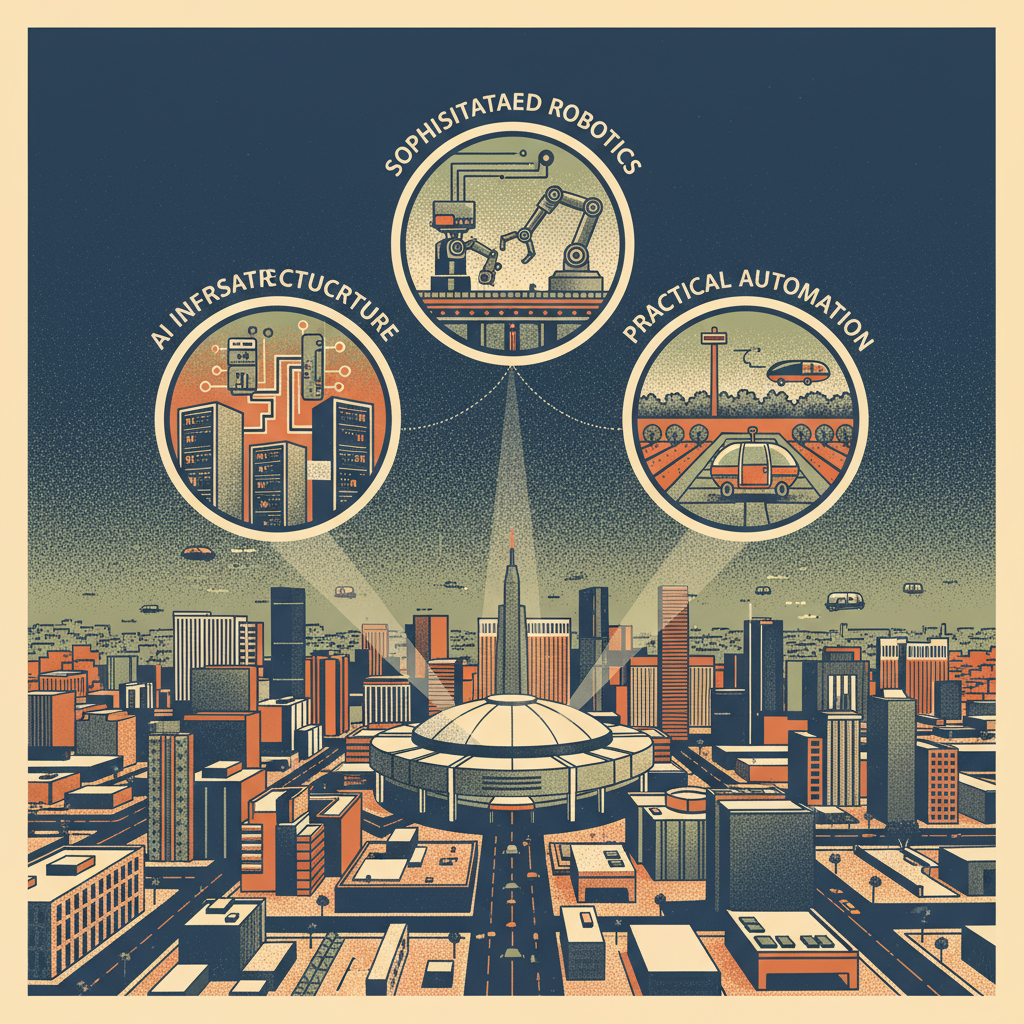
The recent gathering in Las Vegas, CES 2026, wasn’t just another tech show; it was a profound glimpse into a future unfolding before our eyes. With over 4,000 visionary exhibitors across thirteen grand venues, something truly transformative was revealed. The era of flashy consumer gadgets stepped aside, making way for a deeper, more fundamental revolution: the quiet emergence of AI infrastructure, sophisticated robotics, and practical automation that will soon weave itself into the fabric of our industries and daily lives. What we witnessed was the transition of intelligent software and powerful computing from hopeful prototypes to tangible, deployable solutions – a testament to physical AI that doesn’t just process data, but truly interacts with our world.
The Silent Engines of Tomorrow: AI Infrastructure
AI, once a mere concept, is now manifesting as the bedrock of our digital existence. Keynotes at CES focused on AI’s efficient computation, seamless integration, and profound industrial impact.
Giants like AMD unveiled roadmaps showing CPUs, GPUs, and specialized software harmoniously accelerating AI everywhere—from vast data centers to personal devices and the very edge of our networks. NVIDIA, with continuous breakthroughs, described its advancements as a “Woodstock of AI,” hinting at an impending explosion of smarter, more capable models.
Industrial AI’s true potential shone brightly. Imagine self-optimizing factories, accelerated drug discoveries, and autonomous vehicles. Siemens showcased its “digital twins” – virtual replicas of real-world systems – developed with NVIDIA, creating an AI operating system that learns from simulations and live data. We saw NVIDIA’s Cosmos AI physics simulator, crafting realistic virtual worlds for AI learning, and the mighty Vera Rubin superchip, powering demanding computations. Their Alpamayo autonomous vehicle AI promised to bring self-driving technology closer. These are the unseen forces, the silent engines powering the coming age.
Robotics: Intelligence in Motion
Perhaps the most captivating revelation was the maturation of robotics. Here, physical AI truly came alive, moving from impressive demonstrations to functional, scalable systems for homes, factories, and outdoors.
Boston Dynamics unveiled an AI-powered Atlas humanoid robot moving with astonishing fluidity, boasting 56 degrees of freedom and tactile hands. This isn’t just a lab marvel; it’s slated for deployment in Hyundai Motor Group plants by 2028, with plans for a factory producing 30,000 robots annually. Partnerships with Google DeepMind are refining its AI for practical tasks.
In our homes, LG’s CLOiD home robot offered liberation from chores. Imagine a robot handling household tasks with zero labor, recharging itself, and even sensing your emotions.
Beyond these titans, a diverse ecosystem of robots emerged:
- Companions: The Zeroth M1 humanoid, Hengbot quadruped, Mirumi interactive companion, Tombot robotic puppy for emotional support, and Frontier-X Vex pet-following robot.
- Daily helpers: The Nutribot AI nutritionist and the self-cleaning homerunPET litter box.
- Outdoor maintenance: Aiper pool cleaners, Mammotion lawnmowers, and versatile Yarbo systems.
- Entertainment: The SenseRobot chess player and the Pongbot tennis machine.
- Advanced humanoids: New generations like the Unitree G1 & UFB 5, EngineAI, Realbotix, Sharpa, and LimX Dynamics Tron 1.
Experts like Wesley ter Haar called this the dawn of “physical AI that actually works,” from robot servers to self-driving cars, predicting scaled deployments by CES 2027. Counterpoint Research noted humanoids gaining stronger bodies, superior AI, and clearer roles beyond the laboratory.
A World Transformed: Beyond the Machines
The impact of these innovations ripples far beyond individual machines. Autonomous mobility, intertwined with robotics, is becoming a near-term reality thanks to dramatic cost reductions and computing breakthroughs. Digital health is being revolutionized by tiny, edge-processed sensors monitoring our well-being.
The conversation also extended to vital concerns: building resilient supply chains, preparing our workforce, and ensuring sustainability. The CTA even committed to funding green projects in Las Vegas. This profound pivot signals that AI, in its maturity, will become a silent, pervasive infrastructure, driving efficiency and transforming everything from vast factories to our homes. CES 2026 wasn’t just about showing off technology; it was about presenting a future that is no longer distant, but powerfully, undeniably here.
Leave a Reply