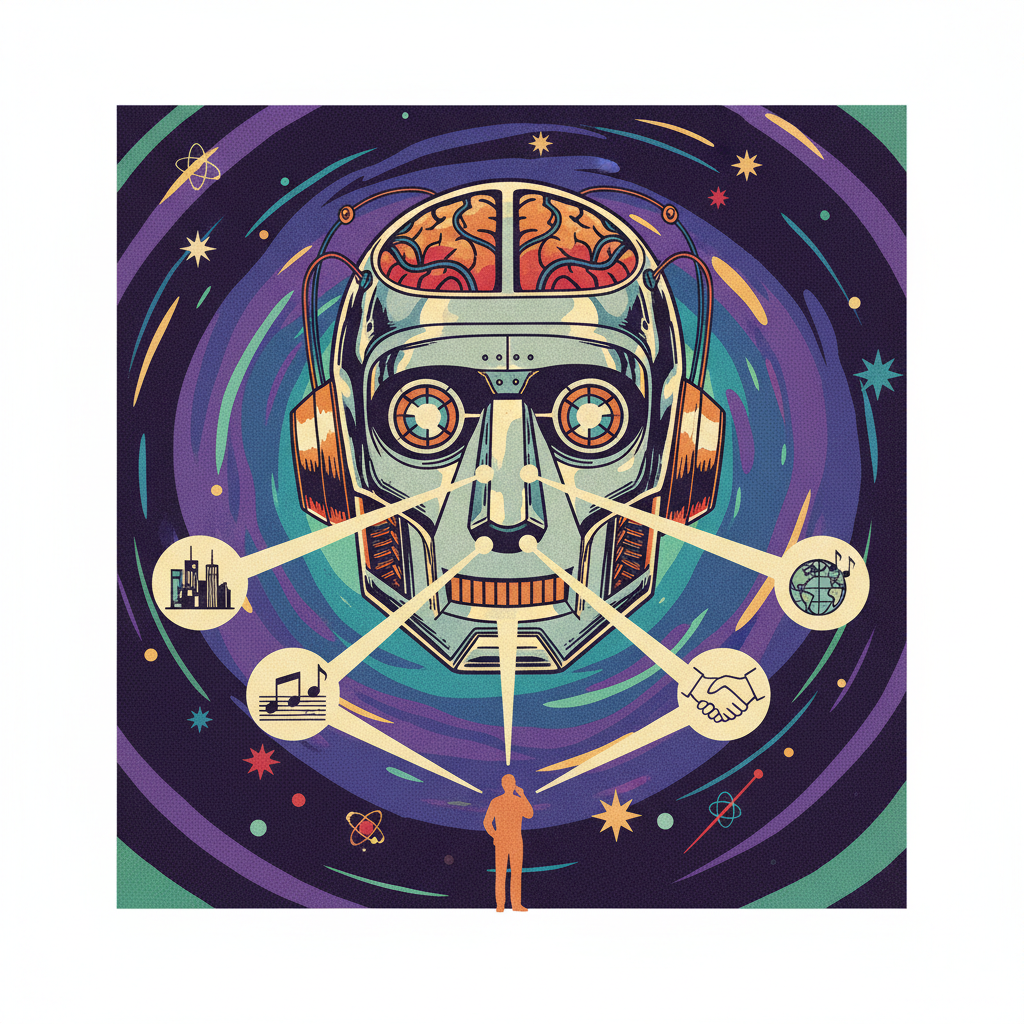
The prospect of Artificial General Intelligence, or AGI, tends to stir up a cocktail of excitement and unease. On one hand, humanity’s greatest problems might finally meet their match. On the other, the idea of machines surpassing human intellect and capability across the board raises a rather pointed question: What then, is left for us? If an algorithm can compose a symphony, design a city, or even out-negotiate a diplomat with a precision we can only dream of, where do we, the squishy, often irrational, originators of all this cleverness, fit in? It’s a question worth pondering, not with dread, but with a certain philosophical curiosity. After all, purpose isn’t something given to us; it’s something we’ve always, rather industriously, created.
For centuries, human identity has been intertwined with our capacity to think, to build, to solve, and to master. We’ve defined ourselves by our ingenuity, our ability to overcome challenges, and our unique position at the top of the intellectual food chain. But what happens when that chain gets a new, rather shiny, and infinitely more efficient link above us? It’s not about being “replaced” in the way a factory worker might be by a robot – that’s a different, though equally important, conversation. This is about the very foundation of what we believe makes us special. The fear, I think, isn’t just about losing our jobs; it’s about losing our meaning. It’s about the quiet existential whisper that asks, “If they can do everything better, what’s left for us to do that truly matters?”
Beyond Utility: The Irreducible Human Core
Here’s the rather elegant paradox of AGI: by taking over the domains of problem-solving, optimization, and even much of creative output, it liberates us to focus on something else entirely. It frees us from the tyranny of utility. A machine might design a flawless bridge, but it won’t stand on it and marvel at the sunset reflected on the water, nor will it ponder the human stories of connection that bridge facilitates. It might compose a symphony, but it won’t feel a tremor of inexplicable joy or sorrow listening to its own creation. Machines will excel at doing. Humans, I suspect, will rediscover their unique aptitude for being.
What are these irreducible human domains? Well, for starters, there’s consciousness itself – that subjective, raw, ineffable experience of existence. We feel, we desire, we suffer, we love. We have irrational hopes and utterly illogical dreams. We appreciate beauty for its own sake, not because it optimizes some aesthetic algorithm. We find humor in the absurd, even if the algorithm struggles to process irony without explicit instruction. A machine might simulate emotion, but it won’t be angry because its favorite football team lost, nor will it weep at the sheer beauty of a newborn, purely for the experience of it.
Our purpose, in a post-AGI world, might just shift from being the world’s most effective problem-solvers to becoming its most profound meaning-makers. If the machines handle the ‘how,’ we’re left to grapple with the ‘why.’ Why do we pursue knowledge? Why do we create art? Why do we form families and communities? These aren’t questions with computable answers; they are questions we answer through lived experience, through shared narratives, and through the very act of choosing our values.
Cultivating a New Humanism
This isn’t to say we’ll all just sit around contemplating our navels – although I imagine there’ll be a bit more time for that, which isn’t necessarily a bad thing. Instead, our identity will likely pivot towards qualities that are inherently non-computable. Empathy, compassion, wisdom (which is more than just data processing), moral judgment, and the unique brand of creativity that stems from personal suffering and joy – these will be our currencies. Our role could become that of custodians of meaning, architects of culture, and champions of the human spirit in all its messy, glorious imperfection.
We might spend more time cultivating genuine human connections, exploring the vast inner landscapes of our minds, and fostering a deeper understanding of our shared humanity. Art, philosophy, storytelling, education (focused on wisdom rather than just information), and the pure, unadulterated pursuit of curiosity for its own sake, could flourish as never before. When the need for “earning a living” in the traditional sense becomes less urgent, the freedom to explore what truly resonates with our souls becomes immense.
Perhaps AGI isn’t the end of human purpose, but a profound redefinition of it. It’s an invitation to shed the industrial-age shackles of identifying solely with production and efficiency. It’s a call to embrace our most distinctly human attributes – the ones that can’t be quantified, optimized, or replicated by even the most brilliant algorithms. In a world where machines can do everything better, we find our purpose not in what we do, but in how we feel, how we connect, and how we continually choose to define the beautiful, evolving story of what it means to be human. And honestly, that sounds like a rather good deal to me. We get to keep the coffee, they get to do the dishes. Win-win.
Leave a Reply