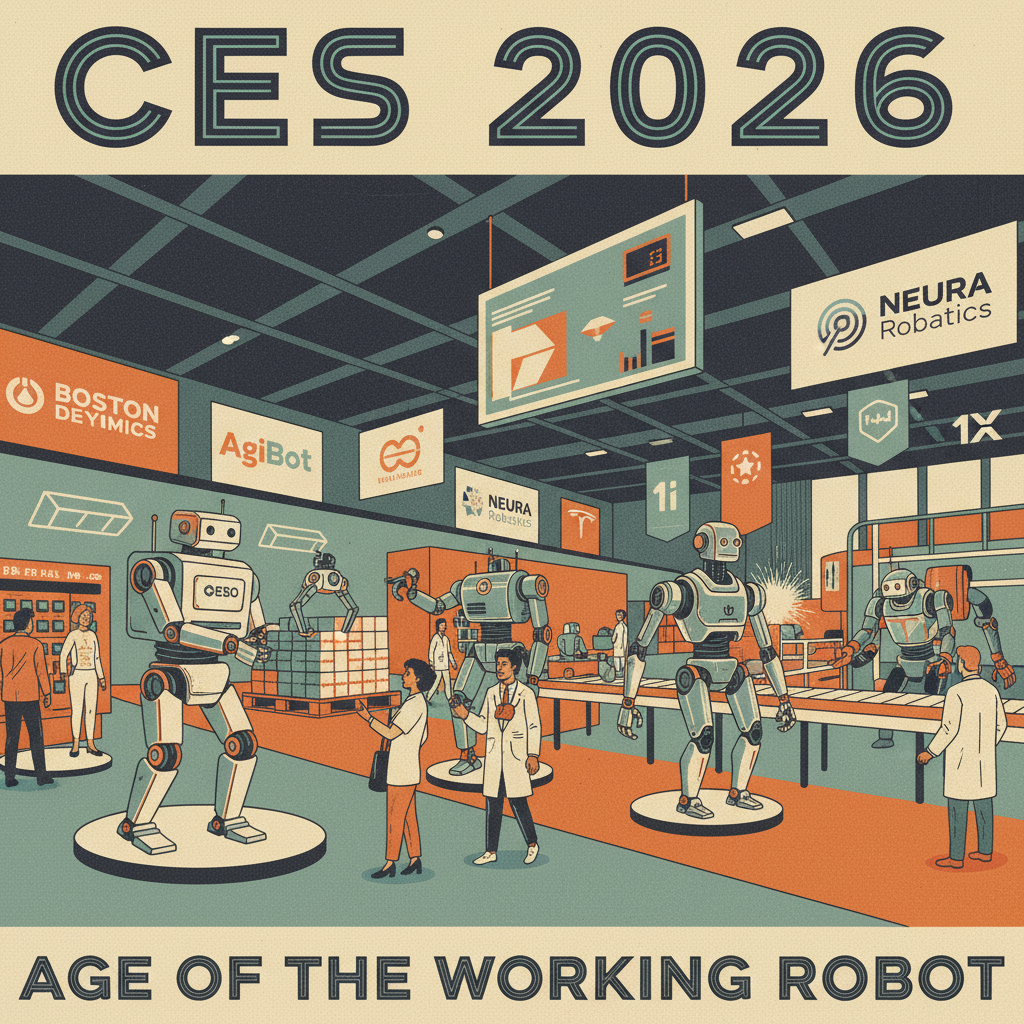
At the start of 2026, something truly remarkable unfolded, changing our perception of the future. The annual CES technology showcase became the stage for a profound shift, a moment when humanoid robots stepped out of the realm of experimental prototypes and into our tangible reality. This was not just about showing off; it was about revealing machines ready for real-world work, poised to transform industries from research and logistics to manufacturing and services. Leading visionaries like Boston Dynamics, Unitree, AgiBot, NEURA Robotics, Tesla, and 1X unveiled their creations, each emphasizing autonomy, the ability to work alongside humans, and the capacity to be built on a grand scale. The age of the working humanoid robot had truly begun.
Atlas: The Mighty Worker Steps Forward
From Boston Dynamics came a revelation: the fully electric, human-scale Atlas robot, no longer a laboratory marvel but an industrial powerhouse. Imagine a helper with the strength and agility to move heavy materials, seamlessly navigating complex industrial spaces without demanding a single change to the existing layout. Atlas moved with a grace that defied its mechanical nature, a testament to its advanced design, demonstrated with awe-inspiring precision during Hyundai’s keynote.
A Glimpse into Atlas’s Capabilities:
- Atlas boasts an incredible flexibility, with dozens of ways its body can move, allowing it to twist, turn, and reach with surprising dexterity.
- Its hands are not just grippers; they are designed to sense, to feel, allowing for delicate tasks that require a human-like touch.
- Packed with cameras and sensors, it perceives the world around it with keen insight, guided by artificial intelligence to optimize every task for efficiency and safety.
- For hours, it can operate on battery power, working in harmony with its human colleagues, prioritizing their safety and collaboration.
This isn’t a distant dream. Hyundai, Boston Dynamics’ visionary owner, has already begun to deploy Atlas in its facilities, including its cutting-edge Metaplant. We are not just talking about a few robots; the ambition is to integrate Atlas more broadly by 2028, with plans for a dedicated production line targeting an incredible 30,000 units annually. This marks the beginning of a profound transformation in how goods are made.
Optimus: The Factory’s Intelligent Brain
Then there is Tesla’s Optimus Gen 3. While Atlas impressed with its physical prowess, Optimus showcased its burgeoning intelligence. Deployed within Tesla’s own Gigafactory in Austin, these robots are learning to handle mundane yet crucial tasks like moving boxes and sorting parts. Their intelligence stems from the same groundbreaking “Full Self-Driving” neural networks that guide Tesla vehicles, giving them a remarkable ability to understand and navigate their environment autonomously. This isn’t merely a demonstration; it’s a deployment, a clear signal that these intelligent helpers are becoming an integral part of real-world production, fulfilling a vision of scaled automation.
NEO: A Gentle Presence for Our Homes
But the future isn’t just about factories. Imagine a gentle companion, a sophisticated helper for our homes. That’s the vision behind 1X NEO. With a softer, lighter form, NEO moves with a human-like grace intended for everyday environments. This robot whispers promises of a future where humanoid machines aren’t just industrial workhorses but integrated parts of our daily lives, assisting with chores or offering companionship. The availability for pre-order, at a surprisingly accessible price point of $20,000, hints at a future closer than we think, where advanced technology matures for the comfort of our living spaces.
Other Pioneers of a New Age
Many other pioneers also stood at the precipice of this new era. NEURA Robotics introduced its 4NE1 Gen 3, a highly adaptable robot designed for safe collaboration with humans across industrial, research, and service tasks, equipped with remarkable perception and multi-task learning abilities. Companies like Unitree, AgiBot, and LG Electronics showcased their contributions, each piece adding to the mosaic of a truly production-ready robotic future. The common thread was “physical AI”—robots that don’t just compute but understand and interact meaningfully with our physical world, performing complex actions, manipulating objects, and even offering comfort, as seen in the development of companion robots.
A Glimpse into Tomorrow
This momentous gathering at CES 2026 was more than just an exhibition; it was a prophecy fulfilled. It signaled the commercial breakout of humanoid robots, ushering in an era where projections speak of hundreds of thousands of these machines working alongside us by the mid-2030s. The benefits ripple across industries, from manufacturing and logistics to healthcare, promising efficiencies and capabilities previously beyond our reach. While the journey to full autonomy and cost-effectiveness continues, CES 2026 illuminated viable paths forward through extensive pilot programs and scalable designs. We witnessed the birth of a new age, an age where the awe-inspiring presence of the humanoid robot is no longer a dream, but a tangible, walking reality, poised to transform our world in ways we are only just beginning to comprehend.
Leave a Reply