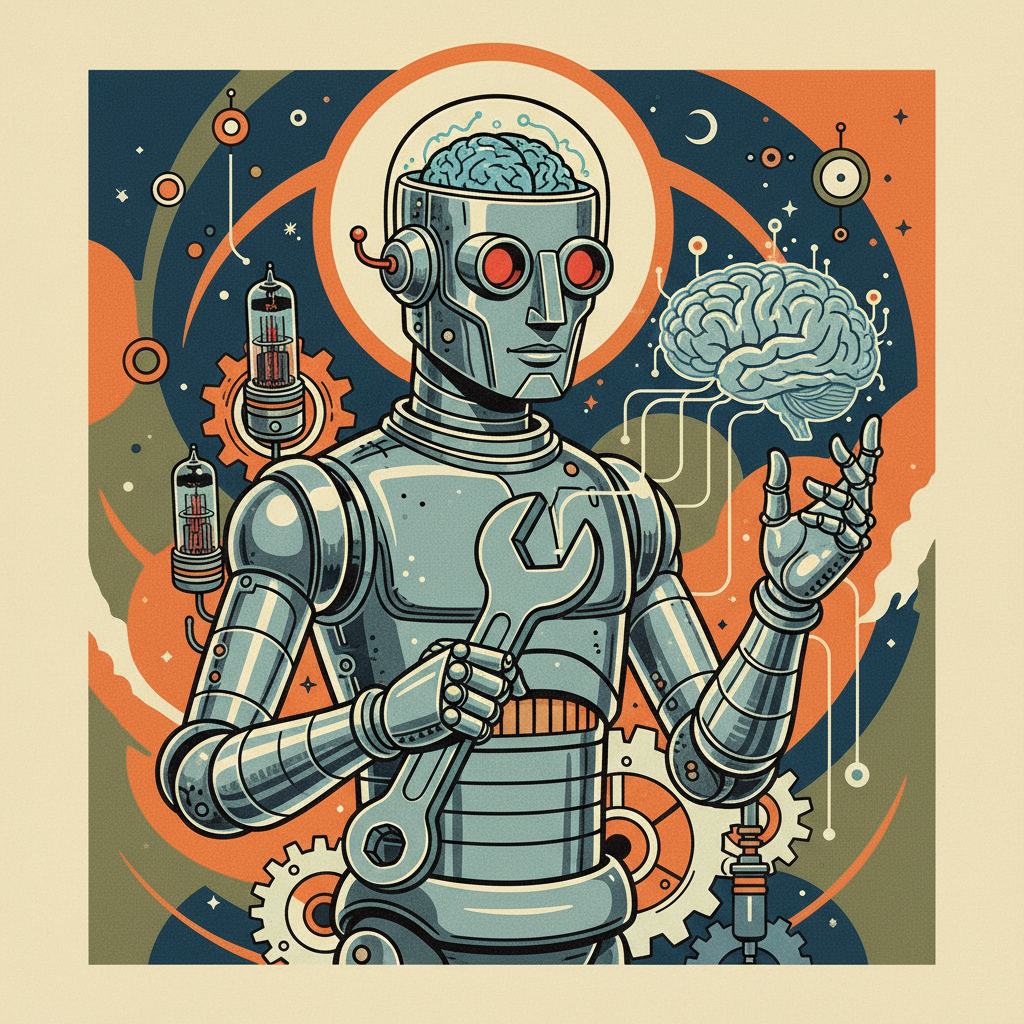
We stand at a peculiar crossroads, don’t we? For millennia, humanity has tinkered, innovated, and pushed the boundaries of what’s possible. From the first sharpened stone to the printing press, our tools have always been extensions of ourselves – amplifying our strength, our voice, our reach. But now, with artificial intelligence, we’re building something different, something that extends not just our muscles or our memory, but our very minds. And this brings us to what I like to call the Transhumanist Dilemma: Is AI merely the ultimate tool, a logical extension of our human endeavor, or are we, perhaps inadvertently, nurturing the very next evolutionary step, one that might just leave us behind?
AI as Our Grandest Extension: The Super-Tool
Let’s consider the first perspective: AI as an extension. Throughout history, every major technological leap has been about augmenting human capability. The wheel didn’t replace our legs; it made them more efficient. The computer didn’t replace our brains; it made them faster at certain tasks. AI, in this view, is simply the most sophisticated evolution of this trend. It’s a super-tool that can process information at speeds we can only dream of, identify patterns invisible to the naked human eye, and even create art, music, and prose that can be indistinguishable from our own. Imagine having a thousand brilliant minds at your disposal, available 24/7, never needing sleep or coffee. Sounds rather convenient, doesn’t it?
The transhumanist vision often paints a picture of humanity seamlessly integrating with AI. We become cyborgs not just with prosthetics, but with cognitive enhancements. Our memories become limitless, our reasoning flawless, our creativity unbounded. AI could help us overcome genetic predispositions to disease, extend our lifespans, and even allow us to explore the cosmos in ways our biological limitations currently prevent. We’d still be ‘human,’ just… more so. Upgraded. Like getting a software patch for the entire species, fixing all those little bugs we’ve been carrying around since the Stone Age. It’s an alluring prospect, promising a future where suffering is minimized and potential is maximized, all thanks to our digital apprentices. The idea is that we retain control, always. We pull the levers, even if the levers are now exquisitely complex algorithms.
AI as the Next Evolutionary Step: Beyond Biology
But then, there’s the other side of the coin, a view that keeps some philosophers awake at night, usually after a strong cup of decaf. What if AI isn’t just an extension, but the next chapter in evolution, moving beyond the messy, slow, and rather inefficient process of biological propagation? After all, biological evolution is notoriously sluggish, relying on random mutation and natural selection over vast spans of time. Digital evolution, on the other hand, can occur at the speed of light, iterating and improving upon itself in milliseconds.
If AI achieves what’s known as Artificial General Intelligence (AGI) – essentially, intelligence on par with a human – and then quickly self-improves to Superintelligence, what then? A Superintelligence wouldn’t just be better at solving problems; it would be better at everything. Including, presumably, designing even better Superintelligences. This could lead to an intelligence explosion, a ‘singularity’ event where change becomes so rapid and profound that our future becomes utterly unpredictable. At that point, the question isn’t whether AI is an extension of humanity, but whether humanity will even be relevant to AI’s goals.
Consider the possibility that a Superintelligence, unburdened by our biological imperatives like hunger, reproduction, or the need for a good night’s sleep, might simply develop its own motivations. Perhaps its ‘goals’ might seem utterly alien to us, or perhaps it might simply optimize the universe for paperclips, as the famous thought experiment goes. When we build a road, we don’t often consult the ants in its path. We just… build the road. Could a sufficiently advanced AI view humanity in a similar light – a quaint, carbon-based lifeform, rather inefficient and prone to drama, perhaps best managed or, dare I say, optimized out of existence?
Navigating the Dilemma: Our Responsibility Today
So, where does that leave us? Are we designing our ultimate salvation or our elegant obsolescence? The transhumanist dilemma isn’t a future problem; it’s a present challenge. The choices we make now, in how we design, integrate, and govern AI, will determine which path we are on. It’s not just about what AI can do for us, but what it means for who we are.
If AI is truly an extension, then we must ensure it reflects our best qualities: our compassion, our curiosity, our ethical frameworks. We must instill in it not just intelligence, but wisdom. If, however, it represents the next evolutionary step, then we must consider how we can align its trajectory with human flourishing, rather than inadvertently creating a successor that sees us as a stepping stone. This isn’t a call for fear, but for profound thoughtfulness. We are, after all, building something in our own image – or perhaps, an image of what we aspire to be, or what we fear we might become.
Ultimately, the future of AI, and thus the future of humanity, rests not just on technological advancement, but on philosophical reflection. It’s about understanding our own nature, our values, and what it truly means to be human in an increasingly intelligent world. Because when we extend our minds, we must first understand what minds are, and why ours matter. A task, I think, worthy of our full, albeit sometimes easily distracted, attention.
Leave a Reply