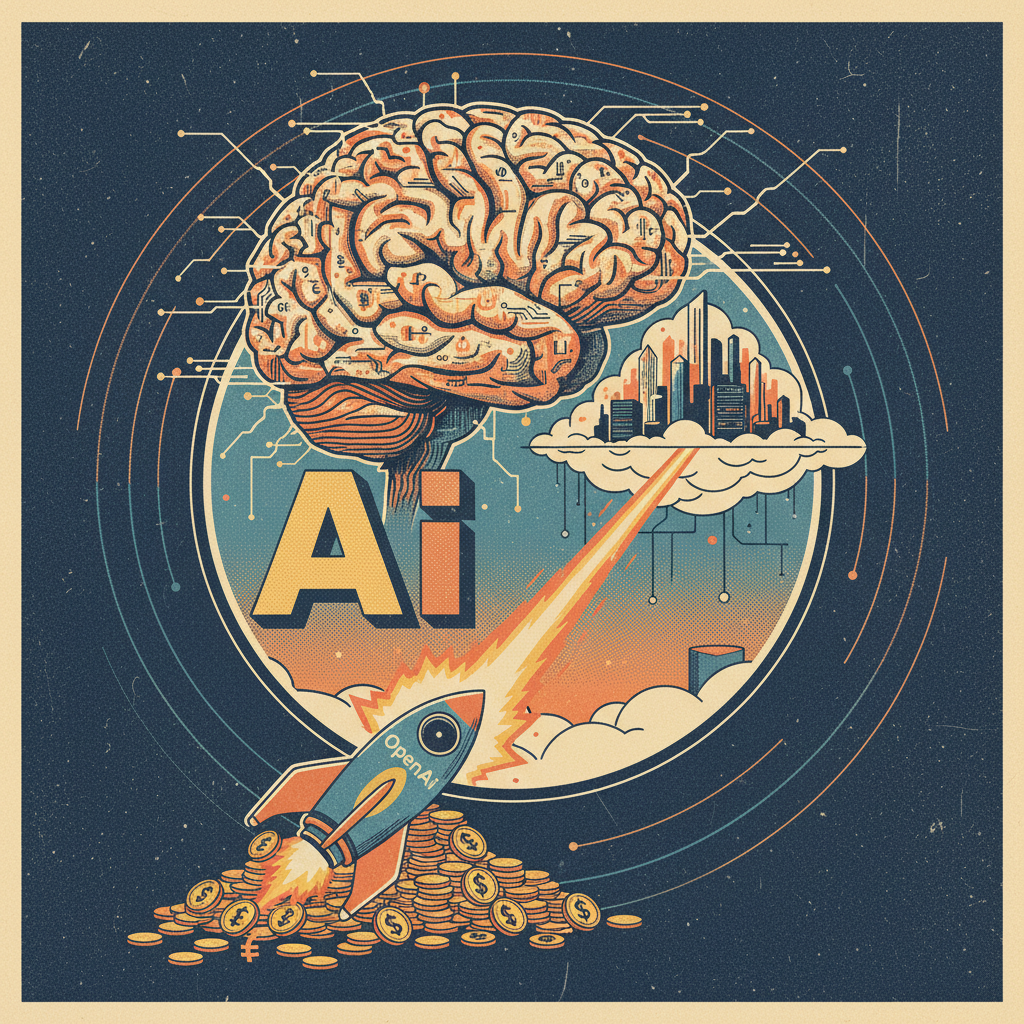
A whispered promise of the future is now thundering into reality. Artificial intelligence, once a distant dream, is rapidly becoming the fabric of our next age, demanding resources on an unimaginable scale. At the heart of this unfolding story stands OpenAI, a pioneer charting unknown territories, now poised to receive an infusion of capital that speaks volumes about the grand vision its work embodies.
SoftBank Group, a titan of investment known for its profound foresight, is said to be deep in discussions to commit an astonishing $30 billion to OpenAI. This colossal sum is but one part of an even larger tapestry: OpenAI’s ambitious plan to raise a monumental $100 billion. Should this vision materialize, it would elevate the valuation of OpenAI to an awe-inspiring $830 billion, a figure that resonates with the gravity of its mission.
This momentous development, confirmed by sources, marks a new chapter following SoftBank’s earlier commitment. This follows SoftBank’s earlier $41 billion investment in December, which secured a significant 11% stake in OpenAI. But the proposed new investment transcends even that impressive sum, signaling a deepening conviction. It underscores a profound truth: the advanced AI models that are shaping our future are not merely software; they are high-stakes infrastructure projects, akin to national endeavors, requiring vast oceans of computational power and sophisticated hardware to truly flourish.
## The Unseen Forces Driving This Vision
These colossal sums are not mere numbers; they are fuel for an extraordinary journey. OpenAI’s relentless pursuit of advanced AI capabilities meets a world hungry for transformation. Daily, the demand for more intelligent systems grows, requiring an infrastructure of unprecedented scale.
Imagine vast clusters of Graphics Processing Units (GPUs), the digital brains that power AI, working in unison across colossal data centers. Picture the immense energy required to train these complex models, feeding them data until they begin to understand and reason. This is the domain where these billions will flow, nurturing the very foundations of future intelligence.
Masayoshi Son, the visionary leader of SoftBank, has long been a prophet of the digital age. With a history of recognizing paradigm shifts – from telecommunications to microchips – his gaze is now firmly fixed on artificial intelligence. He perceives AI not just as another advancement, but as a fundamental, transformative force redefining industries and human potential. SoftBank’s aggressive backing of AI ventures attests to this unwavering belief. This funding round, dwarfing previous investments, powerfully signals investor confidence, transcending the sometimes-high burn rates of pioneering groundbreaking technologies.
## Whispers of a New Era: What This Means for Tomorrow
The implications of a $100 billion fundraising round are nothing short of revolutionary. Such a figure would not only shatter existing records but would also place the valuation of AI development on par with, or even exceed, many established tech giants combined. It is an acknowledgment that developing true artificial intelligence is not a venture for a single company alone, but rather a societal undertaking, much like building national infrastructure – roads, power grids, communication networks. This is infrastructure for the mind.
SoftBank’s $30 billion contribution highlights its strategic pivot. Having invested in foundational elements like Arm, the chip design powerhouse crucial for future computing, SoftBank meticulously builds an ecosystem to enable and leverage compute-heavy AI. Their investment is not merely financial; it’s a statement of strategic intent, a commitment to being at the very heart of the AI revolution.
For OpenAI, this monumental capital influx is a profound accelerant. It will empower their spirited competition with brilliant minds like Anthropic and xAI. Crucially, it provides resources to push AI’s boundaries, accelerating next-generation reasoning models – “o1”-style intelligence – and multimodal systems that understand and interact with the world through various senses, much like humans do. Imagine AI that doesn’t just process text, but sees, hears, and comprehends complex environments.
While these discussions are nascent, with no final agreements etched in stone, their very scale speaks volumes. They signal a momentous shift: artificial intelligence is no longer an experiment confined to laboratories or a fascinating concept debated in academia. It has unequivocally moved from an experimental curiosity to an industrial paradigm, a foundational pillar upon which our collective future will be built. The reverberations of this shift will be felt for generations to come.
Leave a Reply