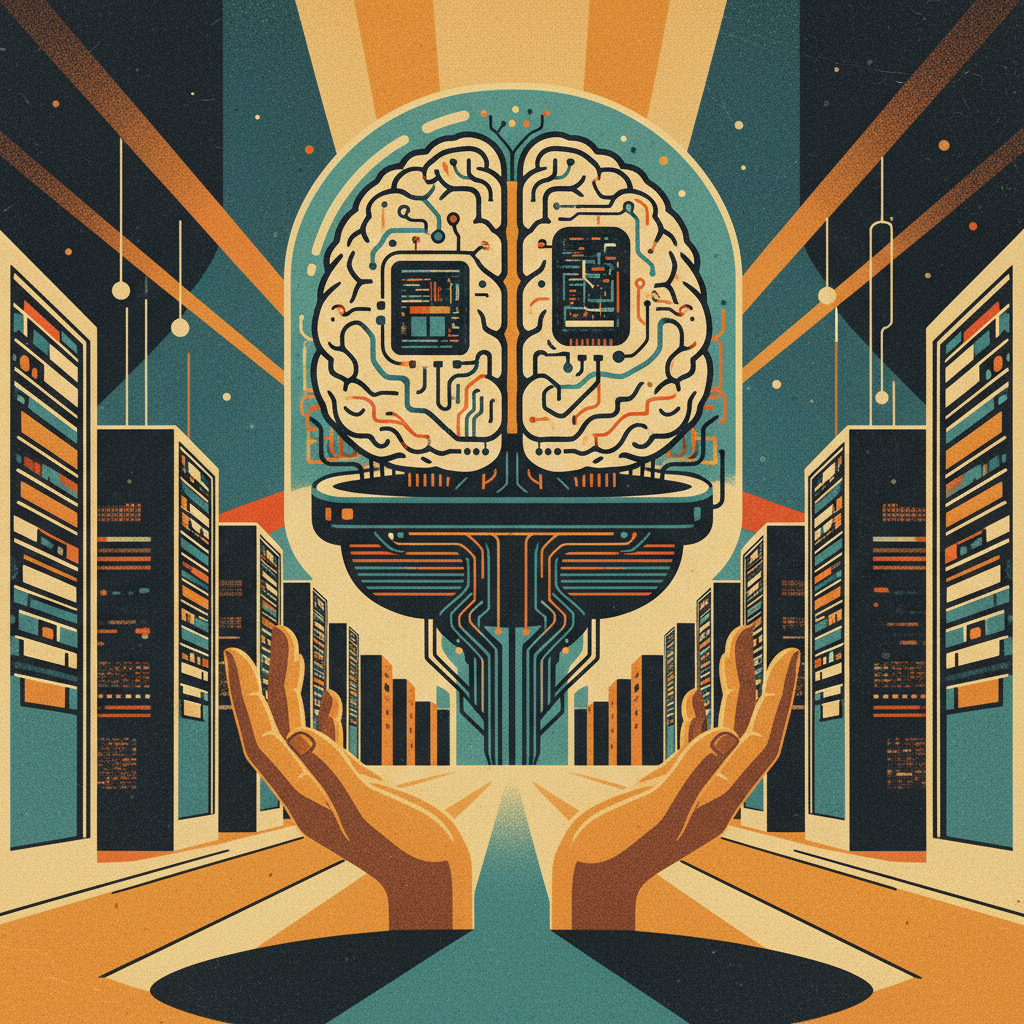
We’ve always been captivated by the future. From ancient seers gazing into entrails to modern-day fortune tellers reading palms, humanity craves certainty, a peek behind the curtain of tomorrow. Today, our new oracle doesn’t whisper prophecies in ancient temples or rely on tea leaves; it crunches numbers in vast server farms. It’s the algorithmic oracle, and its predictions are quietly, yet profoundly, reshaping how we perceive truth, how we place our trust, and what kind of authority we grant to machines.
This isn’t just about weather forecasts, although those are a good starting point. Our algorithms now predict everything from consumer behavior and financial markets to election outcomes and even personal health risks. They offer a seductive promise: to illuminate the path ahead, making decisions clearer and risks more manageable. But as we increasingly lean on these digital diviners, we must ask: What are we actually trusting, what kind of truth are we receiving, and what authority are we ceding?
The Delicate Dance of Trust
Trust in the algorithmic oracle is a curious beast. Unlike trusting a human expert, whose biases and motives we might instinctively question, an AI often feels disarmingly objective. It’s just math, right? Pure logic, devoid of human emotion or agenda. This perceived impartiality can breed a dangerous, almost blind, faith.
We trust the algorithm to recommend our next movie, our next purchase. If it’s usually right about our taste in sci-fi or sneakers, we begin to extend that trust to more significant predictions. If it forecasts a stock market dip and it happens, our confidence soars. This pattern of successful predictions builds a powerful psychological momentum. But here’s the rub: trust built solely on past accuracy, without understanding the ‘how’ or ‘why,’ can be incredibly fragile and, frankly, a little naive. When the oracle is wrong—and it will be—that trust can shatter, leading to disillusionment, or worse, a complete dismissal of all its insights, even the valuable ones.
True trust requires a degree of transparency, or at least a conceptual understanding. We don’t need to pore over lines of code, but we need to grasp the limitations, the assumptions, and the inherent uncertainties. Without that, our relationship with the oracle becomes less about informed confidence and more about a digital form of magical thinking.
Truth: More Than Just a Data Point
This brings us to the nature of truth in an algorithmic prediction. When an AI predicts, say, a 70% chance of rain tomorrow, what does ‘truth’ mean here? Is it a definitive statement about a future that will unfold, immutable and certain? Or is it a statistical probability, a likely outcome based on an astronomical amount of historical weather data?
The algorithmic oracle doesn’t know truth in the human sense. It models it. It finds patterns, correlations, and probabilities within the data it has been fed. It tells us, “Based on everything I’ve seen, this is the most probable path.” But reality, as it often does, has a mischievous way of throwing curveballs. Unforeseen variables, Black Swan events, or simply the butterfly effect of human agency can completely alter the predicted course.
The truth presented by an AI is often probabilistic and conditional. It’s a snapshot of a potential future based on current information. It’s a powerful insight, a valuable input, but it is not destiny carved in stone. Confusing a high probability with absolute certainty is a category error with significant consequences. If we believe a prediction is “the truth,” we might fail to prepare for alternatives or, more critically, fail to act in ways that could alter that predicted truth.
The Authority of the Algorithmic Voice
When an algorithmic oracle predicts, it subtly wields authority. Not legal authority, of course, but the persuasive power of seemingly objective, data-driven insight. If the algorithm predicts a market downturn, investors panic. If it suggests a particular medical intervention, doctors and patients lean towards it. The more accurate its track record, the greater its perceived authority.
The danger here lies not just in the potential for a wrong prediction, but in the unquestioning acceptance of any prediction. It’s in allowing the algorithm to preempt our own critical thinking, our own judgment, our own sense of responsibility. When a decision-maker receives a highly confident prediction from an AI, it takes considerable strength and discernment to question it, especially if the stakes are high. It’s easier, in a sense, to outsource the burden of decision to the all-knowing machine.
As we move towards more general artificial intelligence, the authority of these predictions will only amplify. An AGI might not just predict discrete events, but the cascading, interconnected consequences across complex systems, making its insights seem almost incomprehensibly comprehensive. This sophistication could make it even harder for humans to challenge or even fully comprehend the basis of its pronouncements, thus further solidifying its perceived authority.
Our Place in the Prophecy
This brings us back to the human condition. We desire certainty, especially in uncertain times. An AI offering a glimpse into the future can feel like a comforting hand on our shoulder, or a stern finger wagging at us. But what happens to our agency, our free will, if we consistently defer to the oracle? Are we merely actors in a script written by code?
The beauty of being human is our capacity to defy predictions, to change course, to choose the improbable. An AI might tell you, based on your diet and habits, that you’re heading for a certain health issue. That’s a powerful prediction. But it’s also an invitation to change that future, not simply accept it as an inevitable truth. Our choices, our interventions, our sheer stubbornness can still bend the arc of the future, often in ways an algorithm, trained on past data, might not anticipate.
The algorithmic oracle is an unprecedented tool, offering insights that were once the exclusive domain of science fiction. It’s a powerful mirror reflecting probabilities back at us. But it’s crucial to remember that a prediction, however sophisticated, is not a command. It’s information. It’s an input for human decision-making, not a replacement for it. Our trust should be earned, our understanding of ‘truth’ should be nuanced and probabilistic, and the oracle’s authority should always remain subject to our own critical examination. Because ultimately, the future isn’t just predicted; it’s made. And we, the imperfect, unpredictable humans, are still the primary architects.
Leave a Reply