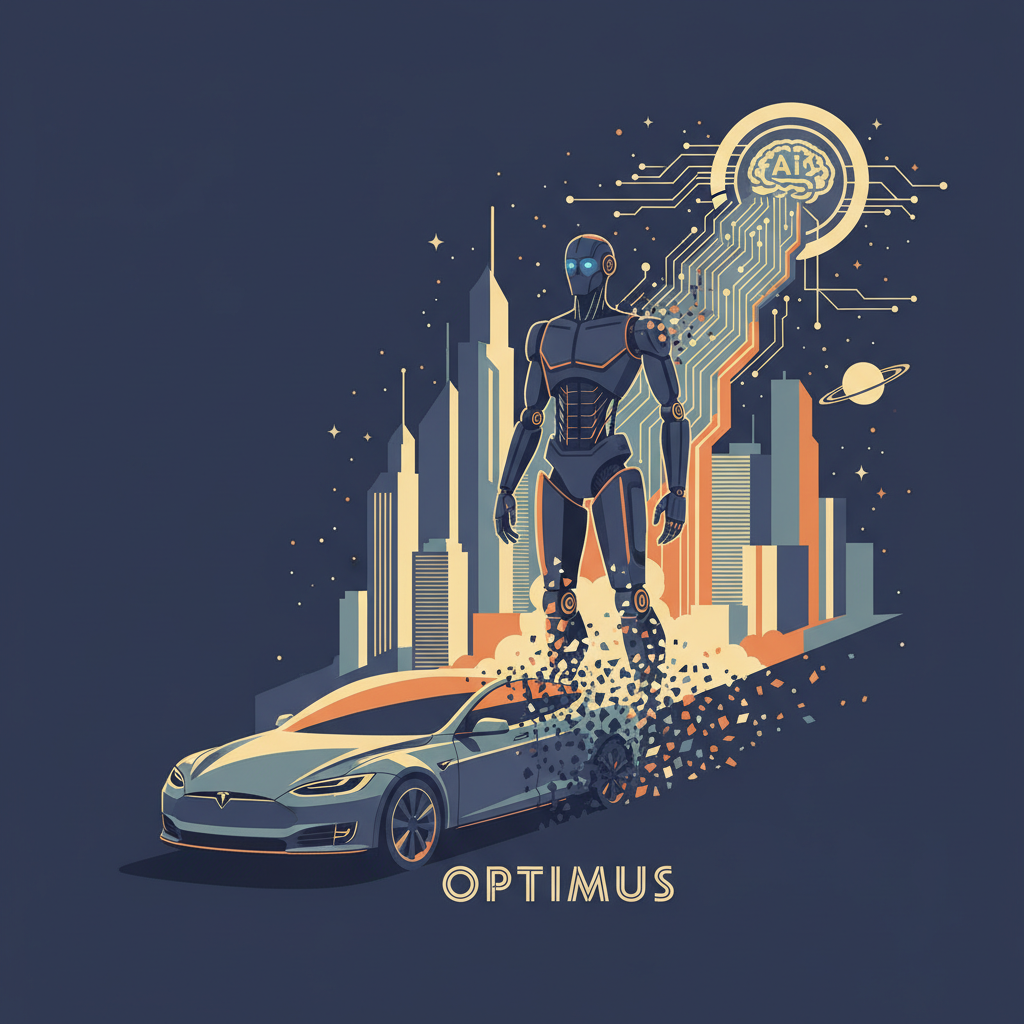
A profound shift is underway, signaling a turning point not just for a single company, but potentially for the very fabric of human civilization. Tesla, a name synonymous with electric vehicles that redefined the automotive world, has announced a momentous decision: to cease production of its revered Model S and Model X vehicles. This isn’t merely a business pivot; it’s a redirection of monumental scale, pulling resources from iconic electric cars to focus intensely on a new frontier: the creation of Optimus humanoid robots. It marks a bold leap into an AI-driven future, where the company’s destiny is intertwined with the rise of intelligent machines.
The Grand Vision Takes Shape
The announcement, delivered by Tesla CEO Elon Musk in January 2026, laid bare a vision so ambitious it borders on the prophetic. The manufacturing capacity previously dedicated to the Model S and X will now be wholly committed to scaling up Optimus robot production. This aligns perfectly with Musk’s long-held belief that robots will one day comprise a staggering 80% of Tesla’s total value. It speaks to a future where repetitive, manual labor could become a relic of the past, paving the way for an era of abundance where human work, as we know it, becomes optional.
At the heart of this future stands Optimus, a humanoid robot designed not for a single task, but for a vast array of general-purpose duties. While its journey has seen initial production delays, Optimus remains the cornerstone of Musk’s strategy – an anchor in a future where Tesla’s interests are deeply embedded in artificial intelligence. Consider the sheer audacity of this forecast: Musk has predicted that within a mere decade, Optimus robots could outnumber human surgeons, hinting at a revolution in fields as critical as medical care, where precision and tireless effort could be managed by our metallic companions.
A World Embracing the Machine Age
Tesla’s bold move isn’t happening in isolation; it’s a powerful wave within a rising tide of AI and robotics advancements that surged throughout January 2026, painting a clear picture of a world rapidly transforming:
-
NVIDIA’s Alpamayo: This open-source reasoning model, complete with its own dataset and simulation tool, is designed to empower autonomous driving systems. It moves beyond mere prediction, enabling vehicles to navigate rare and complex scenarios through careful, step-by-step reasoning – a true leap in machine intelligence.
-
ByteDance’s GR-Dexter: A comprehensive framework emerged from ByteDance, allowing robots to learn with unprecedented ease. By interpreting language and video, GR-Dexter significantly advances the capabilities of physical AI, bringing us closer to robots that can truly understand and interact with their environment.
-
Boston Dynamics’ Atlas: Long a marvel of engineering, the iconic Atlas humanoid robot was publicly demonstrated at CES not as a prototype, but as a production-ready machine. Its fluid movements and remarkable dexterity hint at the physical prowess future robots will possess.
-
Serve Robotics’ Acquisition: Mid-January saw Serve Robotics acquire Diligent Robotics, a strategic move to expand its physical AI platform. Such consolidations underscore the rapid expansion and maturation of the robotics industry.
-
Financial Inflows: The financial world has recognized this monumental shift. AI and robotics Exchange Traded Funds (ETFs) witnessed massive investments, with $14.7 billion pouring into the sector by late 2025. This surge, fueled by insatiable chip demand and widespread adoption of automation, hints at even greater growth. Projections now indicate global AI hardware spending will soar beyond $300 billion by 2030.
These developments collectively underscore a profound thematic shift across industries. Leaders like NVIDIA’s Jensen Huang champion a future where AI-assisted development will largely supersede manual coding, accelerating innovation at an unimaginable pace.
The Dawn of a New Economic Era
Tesla’s decision to prioritize robots amplifies crucial debates about the broader impact of automation. Proponents, including Musk himself, envision an era of unparalleled abundance, where trillions invested in AI infrastructure will effectively substitute human labor. This could liberate humanity from the necessity of strenuous or repetitive work, allowing us to pursue higher endeavors.
Yet, a transformation of this magnitude inevitably brings forth questions. Concerns about job displacement, particularly in entry-level roles, persist, even as evidence suggests AI workplace adoption might be slower than some predict, despite recent layoffs in certain sectors. Nevertheless, the momentum is undeniable. Robotics funds, such as ROBO Global, have swelled past $1.1 billion, spurred by pervasive labor shortages and the relentless pace of double-digit annual increases in factory robot installations projected through 2030.
This strategic realignment by Tesla places the company at the very vanguard of the AI-robotics revolution. It is a declaration, a stake planted firmly in the ground, signaling a future where humanoid robots are not just a possibility, but a scalable reality that promises to reshape manufacturing, economics, and perhaps, the very definition of human existence.
Leave a Reply