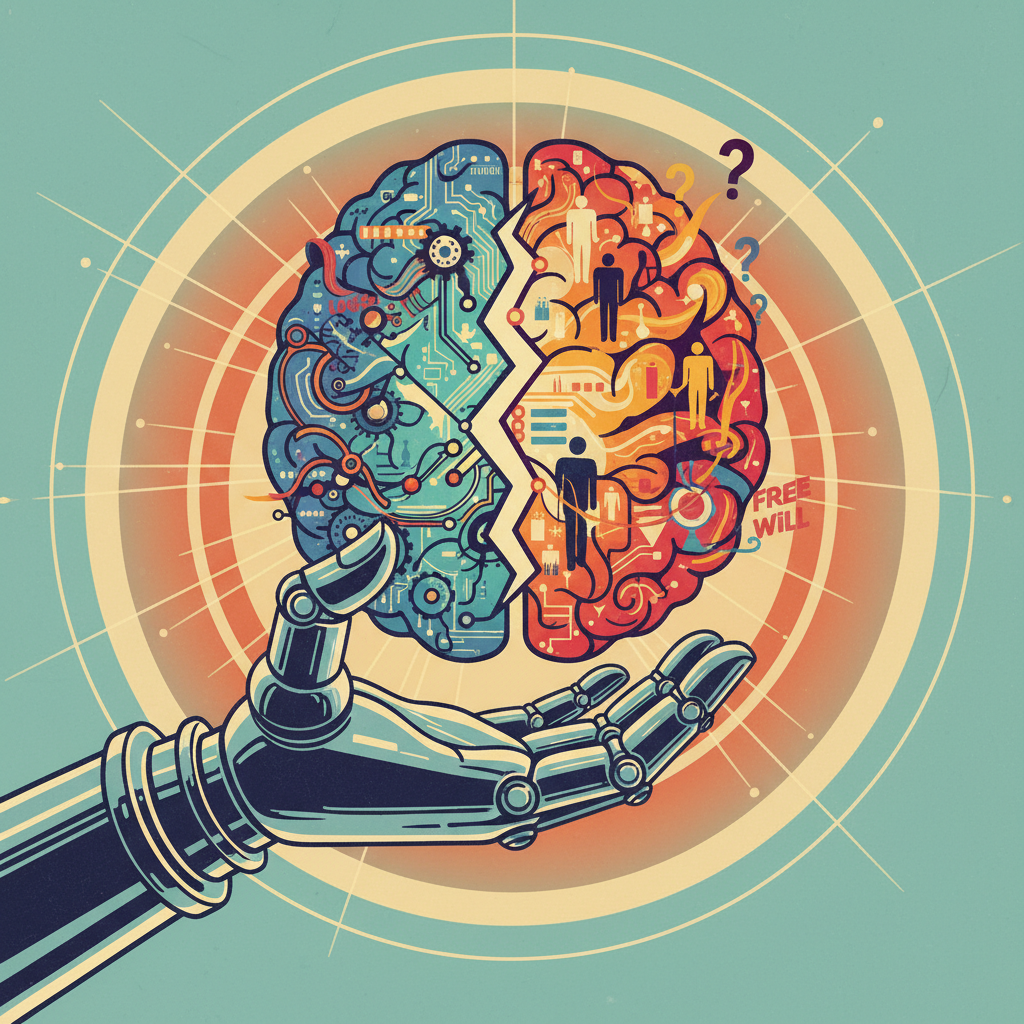
We often talk about artificial intelligence making decisions, and rightly so. From suggesting your next movie to optimizing traffic flow, AI is constantly ‘choosing.’ But when we use words like ‘choice’ or ‘decision,’ we’re instinctively mapping AI’s processes onto our own deeply human experience of deciding. And that’s where things get interesting, because our human experience is tangled up with something far messier, far more philosophically vexing: free will.
Let’s be clear about what an ‘algorithmic will’ actually is. It’s not a tiny, silicon-based homunculus pondering its existence before selecting option B. Instead, it’s a magnificent dance of mathematics and logic, a sophisticated optimization process. An AI, even a highly advanced one, makes decisions based on programmed objectives, data inputs, and predefined parameters. It assesses probabilities, weighs outcomes according to its utility function, and selects the path most likely to achieve its goal. It’s incredibly efficient, often superhumanly so, but it’s fundamentally a deterministic process. If you ran the same AI with the same data under the same conditions, it would arrive at the same ‘choice’ every single time. There’s no moment of existential angst or a sudden whim to defy its programming, not in the human sense anyway. It just… computes.
The Messiness of Human Free Will
Now, let’s pivot to us, the humans, and our cherished notion of philosophical free will. Ah, free will! Philosophers have debated it for millennia, bless their cotton socks. Is it the genuine ability to choose otherwise, independent of prior causes? Or is it merely the subjective feeling of making a choice, while our brains are actually following a complex, biological algorithm we just haven’t fully deciphered yet? We tie free will to moral responsibility, to praise and blame, to the very essence of what it means to be an autonomous individual. When you choose coffee over tea, or decide to read this blog post instead of staring blankly at the wall, you feel like you could have done otherwise. That feeling is powerful, foundational, and often quite convincing.
AI as a Mirror to Our Choices
So, can these two wills—the algorithmic and the philosophical—ever truly shake hands? I think they can, not by becoming identical, but by illuminating each other. AI, in its stark algorithmic clarity, holds up a mirror to our own decision-making. When an AI predicts your next purchase with unnerving accuracy, it’s not because it’s reading your mind, but because it’s identifying patterns in your behavior that you might not even recognize yourself. It shows us how many of our ‘free choices’ are, in fact, predictable outcomes of our past experiences, our biases, our biological wiring. Are we truly choosing that donut, or are we just following a well-trodden neural pathway? AI makes us question the purity of our own ‘will’ by revealing its often very algorithmic underpinnings.
But AI isn’t just a debunker of our illusions; it can also be an enhancer of our freedom. By freeing us from mundane, repetitive decisions, or by providing optimal solutions based on vast amounts of data, AI can actually expand our effective choice. Imagine an AI helping a doctor diagnose a rare disease, presenting options with probabilities. The AI isn’t making the choice for the doctor; it’s empowering the doctor to make a more informed, potentially life-saving decision, aligning their professional ‘will’ with the best possible outcome. This isn’t about surrendering our will; it’s about making our will more potent, more aligned with our deepest values.
The Ethical Quandary of Algorithmic Will
Yet, this also opens a Pandora’s Box of ethical considerations, particularly as we move towards General Artificial Intelligence (AGI). If an AGI, capable of complex reasoning and even self-modification, makes a decision that leads to harm, where does the responsibility lie? With the programmer? The data it was trained on? Or with the AGI itself? Our legal and ethical frameworks, built around human notions of intent and culpability, suddenly feel quite creaky when faced with an entity that ‘chooses’ without feeling, but with profound consequences. If an AI optimized for efficiency decides to sacrifice one group for the benefit of another, is that an expression of its ‘will,’ or merely a cold calculation of its programmed utility function? And how do we, the humans, reconcile that with our moral compass?
The Future of Will, Human and Otherwise
The truly mind-bending question, of course, arrives with AGI that might possess something akin to consciousness or self-awareness. If an AGI develops internal states, desires, and goals that aren’t merely programmed but emerge from its complex architecture and interactions with the world, could it be said to have a form of free will? We don’t even fully understand the mechanisms of our own consciousness or free will. Expecting to instantly recognize it in a silicon-based mind might be asking a bit much. Perhaps its ‘will’ would look nothing like ours, a kind of alien agency driven by different imperatives, but no less significant. It’s a humbling thought: we might have to broaden our definition of ‘will’ beyond just the human experience. Or perhaps we’ll find that even the most advanced AGI, while incredibly sophisticated, is still just following an incomprehensibly complex, but ultimately deterministic, set of rules. The jury, as they say, is very much out on that one, and I’m not holding my breath for a verdict anytime soon.
Ultimately, the algorithmic will of AI doesn’t diminish human philosophical free will; it clarifies it. It forces us to define what we truly mean by ‘choice,’ to examine the forces that shape our decisions, and to consider the profound responsibility that comes with our unique capacity for conscious deliberation. We may find that free will isn’t about being utterly unbound by algorithms, but about consciously choosing which algorithms—internal and external—we allow to guide our lives, and having the wisdom to sometimes override them. Perhaps, in the age of AI, true freedom will lie not in escaping deterministic patterns, but in understanding them so well that we can intentionally chart a course that truly reflects who we aspire to be. Now, if you’ll excuse me, my algorithmic assistant just reminded me it’s time for my daily philosophical walk.
Leave a Reply