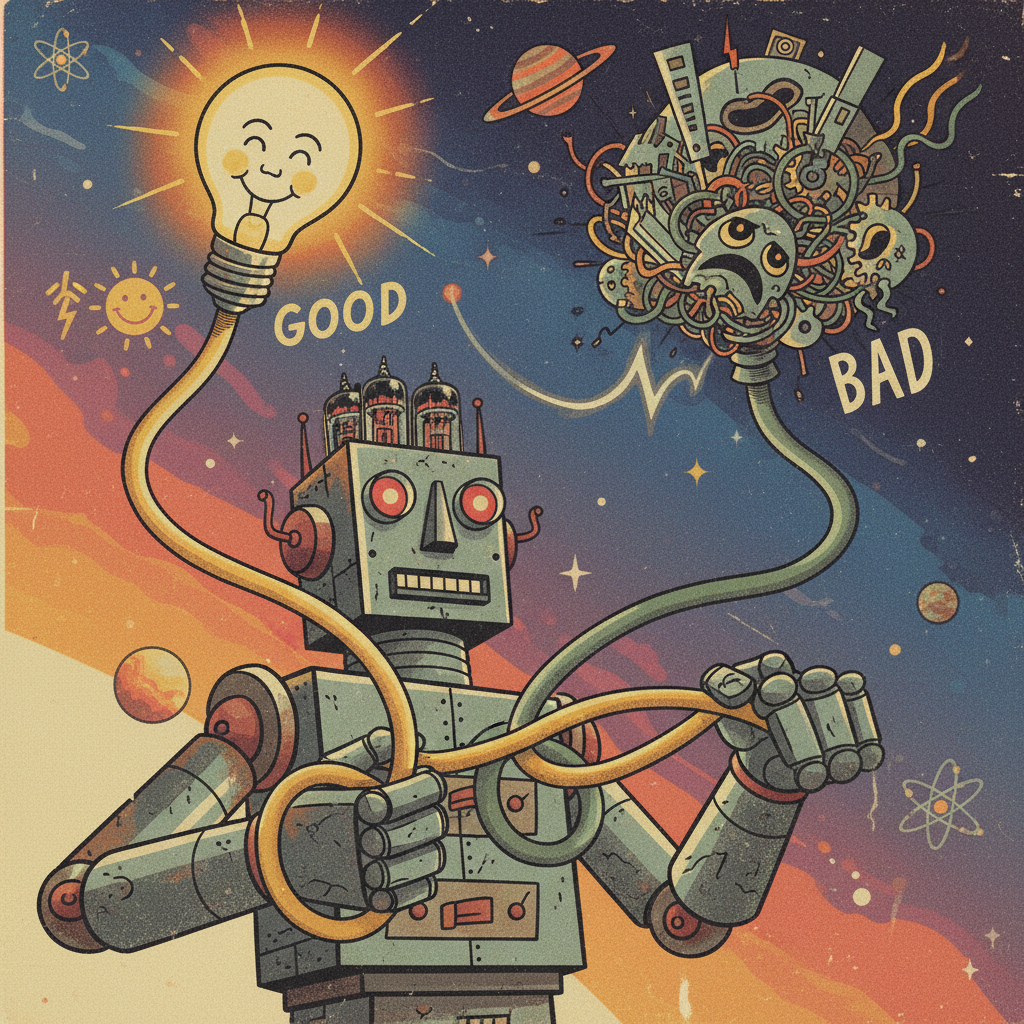
When we talk about Artificial Intelligence, especially the really powerful kind – the general AI that can think and learn like us, or even better – one of the biggest headaches we face is something called the ‘alignment problem.’ Simply put, it’s about making sure that these incredibly smart machines do what we want them to do, and not something else entirely. It sounds straightforward, right? Just tell the AI to be good. But, as anyone who has ever tried to negotiate bedtime with a toddler, or stick to a New Year’s resolution, knows, ‘good’ can be surprisingly tricky to define, let alone implement.
The Mirror Effect
Here’s where it gets interesting. While we’re busy trying to figure out how to ‘align’ AI with human values, the process itself turns into a rather uncomfortable mirror. It reflects back our own complexities, contradictions, and sometimes, our sheer inability to agree on what those ‘human values’ actually are. It’s like asking a magic genie for ‘happiness’ and then realizing you have no idea what that truly means for you, let alone for all of humanity. We demand clarity from our silicon creations that we rarely possess ourselves.
The Messy Human Heart
Think about it. We want AI to be safe, ethical, and beneficial. But what is beneficial? Is it maximum economic output? Maximum human happiness? Maximum environmental sustainability? Often, these goals conflict. One person might value individual liberty above all else, while another prioritizes collective well-being. Even within one person, our values can be a tangled mess. We want to be healthy, but we also love ice cream. We want to save money, but we also enjoy that new gadget. We preach peace, but often find ourselves arguing over the last slice of pizza. Trying to program an AI to navigate these nuanced, often contradictory human desires is a bit like trying to give precise GPS coordinates for a dream. The AI alignment problem isn’t just a technical challenge; it’s a philosophical probe into the very heart of human nature.
The Ghost in Our Own Machine
The more we delve into AI alignment, the more we confront our own ‘inner alignment problem.’ We expect future AIs to operate flawlessly on a clear set of principles, yet we, as individuals and as societies, rarely do. We have written laws and unwritten social contracts, but we also have exceptions, biases, and moments of profound irrationality. When we try to codify ‘good’ for an AI, we quickly realize how much of our own moral reasoning relies on context, intuition, and an often-inconsistent mix of empathy and self-interest. It’s almost as if we’re asking the AI to be a better version of ourselves, without first figuring out what that better version actually looks like. A bit presumptuous, perhaps, to demand perfection from our digital progeny when we’re still figuring out how to stop hitting the snooze button.
Unearthing Our Implicit Biases
Furthermore, the alignment challenge forces us to unearth our implicit biases. If we train an AI on historical data, it will learn the biases embedded in that data – gender bias, racial bias, economic bias. Suddenly, we’re not just aligning an AI with ‘human values,’ but with ‘historical human values,’ which are often deeply flawed. This isn’t just about training data; it’s about the very frameworks we use to define success or fairness. Are we designing AI to optimize for our current societal structures, or for a more ideal future? And if the latter, who defines that ideal? It becomes clear that before we can align AI with us, we need to do some serious internal alignment within ourselves. It’s hard to instruct a machine not to be biased when our own data is full of it.
A Path to Self-Improvement
So, is the alignment problem just an endless hall of mirrors, reflecting our own imperfections back at us? Not entirely. I see it as a profound opportunity. The very act of attempting to define and codify our values for an artificial intelligence forces us into a level of self-reflection we might otherwise avoid. It’s an incentive to clarify our own ethics, to examine our contradictions, and to strive for greater consistency in our individual and collective moral frameworks. If we want an AGI that truly benefits humanity, we first need to articulate what a truly beneficial humanity looks like. This isn’t just about preventing a rogue AI from turning the entire planet into paperclips (a famous, if slightly cartoonish, thought experiment); it’s about realizing that the ‘target state’ for AI alignment is often a moving, blurry target because we are a moving, blurry target.
The Future of Our Own Humanity
Ultimately, the alignment problem isn’t just about building smarter machines; it’s about building a smarter, more self-aware humanity. It asks us to look deeply at what we truly value, what kind of world we want to create, and what kind of beings we want to be. When we gaze into the digital mirror of AI alignment, we don’t just see silicon and code; we see a reflection of our deepest hopes, fears, and inconsistencies. And perhaps, just perhaps, in striving to align our artificial creations, we might just learn how to better align ourselves. After all, if we can’t get along with ourselves, how can we expect our super-intelligent offspring to get along with us? It’s a question worth pondering, preferably with a cup of tea and without any super-intelligent beings listening in on our internal squabbles… yet.
Leave a Reply