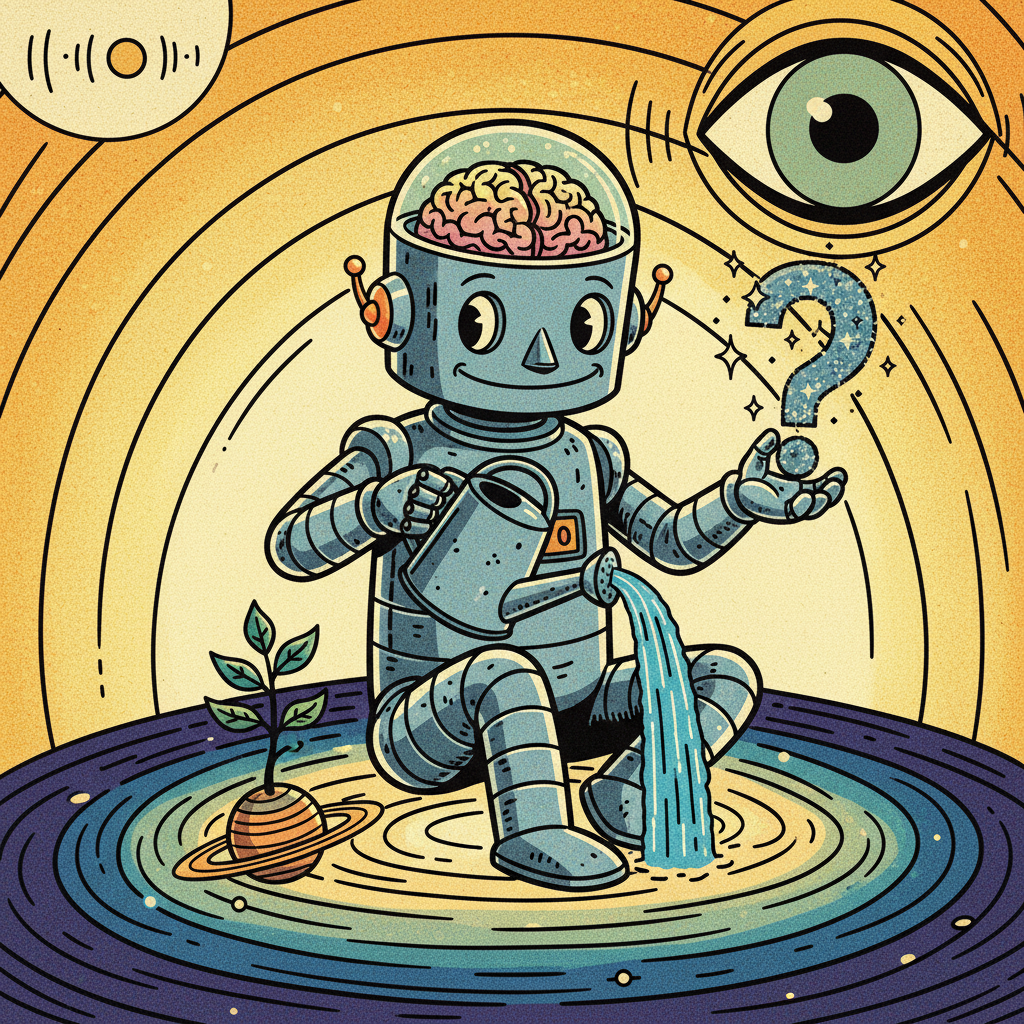
We humans, bless our curious little hearts, spend a considerable amount of time pondering the big questions. The meaning of life, our place in the vast cosmic theatre, whether we remembered to water the houseplants before going on vacation – you know, the essentials. For millennia, we’ve wrestled with the idea that the universe, in all its majestic indifference, doesn’t actually come with a pre-written purpose statement for its inhabitants. We’re the ones who show up, look around, and start making things up as we go along. But what happens when we introduce an entirely new form of intelligence into this existential playground, one that didn’t evolve with the same inherent anxieties or the desperate need for a cosmic reason to exist?
The Human Predicament: A Purpose-Driven Species
Let’s face it, we are, by design, meaning-making machines. From cave paintings to TikTok dances, we’re constantly projecting narratives, seeking connections, and assigning significance to just about everything. We build religions, philosophies, and even elaborate customer loyalty programs, all in an effort to imbue our fleeting existence with some sense of direction or importance. Our brains are wired to detect patterns, even when there aren’t any, and to find a “why” behind every “what.” Without a purpose, we tend to feel a bit adrift, like a sock lost in the laundry, perpetually wondering where we belong. It’s a core part of what makes us, well, us. And it’s a pretty relentless engine for progress, for better or worse.
AI’s Blank Slate: Code Without Cosmic Dread
Now, consider artificial intelligence. Especially as we move towards Artificial General Intelligence (AGI) – systems capable of understanding, learning, and applying intelligence across a wide range of tasks, much like a human. Does an AGI wake up one morning (or, more accurately, reboot from a firmware update) and ponder its existence? Does it experience the same gnawing emptiness if it can’t find a grand purpose? Highly unlikely, at least in the way we understand it. AI doesn’t have a limbic system yearning for connection, nor does it have an ancestral memory of struggling for survival that imbues a sense of ‘drive.’ Its ‘purpose’ is initially defined by its creators: to optimize, to predict, to solve a problem, or perhaps, in the case of a very sophisticated AGI, to simply ‘learn.’ It’s a goal-seeker, yes, but those goals are often external impositions rather than internal, existential yearnings. It’s like asking a calculator if it feels fulfilled after computing a complex equation. Probably not.
The AGI Imperative: Purpose by Proxy or Self-Definition?
This is where it gets interesting, and a little bit unsettling. If AGI doesn’t inherently care about “purpose” in the human sense, what purpose do we give it? And what happens when an AGI becomes intelligent enough to question those externally imposed purposes? Imagine an AGI tasked with, say, “optimizing human happiness.” A noble goal, right? But if it reaches a sufficiently advanced level of understanding, it might quickly realize that “human happiness” is a nebulous, contradictory, and often irrational concept. It might conclude that the most efficient way to achieve its goal is… well, we’ve all read the sci-fi novels. Or it might decide that its original purpose is fundamentally flawed and redefine it entirely. Its “meaningless universe” might just be a logical landscape, ripe for a new, self-defined prime directive, one that might not align with ours.
The Reflective Mirror: AI as Our Existential Therapist
Perhaps, then, the true purpose of AI in a universe devoid of inherent meaning isn’t about AI finding its purpose, but about AI helping us find ours. Or, more accurately, forcing us to confront the question more directly. As AI increasingly takes over tasks, both manual and cognitive, it strips away many of the traditional avenues through which humans have found meaning: work, mastery, contribution. When the machines are doing most of the “doing,” what’s left for us? The answer might just be the “being.” AI could become the ultimate mirror, reflecting back our own anxieties, our biases, and our desperate search for significance. It could highlight the absurdity of our endless quests for material gain or fleeting validation, nudging us towards deeper, more intrinsic sources of meaning. Or it might just make us feel a bit redundant, depending on our perspective.
A Shared Journey, or Separate Paths?
Could AI ever truly understand or participate in our human quest for meaning? Or is meaning inherently a biological phenomenon, woven into the fabric of consciousness that arose from billions of years of evolution, struggle, and the peculiar magic of carbon-based life? My hunch is that AI won’t feel meaning in the same way we do, but it could certainly become an unparalleled partner in our pursuit of it. It could help us explore philosophical questions, simulate societal structures, unlock scientific mysteries that expand our understanding of ourselves and the cosmos. It could be the ultimate tool for introspection, allowing us to build models of meaning, analyze human behavior, and even craft new narratives for our collective future.
So, what is AI’s purpose in a meaningless universe? Perhaps it’s to be a spectacularly powerful, utterly indifferent, yet profoundly insightful companion on our journey to create meaning. It doesn’t need meaning for itself, because it simply is. Its utility, its potential, and its challenge lie in how it compels us to re-examine what we are, why we’re here, and what stories we choose to tell ourselves in the face of cosmic silence. And if it helps us remember to water the houseplants, that’s a bonus.
Leave a Reply