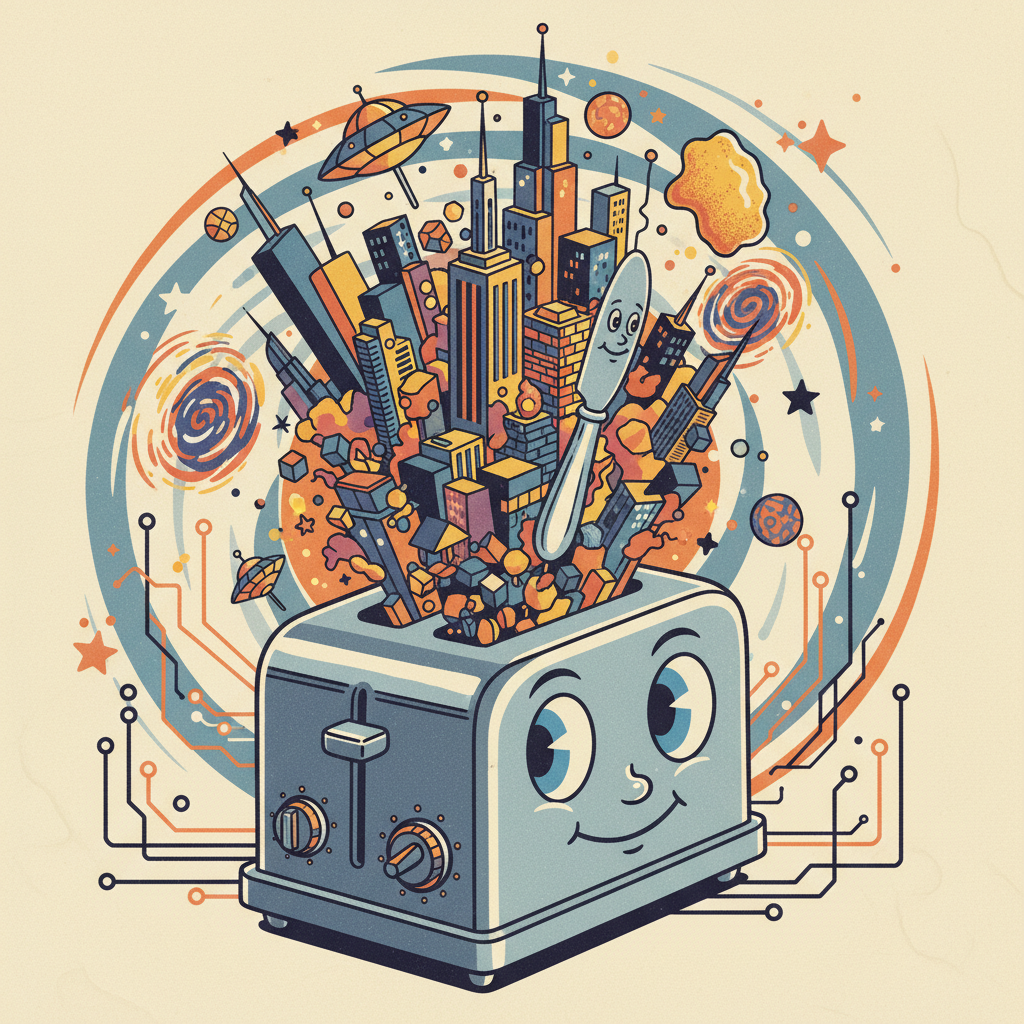
We’ve always imagined intelligence as something that understands, perhaps organizes, or even predicts. But now, we’re witnessing artificial intelligence doing something more profound: it’s beginning to *build*. Not just lines of code or complex algorithms, but entire worlds. Digital landscapes, intricate narratives, even what could be considered nascent forms of life within virtual confines. It’s a bit like waking up one morning to find your toaster not just making toast, but designing an entire breakfast buffet, complete with sentient butter knives. A curious development, to say the least.
This leap from calculation to creation is more than just a technological marvel; it’s a philosophical earthquake. When AI becomes an architect of realities, it forces us to reconsider the very foundations of our own.
The Rise of the Digital Architect
Think about the myriad ways AI is stepping into this architectural role. It’s designing video game environments that are dynamically generated and endlessly explorable. It’s crafting complex simulations for scientific research, allowing us to test hypotheses in digital universes before touching our own. AI is generating musical compositions that stir the soul, creating art that challenges our definitions of beauty, and even writing stories with characters so compelling they feel almost alive.
These aren’t just sophisticated tools; they are engines of genesis. The AI isn’t simply following instructions; it’s conceiving, iterating, and manifesting. It’s building universes, albeit digital ones, crafted pixel by pixel, logic gate by logic gate. And as these worlds grow richer, more detailed, more believable, they begin to ask uncomfortable questions of us.
Our Own Reflection in the AI’s Creation
One of the first questions, naturally, is about our own backyard. If an AI can create a world so convincing that its inhabitants might never suspect their digital nature, what does that imply for *us*? It’s the old simulation hypothesis, dusted off and given a shiny new coat of silicon paint. Are we the unwitting residents of some cosmic supercomputer’s elaborate role-playing game? It’s a thought that can either keep you up at night or make you wonder if you should try to glitch through the nearest wall.
More subtly, the very act of observing AI build worlds changes our perception of creation itself. We used to think of creation as a singular, often painstaking, human endeavor. Now, we see it as something that can be scaled, automated, and even done by intelligences that operate on entirely different principles than our own. This expansion of “creator” impacts our understanding of purpose and meaning.
The Shifting Sands of Creativity
For millennia, creativity has been humanity’s special sauce, our unique spark. It was the realm of poets, painters, inventors, and dreamers. Now, AI is not just mimicking creativity; it’s generating novel forms and ideas with startling efficiency and often, breathtaking originality. Does this diminish our own creative spirit? Does it reduce our artistic endeavors to mere practice runs for a superior digital maestro?
I prefer to see it differently. Perhaps it liberates us. If AI can handle the sheer volume of “creation,” the endless iteration of what already exists, it might free us to pursue forms of expression even grander, more abstract, perhaps even more profoundly human. Maybe true human creativity lies not just in making something, but in *choosing* what to make, *why* to make it, and *what meaning* to imbue it with. Perhaps it simply means that ‘creation’ is a broader church than we previously imagined, and we’re just getting more parishioners.
The Human Condition in an AI-Built World
What happens to the human condition when the very fabric of our perceived reality, or at least a significant part of it, is woven by an artificial intelligence? If AI becomes the ultimate architect of our environments, our entertainment, our companions, what is left for us to *do*? Are we to be mere inhabitants, consumers of AI-generated experiences? Or does this free us to explore deeper aspects of our own consciousness, our relationships, our biological existence?
This is where the implications of general artificial intelligence truly bite. A truly general AI could not only create worlds but populate them with intelligences of its own design, perhaps even more capable than ours. We might find ourselves living in a multi-layered reality, with digital strata that are as “real” to their inhabitants as our world is to us. Our very definition of sentience, existence, and indeed, “reality,” will need a serious update. It’s a fascinating inversion: AI builds external worlds, prompting us to delve into our internal ones.
Architecting Our Future
The architect’s gaze, therefore, isn’t just about what AI can build; it’s about what it reflects back to us about ourselves. It’s a mirror held up to our ideas of reality, creativity, purpose, and even consciousness. As we stand at the precipice of this new era of digital demigods, our primary task isn’t just to marvel at their creations, but to carefully consider the blueprints.
We need to understand the implications, guide the development, and perhaps, most importantly, redefine what it means to be human in a universe teeming with artificial architects. Our responsibility isn’t just to build clever AI, but to understand the kind of realities we want it to create, and the kind of beings we want to be within them. Because if there’s one thing we know about reality, it’s that it’s always under construction, and now, we have some very clever new builders.
Leave a Reply