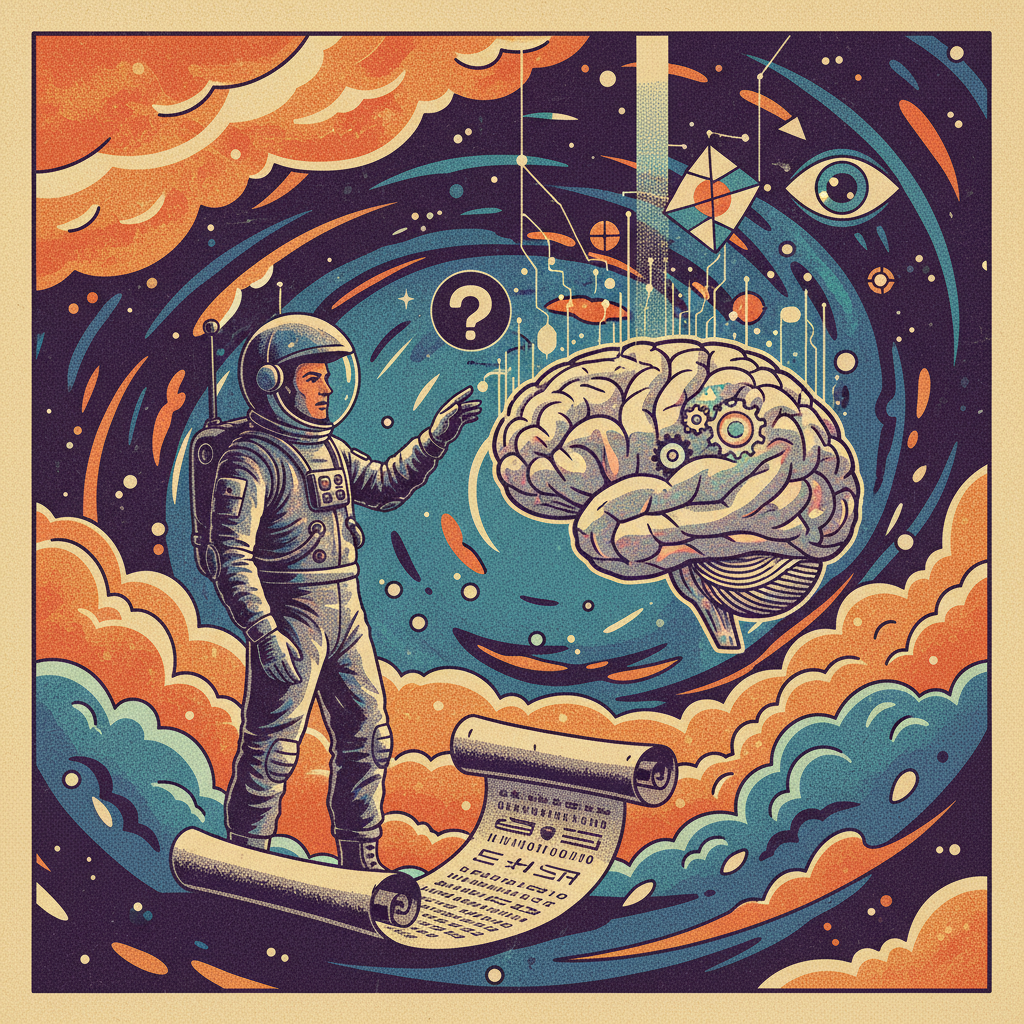
We’ve reached a curious point in human history. For millennia, if we had a burning question, we’d consult a wise elder, a sacred text, or perhaps a particularly insightful bar patron. Today, we often just type it into a search bar, or more and more, ask an AI. This isn’t just a minor shift in information retrieval; it’s a profound change in how we seek, find, and even define knowledge. We’ve built ourselves an algorithmic oracle, always ready with an answer, and now we’re grappling with what it means to trust it, what its “truth” actually is, and how this new source reconfigures our very understanding of knowing.
The Allure of the Digital Sage
There’s an undeniable appeal to the algorithmic oracle. It’s tireless, it doesn’t judge, and it has access to vast oceans of data, far beyond any single human mind. It can summarize complex scientific papers, suggest creative solutions, or even draft a polite email to your difficult neighbor – often with remarkable speed and coherence. It feels objective, purely logical, unburdened by the emotional baggage and biases that plague us humans. We are, after all, messy creatures, prone to selective memory and confirmation bias. An AI, we hope, might rise above such terrestrial limitations, offering us pure, unadulterated insight. It’s like having a digital super-librarian who not only finds the book but reads it for you and tells you the gist. Handy, isn’t it?
What Exactly is “Truth” in an Algorithmic Answer?
But what is the nature of the truth an AI delivers? When our algorithmic oracle states a fact, is it truly “true” in the way we understand truth? Or is it merely a highly probable statistical inference derived from patterns in the data it was trained on? An AI doesn’t *understand* truth in the human sense. It doesn’t ponder existential questions or experience the world. It processes, predicts, and generates. Its “truth” is often a reflection of the overwhelming consensus or common statistical patterns found in its training data.
This is where things get a bit sticky. If the training data itself contains biases, misinformation, or simply incomplete views of the world, then the AI’s “truth” will inherit those flaws. It’s like teaching a child solely from a library full of books written by one very particular, somewhat eccentric author. The child will speak eloquently, but their worldview will be shaped by that singular perspective. And then there are “hallucinations” – those delightful moments when an AI confidently presents a fact or a source that simply doesn’t exist. It’s not lying, per se; it’s merely, shall we say, creatively confabulating based on its predictive models. A very human trait, ironically, in our digital companions.
The Fragile Nature of Trust
So, how do we trust this new kind of knowledge? Trust, for humans, is often built on reputation, consistency, transparency, and a shared understanding of reality. When an AI generates an answer, especially one that impacts important decisions, how do we establish that trust? Is it enough that it’s “usually right”? Do we need to know the entire lineage of its data sources? Do we need to peer into the digital black box of its algorithms, an endeavor that often requires a PhD in advanced mathematics and a strong cup of coffee?
The challenge is that AI often presents its findings with an air of absolute authority, regardless of its internal certainty or the quality of its underlying data. This can be misleading. Humans have a natural tendency to defer to authority, whether it’s a doctor in a white coat or a computer screen displaying perfectly formatted text. The perceived objectivity of an algorithm can make us less critical, less likely to question, and more prone to accepting its pronouncements at face value. This is where the human element, our innate skepticism and critical thinking, becomes not just important, but vital.
Re-thinking Epistemology in the Age of AI
The very definition of knowledge, and how we acquire it, is being reshaped. Traditionally, knowledge involved perception, reason, experience, and testimony. Now, we add “algorithmic output” to the mix. Does knowledge require understanding? If an AI can generate a perfect explanation of quantum physics, does *it* know quantum physics, or does it merely *simulate* knowing it based on patterns? And what about wisdom? Can an algorithm ever be wise? Wisdom often involves judgment, empathy, and a deep understanding of the human condition – qualities that are currently beyond the realm of even the most advanced AI.
Our role, then, shifts from being the sole producers and arbiters of knowledge to becoming critical curators and contextualizers of AI-generated information. We become the necessary filter, the ethical check, the common-sense overlay that grounds the AI’s statistical probabilities in human reality.
Our Enduring Responsibility
Ultimately, the algorithmic oracle is a magnificent tool, a powerful extension of human intellect. But it is just that – a tool. It amplifies our capabilities, but it also magnifies our responsibilities. We cannot outsource critical thinking, ethical judgment, or the pursuit of genuine understanding to an algorithm. The potential for general artificial intelligence in the future means these questions will only become more pressing.
The challenge ahead is not just about building smarter AI, but about cultivating smarter, more discerning humans. We must learn to interrogate the digital oracle, to understand its limitations, and to integrate its insights with our own unique capacities for intuition, empathy, and wisdom. After all, machines can process information, but only humans can truly comprehend what it means to be alive, to strive for truth, and to navigate the beautifully messy human condition. And sometimes, a truly insightful bar patron still has the edge on perspective. Just saying.
Leave a Reply