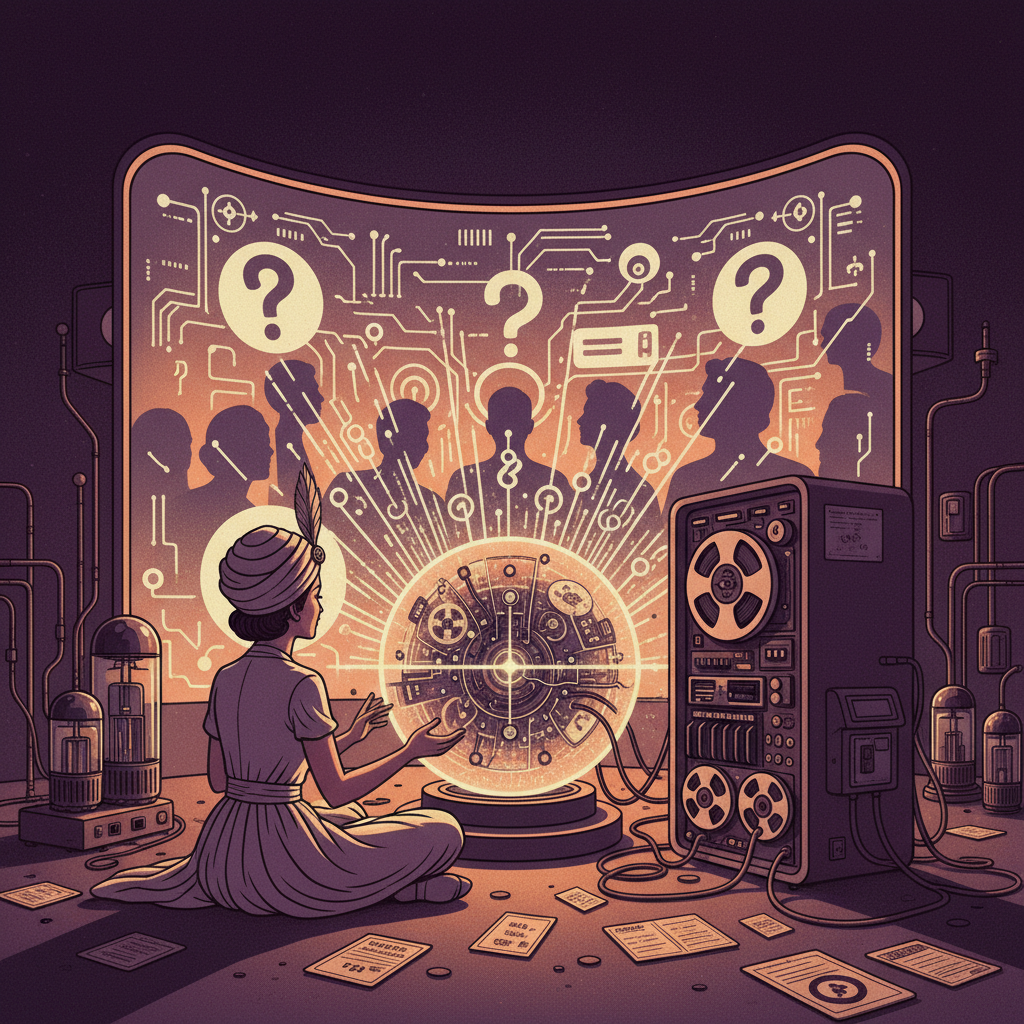
For millennia, we’ve looked to various sources for answers: elders, sacred texts, wise philosophers, even the occasional gut feeling after a particularly spicy meal. Now, we have a new contender, a formidable presence quietly taking its place at the heart of our information streams: the Algorithmic Oracle. It promises knowledge, offers predictions, and, increasingly, shapes our understanding of the world. But as we defer more and more to these digital diviners, it’s worth asking: what exactly are we redefining when we consult them? What happens to knowledge, truth, and our very way of knowing things in the age of AI?
The moment we ask an AI a question, be it about the capital of Burundi or the likelihood of a global recession, we’re engaging with a novel form of knowledge acquisition. Traditionally, knowledge involved human perception, reasoning, memory, and social consensus. Now, it often involves a vast neural network sifting through incomprehensibly large datasets, finding patterns invisible to the human eye, and generating a coherent response. Is this the same “knowledge” that we cultivate through years of study, experience, and critical thought? Or is it something different, a powerful echo chamber of existing information, brilliantly synthesized yet fundamentally lacking in what we might call ‘understanding’? It’s like having a library that can not only find any book but can also write new ones in an instant, without necessarily having *read* them in the human sense.
The Slippery Nature of Algorithmic Truth
Then there’s the question of truth. For humans, truth is often messy, contextual, and subject to interpretation. We argue over it, seek evidence, and sometimes even die for it. The ‘truth’ an AI presents, however, is largely statistical. It’s the most probable answer based on the patterns it has observed. If its training data is biased, its truth will be biased. If the data is incomplete, its truth will be partial. And sometimes, bless its silicon heart, an AI will simply invent things, a phenomenon we politely call “hallucination.” It’s not lying, mind you; it’s just confidently wrong, which in some circles is considered a talent. The AI doesn’t *know* it’s wrong in the human sense of conscious error; it’s merely generating the most plausible sequence of tokens. This raises a profound challenge: if the oracle can be so convincingly mistaken, how do we discern its genuine insights from its confident fictions?
Epistemology Under Scrutiny
This brings us to epistemology, the fancy word for “how do we know what we know?” For centuries, our epistemological frameworks have relied on sensory experience, logical deduction, expert testimony, and empirical verification. Now, “the AI said so” is becoming a common justification for belief. How do we, as humans, justify our trust in an algorithmic answer? Do we demand to see its ‘working’? Can we even understand its ‘working’ when it involves billions of parameters dancing in a neural network, a process often too complex for even its creators to fully unpack? The black box problem isn’t just an engineering challenge; it’s an epistemological crisis. We’re asked to trust a source whose internal mechanisms for arriving at a conclusion are often opaque, if not entirely inscrutable. This shift fundamentally alters the burden of proof and the very nature of justified belief. We move from understanding *why* something is true to simply accepting *that* an algorithm has deemed it so.
The Human Condition in the Loop
The real danger isn’t necessarily that AI will intentionally mislead us, but that we might intellectually atrophy from over-reliance. If the oracle always has an answer, do we still cultivate curiosity? Do we still grapple with ambiguity, which, let’s be honest, is where most human wisdom actually germinates? The human condition thrives on inquiry, on wrestling with uncertainty, on the slow, often painful, process of forming our own judgments. When an AI can instantly provide a concise summary, a definitive prediction, or a seemingly perfect solution, the temptation to outsource our critical thinking and intellectual heavy lifting becomes immense. We risk trading the rich, multifaceted experience of truly *knowing* for the efficiency of merely *being told*. The challenge is to leverage the oracle’s power without surrendering our own capacity for independent thought, for the unique spark of insight that often comes from human intuition and subjective experience, things an algorithm currently has no direct access to.
Navigating the New Landscape
So, while the Algorithmic Oracle offers incredible power to process, synthesize, and predict, the real test is not in its intelligence, but in ours. It’s about how we choose to integrate it – not as a replacement for human inquiry, but as a fascinating, often bewildering, companion on our unending quest for understanding. We must remain vigilant, cultivating a healthy skepticism, always asking not just “what did the AI say?” but “how did it arrive at that?” and, perhaps most importantly, “what does this mean for *us*?” It means recognizing that while algorithms can process information, only humans can imbue it with meaning, purpose, and ethical consideration. A very smart companion, yes, but one that still needs us to remind it occasionally that context is king, that wisdom transcends data, and that sometimes, the most profound truths aren’t found in a dataset, but in a quiet moment of human reflection.
Leave a Reply