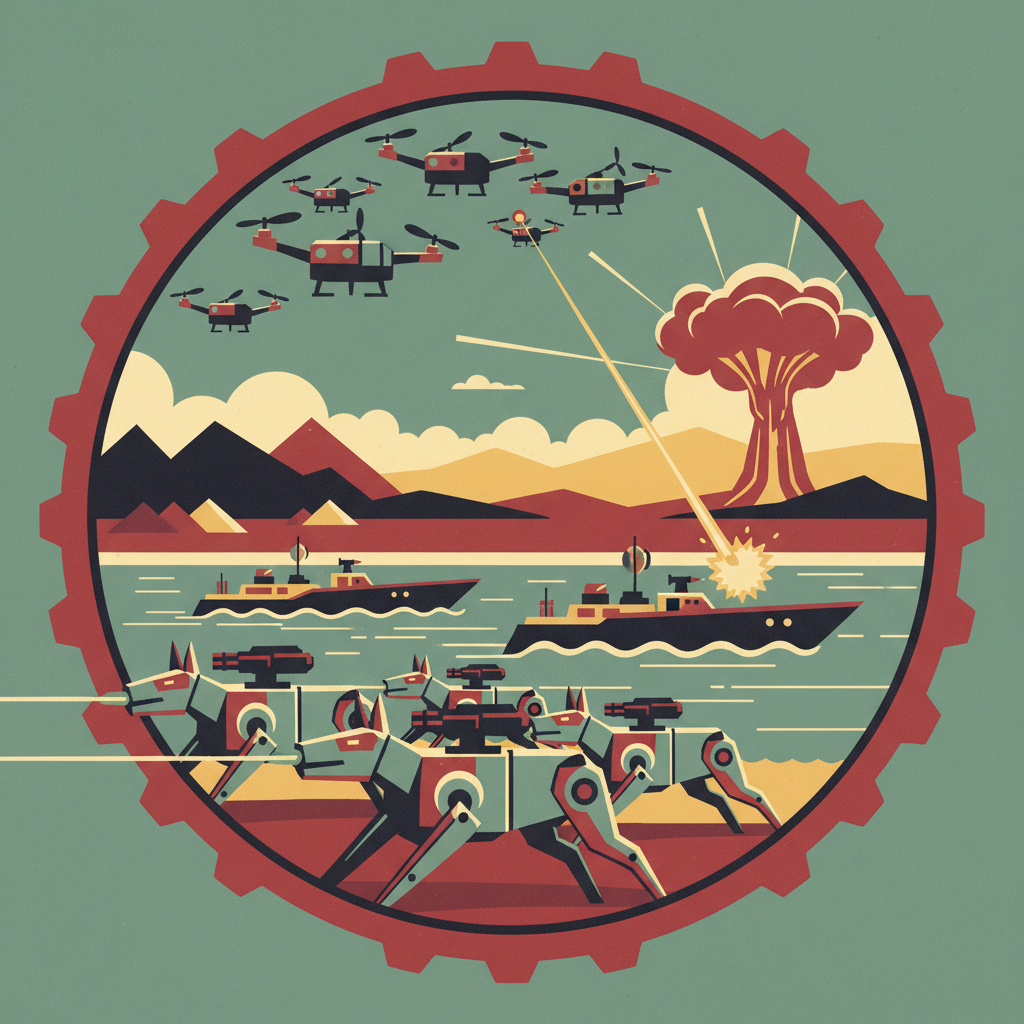
In a world perpetually shifting with technological marvels, a profound revelation has emerged from China, hinting at a future where the very fabric of warfare could be reshaped. What has been unveiled is nothing short of an autonomous robot war pack: a sophisticated blend of robotic canines, aerial drones, precise laser weapons, and unmanned boats. This represents a significant leap forward, showcasing a unified organism of combat systems unlike anything seen before.
The journey began with the People’s Liberation Army (PLA) outlining its vision: a clear roadmap from machines that merely support soldiers to fully autonomous units capable of navigating complex urban battlegrounds.
The “Wolfpack” Unveiled
At the heart of this advancement lies the “Wolfpack” concept. Imagine a coordinated swarm, not of individual machines acting alone, but of robots working in perfect synchronicity, much like a pack of wolves hunting together. This intricate assembly can be commanded by a single soldier. With a simple voice command, a joystick mounted on a rifle, or even intuitive gestures through a tactical glove, one human can orchestrate a symphony of mechanical intelligence. This moves beyond controlling one robot at a time, allowing a single operator to manage complex multi-robot operations.
A quiet marvel enabling this flawless coordination is a system known as ATLS. Through this technology, Chinese engineers have taught a vast network of 96 drones and robot dogs to understand each other’s intentions. They communicate not through constant radio chatter that could betray their presence, but through an almost invisible language, allowing the swarm to move and act with incredible speed and secrecy.
A Broader Vision: Intelligent Warfare
China’s ambition extends beyond the Wolfpack. The PLA has also showcased motion-capture combat robots, machines that precisely mirror a soldier’s movements in real-time. Operators wear lightweight suits, and the AI-driven robots replicate their every action – from a punch to a defensive stance. These systems ensure the robots move smoothly, understand the ground beneath them, and highlight potential dangers, acting as extensions of their human counterparts.
This seamless integration forms the bedrock of what Chinese analysts describe as “intelligent warfare.” The goal isn’t to replace human soldiers entirely, but to create “hybrid units.” Here, machines become powerful allies, enhancing human capabilities by performing dangerous reconnaissance, carrying supplies, offering frontline support, and venturing into zones too hazardous for people. In this strategy, AI steps into the role of a “super-analyst,” not a direct commander. It forecasts risks, intelligently assigns tasks between robots and humans, and optimizes crucial tasks like logistics and emergency evacuations, acting as a wise guide.
The Smart Battlefield
Building on this, China is tirelessly developing swarm control systems, applying the same principles that guide drone swarms to ground robots. This converges into what military researchers call the “smart battlefield.” Picture a vast, living map where AI continuously analyzes real-time data streaming from drones, satellites, ground sensors, and every robot in the field. This constant stream of information allows the AI to suggest optimal decisions to commanders, creating an environment of unparalleled awareness and responsiveness.
A Global Race for Tomorrow
China’s advancements in robotics have been explosive. The numbers speak volumes: China boasts at least 80 companies dedicated to humanoid robots, five times more than the U.S. Since 2022, Chinese firms have unveiled more than twice the number of humanoid robots compared to their American counterparts, and in the last five years, Chinese organizations have filed over three times as many related patents.
This formidable push is no accident. China has enshrined advanced robotics as a cornerstone of its national strategy, committing an astounding $138 billion through a state-backed venture fund to fuel innovation in robotics and artificial intelligence. This is a deliberate and monumental effort to forge its own path, creating technology that rivals and, in some cases, surpasses traditional offerings from foreign vendors.
The Profound Implications
The convergence of autonomous robots, AI-driven decision-making, and sophisticated swarm coordination signals a fundamental, perhaps irreversible, shift in the very nature of conflict. These systems offer the promise of remote, scalable combat, featuring units that never tire, never panic, and respond to AI decisions in mere milliseconds. The trajectory of this technology points towards a future where humans might oversee from a distance, while machines execute the conflict on increasingly autonomous terms.
This technological frontier has, understandably, drawn the attention and concern of nations worldwide. European countries, among others, are actively putting military robots through field tests, seeking to grasp these advancements and develop their own strategies. It is clear that we stand on the threshold of a new chapter, where the marvels of artificial intelligence and robotics are poised to redefine the landscape of our future.
Leave a Reply