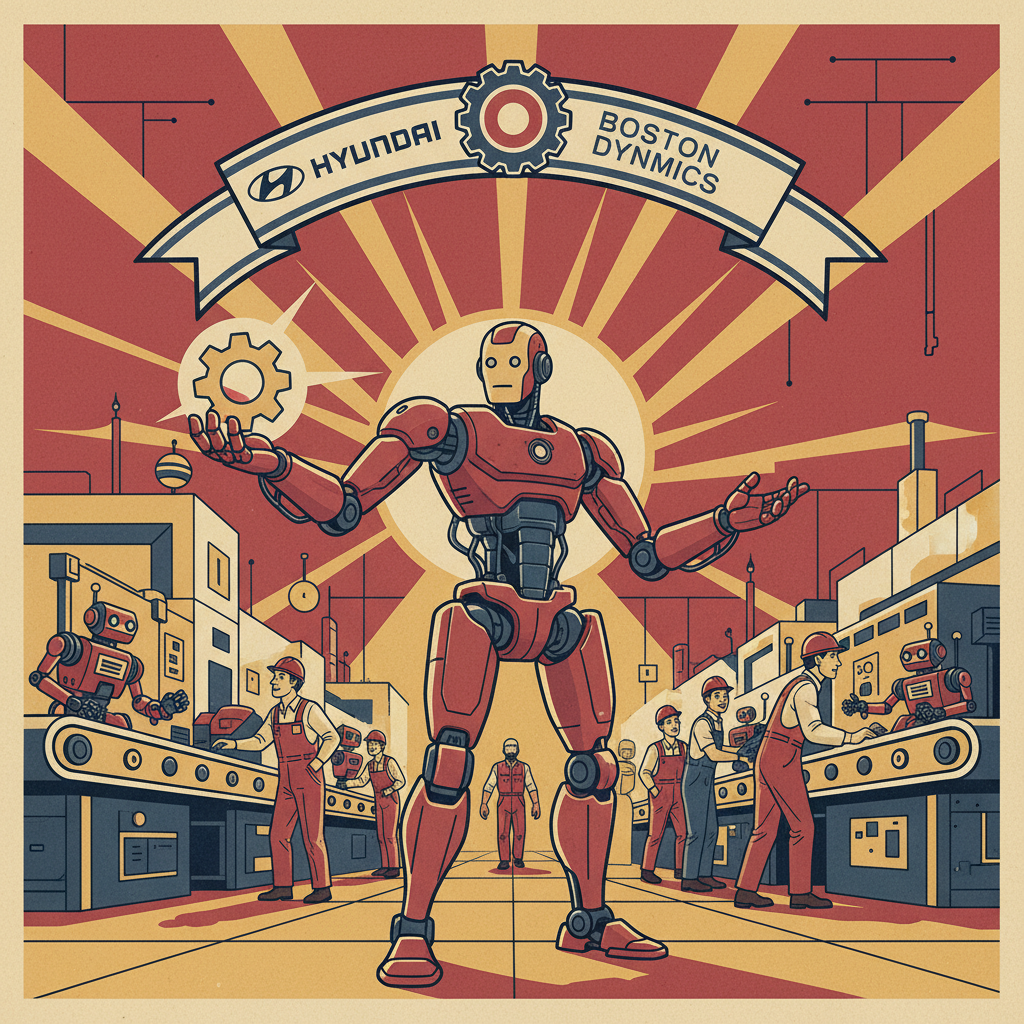
In the grand tapestry of human innovation, certain moments stand out as pivotal—times when our dreams take solid form and reshape the world around us. We stand on the precipice of such a moment, as Hyundai Motor Group prepares to usher in an extraordinary era for manufacturing. Through its visionary subsidiary, Boston Dynamics, a name synonymous with pushing the boundaries of robotics, Hyundai is poised to introduce an advanced creation into its US factories: the **Atlas humanoid robot**. This isn’t merely a technological upgrade; it is a profound step towards a future where human ingenuity and robotic capability converge to forge safer, more efficient, and more productive environments.
Beginning in 2028, these remarkable machines will start their journey at the Hyundai Motor Group Metaplant America (HMGMA) in Savannah, Georgia. Their initial mission is clear: to meticulously handle repetitive tasks, freeing human hands from demanding and sometimes hazardous work. This initiative is a cornerstone of Hyundai’s monumental multibillion-dollar investment in the realms of Artificial Intelligence, advanced robotics, and intelligent automation. It reflects a deep commitment to enhancing not just the speed of production, but also the safety and well-being of the human workforce, lifting the physical burdens that have long defined industrial labor.
The Unveiling of a New Horizon
The world first glimpsed the production-ready Atlas at the illustrious CES 2026 in Las Vegas. There, it was unveiled not as a mere research prototype, but as a robust industrial tool, ready to take its place on the factory floor. This grand announcement underscored Hyundai’s expansive vision, a strategy they’ve thoughtfully named “human-centered automation.” It’s a philosophy that places humanity at its core, intending for these robots to undertake tasks that are high-risk, repetitive, or inherently dangerous. From the precise handling of materials and the sequencing of parts to the delicate installation of components, Atlas will initially embrace these foundational roles. By 2030, its capabilities will evolve to encompass even more intricate assembly responsibilities, mirroring Hyundai’s impressive $20 billion commitment to automotive production, AI, and autonomous driving technology within the United States.
Atlas: A Testament to Ingenuity
The newest iteration of Atlas stands as a marvel of modern engineering—a fully electric, bipedal humanoid meticulously designed to thrive within the dynamic environment of a factory. Every aspect of its creation speaks to a blend of strength, precision, and resilience:
- Hands of Precision and Power: Atlas possesses hands crafted to mimic our own, equipped with advanced tactile sensing. Its joints boast full rotational capabilities, allowing for a dexterity that enables it to lift an impressive 110 pounds (50 kg) with controlled grace and formidable strength.
- Built to Endure: This creation is no stranger to extremes. It can diligently operate in temperatures ranging from a biting -4°F (-20°C) to a scorching 104°F (40°C). Its design is water- and weather-resistant, and an intricate network of sensors allows it to navigate complex, bustling spaces with unwavering confidence and awareness.
- Autonomous Intelligence: Atlas is endowed with a battery life of four hours, capable of replacing its own power source to ensure continuous operation. More profoundly, it possesses the ability to learn new tasks, adapting and integrating seamlessly into existing human workstations, truly becoming a collaborative partner.
It is important to note that the factory model is the distinctive blue variant showcased at CES 2026, marking a clear evolution from its earlier research prototypes to a machine ready for the demands of industrial application.
| Feature | Specification |
|---|---|
| Lift Capacity | Up to 110 lbs (50 kg) |
| Operating Temperature | -4°F to 104°F (-20°C to 40°C) |
| Battery Life | 4 hours (with self-replacement) |
| Primary Tasks | Material handling, parts sequencing, component installation (evolving to assembly) |
A Carefully Charted Path Forward
The deployment of Atlas is not a sudden leap but a meticulously planned progression, unfolding in thoughtful stages:
- 2026: The Genesis of Integration: This year marks the beginning of vital field testing within Hyundai’s facilities. Production commences at Boston Dynamics’ headquarters, with the initial supply reserved exclusively for Hyundai’s pioneering efforts. Simultaneously, a dedicated Robot Metaplant Application Centre will open in the US, serving as a specialized training ground where Atlas will master crucial skills such as lifting, turning, and gripping.
- 2028: The Grand Introduction: The envisioned large-scale integration takes hold at HMGMA in Georgia. Atlas will assume its role in repetitive tasks, and its performance will be carefully evaluated, confirming the profound benefits it brings to safety, quality, and operational stability before its expansion to other facilities.
- 2030 and Beyond: A Future Unbound: As its capabilities mature, Atlas will transition to more complex assembly tasks across various facilities. The long-term vision is truly transformative: the mass production of an astounding 30,000 units annually in a new, jointly established robotics factory, signifying a future where these machines are an integral part of global industry.
Shaping Tomorrow’s Industrial Landscape
Hyundai foresees humanoid robots becoming the dominant force within the physical AI market. This vision heralds the advent of “software-defined factories”—adaptive, intelligent environments where operations are continuously refined and optimized through data and artificial intelligence. This strategic move firmly places Hyundai among the vanguard of companies, alongside industry giants like Tesla and BYD, in harnessing the transformative power of humanoid robotics for automotive production. The emphasis remains steadfastly on enhancing worker safety and achieving unparalleled efficiency.
By developing its own robots and cultivating a “data factory” for their extensive training, Hyundai is not just participating in the future; it is actively shaping it. The ambition to deploy tens of thousands of these advanced partners worldwide speaks to a deep conviction that they will fundamentally transform manufacturing labor. Early evaluations are already underway, including real-world sequencing tests at customer sites, paving the way for a future where humanity and advanced robotics work hand-in-hand, realizing potential previously confined to the realms of imagination.
Leave a Reply