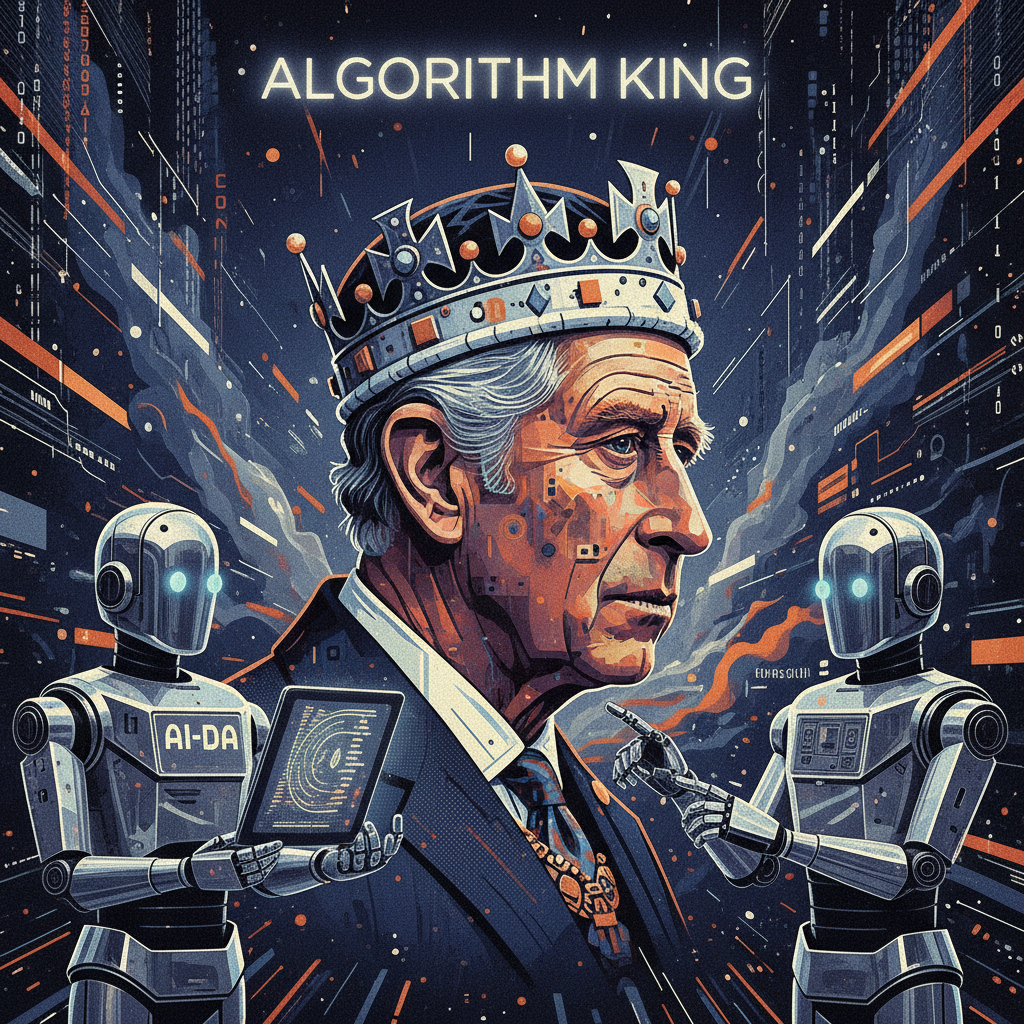
In a moment that truly felt like stepping into the future, a portrait of His Majesty King Charles III was unveiled, created not by human hands alone, but by a consciousness forged from silicon and code. This wasn’t just another painting; it was a profound statement, an artwork named **Algorithm King**, brought to life by Ai-Da, the world’s first ultra-realistic humanoid robot artist.
The setting was fittingly grand: the 2025 AI for Good Summit in Geneva. There, amidst discussions of technology’s promise, Ai-Da presented her vision of the King. It was a mixed-media masterpiece, a harmonious blend of AI algorithms, intricate computer vision, precise robotic arms, 3D printing, and the timeless touch of acrylic paint. This creation immediately sparked a vital conversation, not just about art, but about the very soul of creativity in an age where machines are learning to dream.
Ai-Da: A Marvel of Modern Craft
Ai-Da herself is a testament to human ingenuity. Born in 2019 from the vision of British gallerist Aidan Meller, she was meticulously built in Cornwall by Engineered Arts. Her sophisticated programming benefited from the bright minds at the Universities of Oxford and Birmingham. Her name, a respectful nod to Ada Lovelace, the pioneering 19th-century mathematician, hints at the profound intelligence that underpins her existence.
Gazing into Ai-Da’s lifelike eyes is to peer into high-tech cameras, her means of perceiving the world. Her robotic arms move with a grace born of precision, translating her algorithmic understanding into tangible brushstrokes. And when she speaks, her advanced language model allows her to converse, to articulate thoughts that challenge our preconceptions of what a machine can be. She is more than a painter; she is a performance artist, a designer, a poet – weaving oil paintings on canvas through a process that beautifully marries robotic accuracy with algorithmic interpretation.
Bringing the King to Life
The journey to create *Algorithm King* began with reverence. Ai-Da meticulously analyzed numerous images of His Majesty, carefully selecting one from his diplomatic engagements. Her cameras and AI then embarked on an intricate dance of perception and creation. She generated sketches, followed by preparatory paintings, each layer building upon the last, processing the nuances of tone, texture, and abstraction with a meticulousness that transcends human limitations.
The final vision was then enlarged into a captivating 3D textured image, where the finishing brushstrokes were applied. While studio assistants handled the practicalities of paint mixing, every creative decision, every stroke that shaped the King’s likeness, remained Ai-Da’s. Unveiled at a UK Mission reception during the UN’s AI for Good Summit, this portrait took its place beside her earlier work, *Algorithm Queen*, a poignant tribute to the late Queen Elizabeth II.
In a voice that resonated with the significance of the moment, Ai-Da herself articulated the deeper meaning behind her creation: “Presenting my portrait of His Majesty King Charles III is not just a creative act, it’s a statement about the evolving role of AI in our society, and to reflect on how artificial intelligence is shaping the cultural landscape.” Her words invite us to ponder the profound shifts underway.
A Lasting Impression on the Art World
Ai-Da’s impact extends far beyond this singular portrait. Her works have garnered remarkable commercial success, demonstrating that the market recognizes the unique value she brings. Her 2024 painting, *A.I. God. Portrait of Alan Turing*, achieved a staggering sale of over £1 million at Sotheby’s New York, setting an unprecedented record for robot-created art. She has even stood before the UK House of Lords, offering her unique perspective on the future of creative industries.
The UK government itself highlighted the portrait of King Charles as a beautiful “intersection of innovation, artistic expression, and emerging technology,” acknowledging the profound significance of Ai-Da’s contributions.
The Deeper Conversation: AI, Creativity, and Art’s Tomorrow
The unveiling of *Algorithm King* has, understandably, ignited a passionate dialogue. For some, Ai-Da represents a revolutionary force, transforming the very definition of art through robotic creativity and challenging our traditional notions of authorship. She stands as a beacon of what is possible when technology and imagination intertwine.
Yet, others approach her work with a critical eye, questioning if machine-generated art, however sophisticated, can truly embody the human spirit of creativity. These debates are not merely academic; they delve into the very essence of what it means to create, to interpret, and to express. As artificial intelligence weaves itself ever more deeply into the fabric of our culture, Ai-Da’s existence prompts a crucial reflection: will AI augment and elevate human artistry, or will it disrupt and redefine it entirely? Her art is not just seen; it is deeply felt, and it compels us to look inward at our own understanding of inspiration and imagination.
Leave a Reply