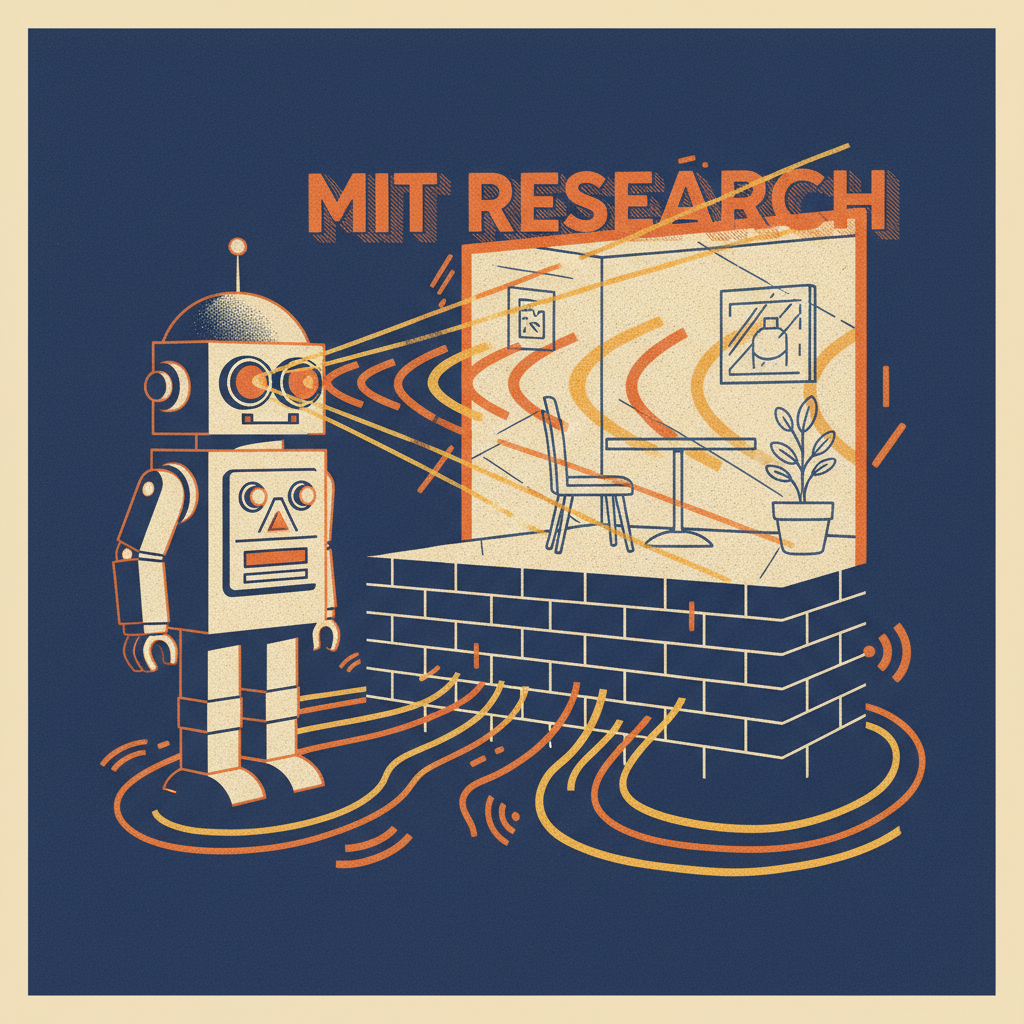
Imagine a world where sight isn’t limited by walls, where hidden objects and entire rooms reveal themselves without a camera ever seeing them. For centuries, this has been the realm of imagination, but now, groundbreaking research from MIT is turning this vision into a tangible reality. Through the power of advanced artificial intelligence, robots are gaining an astonishing new ability: to “see” the unseen, peering through solid barriers using nothing more than the invisible whispers of Wi-Fi and specialized radio waves.
This is a truly profound moment, as researchers at MIT have developed a way for smart AI to reconstruct hidden objects and even entire indoor scenes with a level of detail previously unimaginable. It’s like giving our machines an entirely new sense, allowing them to perceive what’s behind the curtain of our physical world.
The Challenge of the Veil
For more than ten years, a dedicated group at MIT has been exploring how wireless signals might help robots understand and interact with objects hidden behind everyday materials like plastic, cardboard, or wood. Traditionally, they could capture faint clues from reflected signals, but these clues offered only partial glimpses—often just the top of an object, leaving the rest as a blurry, incomplete shape. Think of trying to identify something from just a tiny, out-of-focus corner; it simply wasn’t enough for a robot to truly grasp or navigate with precision. The hidden world remained largely shrouded, offering only fragmented hints.
AI Unlocks Wireless Vision
Now, a spectacular breakthrough has occurred. The MIT team has harnessed a powerful form of artificial intelligence called generative AI, which has the remarkable ability to imagine and create. They’ve trained this AI using special techniques, teaching it to understand the subtle physics of how radio waves reflect off surfaces. It’s like teaching an artist to draw a complete picture from just a few faint smudges on a canvas.
The AI models learn from countless examples, pairing radio wave measurements with actual camera images of objects and rooms. From these lessons, the AI learns to infer what’s truly there, generating incredibly detailed “sketches” that are refined into full, accurate reconstructions. It’s no longer guessing; it’s understanding the fundamental physics of the unseen world.
Revealing Hidden Treasures: Wave-Former
One of these astonishing systems is called Wave-Former. Imagine a robot sending out special radio waves, which bounce off an apple hidden behind a box. Wave-Former takes these faint reflections and, using its generative AI, proposes possible shapes for the hidden object. Then, it uses its immense creative intelligence to complete those shapes, refining them until it presents a full, three-dimensional image of the hidden item. This system can accurately depict over 70 different everyday items—from fruits and tools to various containers—all while they remain completely out of sight behind solid walls. It’s like having X-ray vision, but for shapes and forms.
Mapping the Invisible: RISE
Another equally remarkable system is called RISE. This AI focuses on mapping entire rooms. It achieves this by analyzing what researchers lovingly call “ghost signals”—the reflections off moving humans within a space. Previously, these signals were often dismissed as mere noise. But RISE understands that these moving reflections carry vital information, revealing the locations of walls, furniture, and other stationary objects. It’s a profound shift: what was once static background noise is now the key to unlocking the full blueprint of an indoor environment.
As Professor Fadel Adib, who leads this pioneering work, describes it, this is a “qualitative leap.” We’re moving beyond merely filling in gaps to truly interpreting and understanding an entire hidden scene. “We are using AI to finally unlock wireless vision,” he states, marking a pivotal moment in our technological journey.
The Learning Journey of an AI Seer
The secret to this AI’s incredible ability lies in its training. The models learn from countless pairs of radio frequency (RF) measurements and corresponding real-world camera images. This teaches them to infer plausible visual information from noisy, incomplete data. Instead of making vague guesses, the AI produces highly accurate, AI-generated “sketches” that are deeply rooted in the real physics of how waves interact with objects.
What makes this even more practical and profound is that a single, stationary radar unit is often all that’s needed. This makes the technology readily applicable for robots operating in our modern environments, which are already rich with Wi-Fi and other wireless signals. It’s an elegant solution to a complex problem, leveraging the very air around us to reveal its secrets.
A New Dawn for Robotics and Our World
The implications of this wireless vision are vast and transformative. It means robots can become truly autonomous in environments where traditional cameras or LiDAR (light detection and ranging) systems fail—places with thick smoke, complete darkness, or numerous physical obstructions. Think of robots performing search-and-rescue missions, carefully navigating collapsed buildings to find survivors, or providing enhanced care for the elderly by understanding their movements and surroundings in a non-intrusive way. It could revolutionize inventory management in complex warehouses, where knowing the exact location of every item, even behind shelves, becomes effortless.
Beyond robotics, this breakthrough blurs the line between our physical world and the digital realm in a profound way. It shows how ambient signals—the Wi-Fi from your router, for example—can be interpreted to reveal deeply personal information. This raises significant questions about privacy, about the potential for “vision” that transcends physical barriers, and about the ethical responsibilities we hold as we build this new layer of perception into our infrastructure. This discovery not only empowers machines but also presents humanity with new, crucial challenges in how we govern and protect the astonishing capabilities of AI.
Leave a Reply