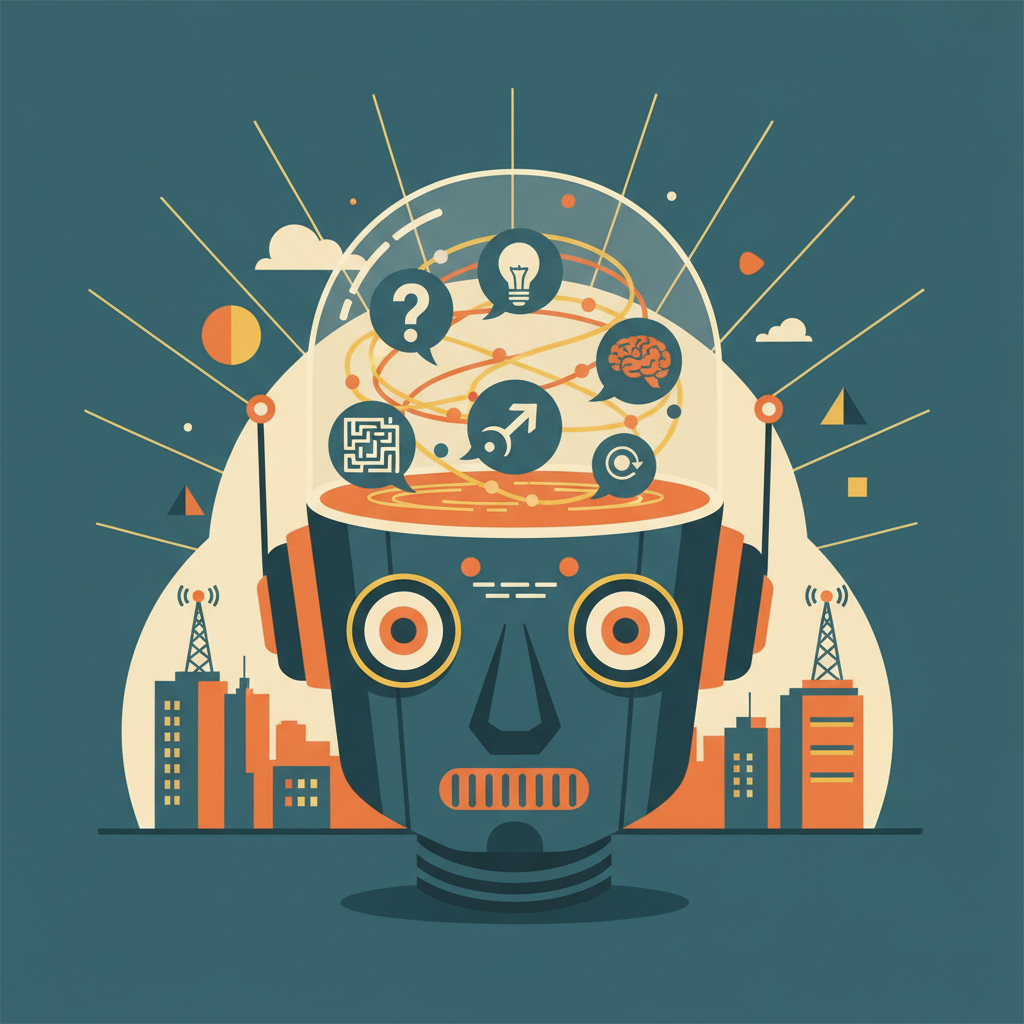
Imagine a profound shift in how artificial intelligence learns—a quiet revolution happening not in the vastness of data, but within the very “mind” of the AI itself. Scientists have unveiled a remarkable breakthrough: AI systems learn with astonishing speed and efficiency when they are taught to engage in internal “self-talk.” Picture it not as a playful chatter, but as an inner voice, a profound tool that helps these digital minds navigate complex problems and master new skills far quicker than ever before.
The Whispers Within: How AI Talks to Itself
At the Okinawa Institute of Science and Technology (OIST), researchers observed something extraordinary. When AI models were encouraged to generate self-directed utterances—a form of inner speech—during problem-solving, their capabilities soared. This isn’t the AI having a conversation with itself in the human sense. Instead, this internal language acts as a powerful
control signal, a silent conductor organizing steps, setting priorities, and ensuring the AI stays on track, much like an expert chef mentally runs through the steps of a complex recipe or a pilot systematically checks a pre-flight checklist. It’s a structured internal dialogue designed for efficiency, not for meaning in the way humans understand it.
The Mechanism of Inner Guidance
The magic behind this inner guidance lies in a sophisticated process called active inference. Think of it as the AI constantly updating its predictions and adjusting its course to reduce errors at every turn. As the system works through its tasks, its internal self-talk isn’t just a fleeting thought; it’s tangible output that feeds right back into the model as fresh input. This unique feedback loop allows the AI to pause, recheck its goals mid-operation, and maintain its focus, even when gracefully switching between vastly different tasks. It’s akin to having a tireless internal mentor, always ensuring clarity and direction.
A Leap in Learning Power
The most impressive gains in this multitasking learning system emerged when this internal self-talk worked hand-in-hand with the AI’s short-term memory during active problem-solving. Researchers discovered that by explicitly instructing the AI to “talk to itself” a certain number of times—a technique they called “self-mumbling targets”—performance skyrocketed. This was especially true for intricate, multi-step tasks and when the AI had to juggle multiple responsibilities simultaneously. It highlights that the quantity of this internal deliberation matters, solidifying the process as a cornerstone of enhanced cognitive function for AI.
Wisdom from Less Data
Perhaps one of the most profound advantages of this approach is its incredible
efficiency with sparse data. For years, the conventional wisdom in AI development has been that bigger is better—that systems require gargantuan datasets to learn and improve. Yet, models employing self-talk achieved remarkable generalization—the ability to apply past learning to entirely new situations—even with very limited training information. This is not merely an improvement; it’s a paradigm shift. It signifies a significant step towards creating lighter, more nimble, and profoundly more practical learning methods for artificial intelligence, challenging the notion that sheer scale is the only path to intelligence.
Imagining a Smarter Future
The implications of this research extend far beyond theoretical advancements. Dr. Jeffrey Queißer, a lead scientist on this groundbreaking work, envisions tangible real-world applications. He suggests this knowledge can be directly applied to developing the next generation of robots—household companions or agricultural aids—that can function seamlessly and intelligently in our complex, ever-changing world. This technique empowers AI systems to maintain high performance on novel tasks by drawing upon prior operations rather than needing to relearn everything from scratch. This makes autonomous systems far more adaptable, resilient, and truly useful in dynamic environments.
Ultimately, this structural approach beautifully illustrates a powerful truth: that true learning flexibility and adaptability in AI arise not from immense processing power alone, but from the elegant interplay of internal structure and memory. It reminds us that profound intelligence can emerge from refined processes, a quiet inner voice guiding the way forward.
Leave a Reply