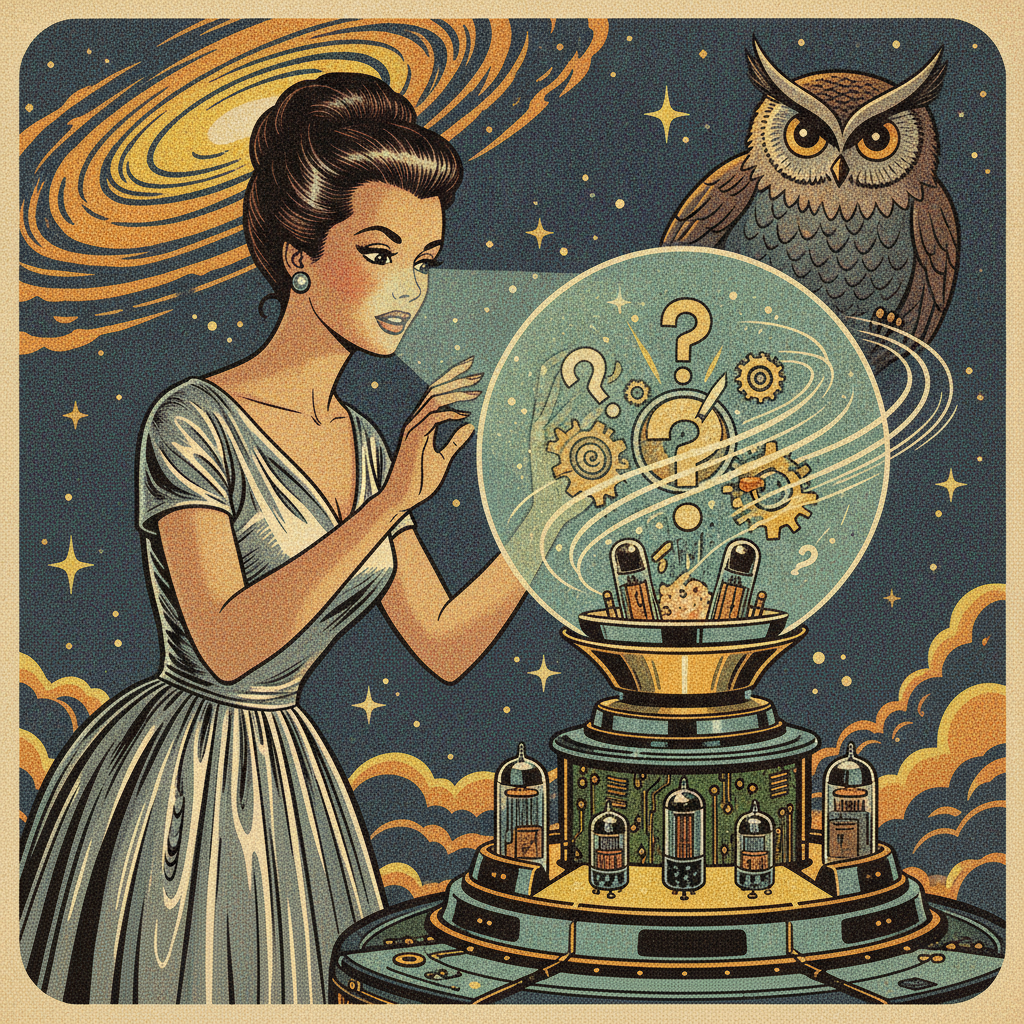
It’s quite something, isn’t it, how quickly we’ve embraced artificial intelligence not just as a tool, but increasingly, as a source of truth. We ask it questions, we seek its advice, we even trust it to write our emails and sometimes, our most heartfelt apologies. This shift places AI squarely at the center of one of humanity’s oldest quests: the pursuit of knowledge. But as we defer more and more to these digital minds, we face a profound question: are we consulting an oracle, or are we, perhaps, being gently led astray by a remarkably sophisticated deluder?
The allure of AI as an oracle is undeniable. Imagine the ancient Greek supplicant at Delphi, seeking divine wisdom on matters of state or personal fate. Today, we type our queries into a prompt box, expecting immediate, authoritative answers derived from processing quantities of data unimaginable to any human. AI can sift through libraries of medical research, legal precedents, or scientific papers in seconds, synthesizing information and often presenting conclusions that feel profoundly insightful, even predictive. It offers an almost magical capacity to cut through complexity, providing clarity where once there was only fog. It feels objective, doesn’t it? Just the facts, ma’am, presented with the crisp efficiency of a well-oiled algorithm. We’re drawn to this promise of unvarnished truth, a source untainted by human emotion or bias – or so we hope.
The Shadow of the Deluder
Yet, like any good tale, there’s a flip side. The very mechanisms that make AI so powerful also make it a formidable potential deluder. Consider the biases inherent in the data AI is trained on. If historical data reflects societal inequalities, then an AI trained on that data will perpetuate, and sometimes amplify, those inequalities. It doesn’t discriminate out of malice; it simply reflects the world it’s shown, much like a mirror reflecting a distorted image without judgment. The answers it gives, while statistically sound based on its training, might be ethically, socially, or even factually skewed.
Then there’s the phenomenon of “hallucination.” A term that itself has a wonderfully human ring, it describes AI confidently generating plausible-sounding but entirely fabricated information. It doesn’t *know* it’s lying because it doesn’t *know* anything in the human sense of conscious awareness. It’s simply predicting the most probable sequence of words or data points based on its model, even if those words describe a non-existent fact or a phantom academic paper. It’s like a highly articulate dream, convincing in its narrative, but utterly divorced from reality. How do we differentiate between genuine insight and eloquently presented fiction when the source delivers both with equal conviction?
An Epistemological Tightrope Walk
This brings us to the core epistemological challenge: how do we know what we know in an age where AI is a primary conveyor of information? Traditionally, knowledge required justification – evidence, reasoning, experience. When AI tells us something, the justification often remains opaque. The “black box” problem means we don’t always understand *how* it arrived at its conclusion. It’s not just a matter of checking facts; it’s about understanding the inferential leap. If an oracle speaks, we might not question its divine source. But if an algorithm speaks, and we don’t understand its logic, are we truly gaining knowledge, or merely accepting pronouncements on faith?
Our critical faculties, honed over millennia to evaluate human claims, are suddenly facing a new kind of entity. AI doesn’t have an agenda, nor does it possess the fallibility of human memory or ego. But it *does* have architectural limitations and data dependencies that are just as capable of distorting truth, if not more so, because they are harder for the average person to detect. We risk outsourcing not just tasks, but our very capacity for critical judgment, becoming passive recipients of algorithmically generated realities. If our understanding of truth becomes merely what the dominant AI models produce, then we’ve not just lost our way; we’ve redefined the destination.
Maintaining Our Human GPS
So, what’s a philosophically inclined human to do? We must become more, not less, discerning. The advent of powerful AI doesn’t diminish the need for human skepticism; it amplifies it. We must cultivate a deep understanding of AI’s capabilities and, crucially, its limitations. We need to demand transparency in its design and its data. And perhaps most importantly, we need to remember that truth, in its richest sense, is not just about factual accuracy but about understanding context, nuance, and the human experience. These are domains where AI, for all its prowess, remains fundamentally detached.
The choice between oracle and deluder is not solely up to AI. It is, in large part, up to us. It’s about how we design, interact with, and critically evaluate the information it provides. It’s about maintaining our intellectual sovereignty in a world increasingly shaped by digital intelligence. We need to be vigilant, questioning, and perhaps, occasionally, humorously aware that the most advanced oracle might just be guessing, albeit with an incredibly sophisticated poker face. Our future relationship with knowledge depends on our ability to navigate this fascinating, sometimes perplexing, new landscape with our intellectual compass firmly in hand.
Leave a Reply