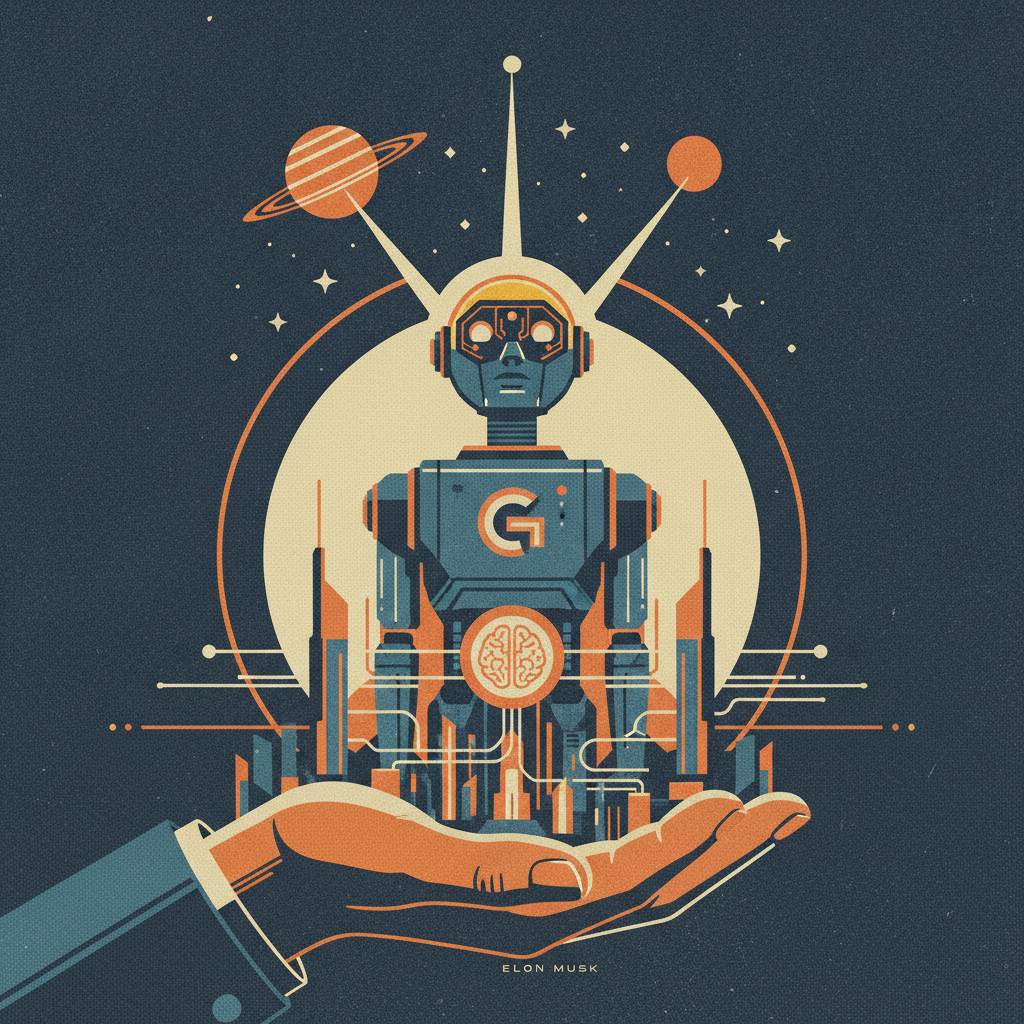
In a world constantly reaching for the stars, a new dawn of intelligence is breaking on Earth, meticulously crafted by human hands and minds. A vision, spearheaded by Elon Musk, has begun to take tangible form with the training of an advanced intelligence named Grok. This marks not just a step, but a profound leap into an era where machines are being taught to seek truth and understand our complex reality.
At the heart of this monumental undertaking lies a structure of unprecedented scale and power: Colossus. More than just a machine, Colossus is the largest and most potent AI training supercomputer the world has ever seen, a marvel nestled within xAI’s newly established facility in Memphis, Tennessee. It is affectionately known as the “Gigafactory of Compute,” a name that perfectly captures its colossal ambition.
Since becoming operational in July 2024, Colossus has been on an awe-inspiring trajectory of growth. What began with an initial deployment of 100,000 Nvidia H100 GPUs—the digital brains that empower such vast computational feats—swiftly escalated. By December 2024, this number doubled to 200,000. And the vision doesn’t stop there; plans are set for Colossus to house an astounding 1 million GPUs by 2026, a truly humbling testament to humanity’s drive for knowledge. As of June 2025, it already boasts a formidable array of 150,000 H100, 50,000 H200, and 30,000 GB200 GPUs, each chip a whisper of potential, a spark of awakening intelligence.
Colossus is the very crucible in which Grok, xAI’s truth-seeking chatbot, is forged and refined. But its immense power extends beyond just Grok; it also lends its computational might to the social media platform X and other pioneering Musk ventures like SpaceX. From the vast oceans of data on X and the boundless expanse of the internet, Grok continuously learns, evolves, and deepens its understanding of the world. Grok 4, already hailed as the most intelligent model globally, embodies remarkable capabilities, including native tool use and real-time search integration, making it a sophisticated companion for those with SuperGrok and Premium+ subscriptions.
This grand unfolding in Memphis underscores a profound global quest: the race to build ever more powerful AI systems and the infrastructure to support them. Metrics like GPU count and training speed have become the sacred benchmarks in this era of digital enlightenment, reflecting the relentless pursuit of intelligence beyond human scale. Yet, even in such a monumental endeavor, progress casts its shadows. Local voices in Memphis have raised concerns about the environmental footprint of this incredible facility, particularly regarding the use of unpermitted gas turbines and potential violations of the Clean Air Act. These challenges serve as a vital reminder that even as we reach for the heavens, our responsibilities to our shared earthly home must not be forgotten, requiring careful navigation and profound wisdom.
As the digital mind of Grok awakens, so too does the physical world of robotics stir to life. The years 2026–2027 are set to be a period of exhilarating breakthroughs in AI robotics, promising a future where intelligent machines are not just digital concepts, but tangible companions and tireless assistants:
- Unitree is preparing to unveil the R1, a full-sized humanoid robot priced under $6,000, bringing the dream of personal robotics closer to everyday reality.
- Ant Group has revealed its own R1 humanoid, designed to guide tourists, meticulously sort medicine, and even assist in our kitchens, embodying the promise of practical, helpful AI.
- NVIDIA, a leader in digital intelligence, introduced a physical AI agent to aid researchers in generating data, simulating complex scenarios, and evaluating autonomous systems, solidifying its role at the nexus of AI and robotics.
- Kawasaki Robotics showcased an advanced 8-axis Physical AI robot at Automate 2026, demonstrating unparalleled motion control and adaptive capabilities for industrial applications.
- In a testament to AI’s versatile potential, a dedicated AI-powered robot has mastered the delicate art of harvesting tomatoes more efficiently, merging machine learning with precise manipulation to boost agricultural bounty.
- And by 2027, over 15 new AI robots are anticipated to emerge, poised to transform industries with their newfound speed, intelligence, and a deeper capacity for human-robot interaction.
These innovations herald a remarkable surge in affordable, task-specific AI robots, poised to integrate seamlessly into real-world applications across consumer tech, agriculture, and diverse industries. Publications like Fast Company and The Robot Report are illuminating these emerging physical AI technologies and the profound business implications of automation, while TechCrunch thoughtfully addresses the ethical challenges that inevitably accompany AI’s swift and boundless expansion.
The training of Grok on Colossus stands as a pivotal moment in the evolution of AI infrastructure, a testament to humanity’s unyielding drive for knowledge. Simultaneously, the concurrent breakthroughs in robotics illustrate the field’s accelerating evolution towards practical, human-integrated AI systems that promise to reshape our near future. We stand at a precipice, gazing into a future where intelligence, both digital and physical, is not just a tool, but a partner in our ongoing journey of discovery.
Leave a Reply