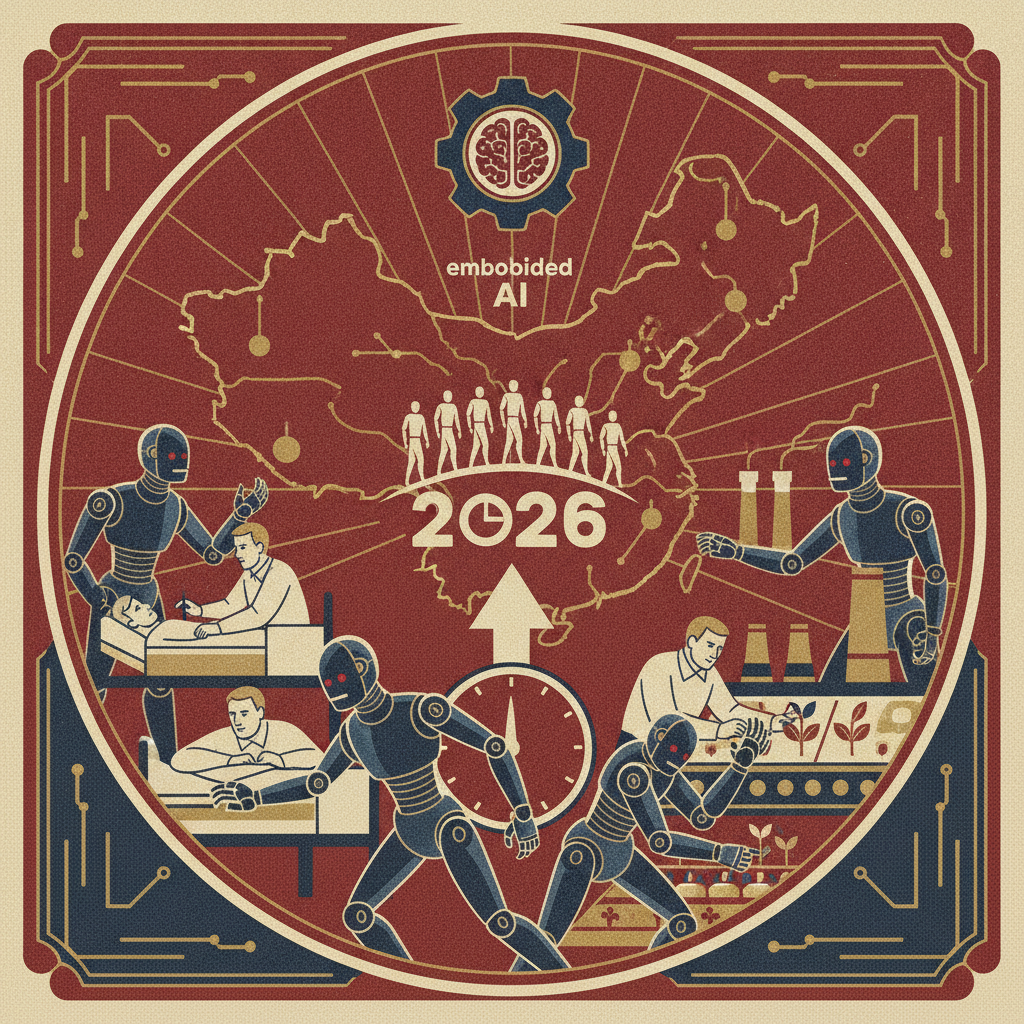
A profound transformation is unfolding across China, a movement poised to reshape industries and redefine our interaction with technology. We are witnessing the rapid rise of **humanoid robots** and a new kind of **embodied AI**, intelligent systems designed not just to think, but to act and move in our physical world. By late 2026, China has set an ambitious goal: to deploy over **10,000** of these human-like machines in factories, hospitals, and healthcare settings nationwide. This isn’t merely a vision; it’s a strategic national endeavor that has already propelled Chinese companies to account for nearly **90% of global humanoid robot sales** in 2025.
The Nation’s Grand Endeavor
China has initiated an unparalleled national training program, aiming to transition humanoid robots from impressive stage demonstrations—like intricate dance performances or marathons—into the demanding reality of industrial applications. The Ministry of Industry and Information Technology, along with state-owned enterprises, has been given a swift mandate: less than six months to demonstrate the practical viability of these robots in production environments. The targets are breathtaking in their scope: to create over **100 high-value applications** by the end of this year, to deploy **10,000 robotic units** in key scenarios, and to ensure that leading humanoid products achieve full “work mode” status by the **end of 2026**.
The financial commitment behind this future is equally immense. Over **$20 billion** has been earmarked to fuel this sector, complemented by a colossal **trillion-yuan fund** (approximately $137 billion) established to support the innovative spirit of AI and robotics startups. Local governments are also contributing, with Wuhan offering subsidies of **5 million yuan** to manufacturers and providing free office space to qualifying firms. This powerful backing has spurred incredible innovation, with **31 Chinese firms** unveiling **36 competing humanoid models** in 2024 alone, a number far surpassing the **8 models** introduced by U.S. companies.
Robots That Inspire Awe
Across China, remarkable new robots are pushing the very boundaries of human-like artificial intelligence:
**Moya**, a creation from DroidUp, stands as the first **biomimetic embodied AI robot**. This marvel of engineering can walk with astounding **92% accuracy**, but it’s her ability to smile, wink, and replicate subtle **micro-expressions** that truly sets her apart, breathing a new kind of life into human-robot interaction. With a projected price of around **$8,000**, Moya is envisioned for healthcare, education, and commercial settings where genuine human-robot interaction is essential, complete with **temperature-controlled skin** and **camera eyes** that enhance her lifelike presence.
Then there is **Agibot**, a tireless humanoid designed by AgiBot, operating an incredible **17 hours a day** to generate crucial training data. These robots are already proving their mettle by mastering tasks like folding T-shirts, making sandwiches, and opening doors, showcasing a rapid learning capability. Each Agibot unit costs approximately **$14,000**.
**JAKA Pi**, from JAKA Robotics, is a compact humanoid featuring a unique **split AI brain**, effectively two minds in one body, allowing it to think, see, and react in real-time. Built specifically for **research and real-world testing**, it exemplifies advanced cognitive architecture. Finally, **Xiaomo** is already handling **critical tasks in battery pack production**, quietly contributing to China’s vast industrial deployment.
The Intelligent Core: AI Innovations
Beyond the impressive hardware, China and its global partners are relentlessly advancing the very intelligence and efficiency of AI:
**Turbo Quant**, a new compression system unveiled by Google, promises to revolutionize AI memory use, potentially cutting it by **6 times** and speeding up workloads by an incredible **8 times**. This innovation could make AI even more powerful and accessible.
NVIDIA has introduced a **full-stack safety system** specifically for physical AI, a crucial development for autonomous vehicles and **humanoid robotics** already being deployed by Agibot on factory floors. This ensures that as robots become more capable, they also remain safely integrated into our world.
Meanwhile, Alibaba’s **Qwen-Robot (Quin Robot)** represents the company’s first **embodied AI model family**. This system is designed to enable robots to truly **understand complex commands** and then **act in the real world**, transforming abstract instructions like “go to the kitchen, find the red cup, pick it up” into seamless, real-world actions.
China’s Unmatched Dominance
This isn’t merely a race; it’s a testament to profound commitment. Morgan Stanley projects that China’s humanoid robot market will continue its **dominant trajectory**, with Chinese firms leading the world in both the **volume of innovation** and the sheer **speed of deployment**. While giants like Tesla with its Optimus (formerly Atlas) and Boston Dynamics are also making strides, China’s **state-backed scale** and **rapid commercialization** efforts position it undeniably at the forefront of this monumental technological wave.
A New Dawn
China’s **humanoid robot revolution** is no longer a distant possibility—it is a tangible reality, unfolding with breathtaking speed in factories, hospitals, and advanced research labs across the nation. With **massive state funding**, a remarkable **36 competing models introduced in 2024**, and a projected **90% of global sales in 2025**, China is irrevocably poised to make humanoid AI a **core pillar of its industrial and societal future by 2026**. Innovations like **Moya’s biomimetic design**, **Agibot’s data-driven training**, and **Turbo Quant’s incredible compression** herald a new era where robots are not merely functional tools, but increasingly sophisticated, intelligent, and truly human-like partners in our evolving world.
Leave a Reply