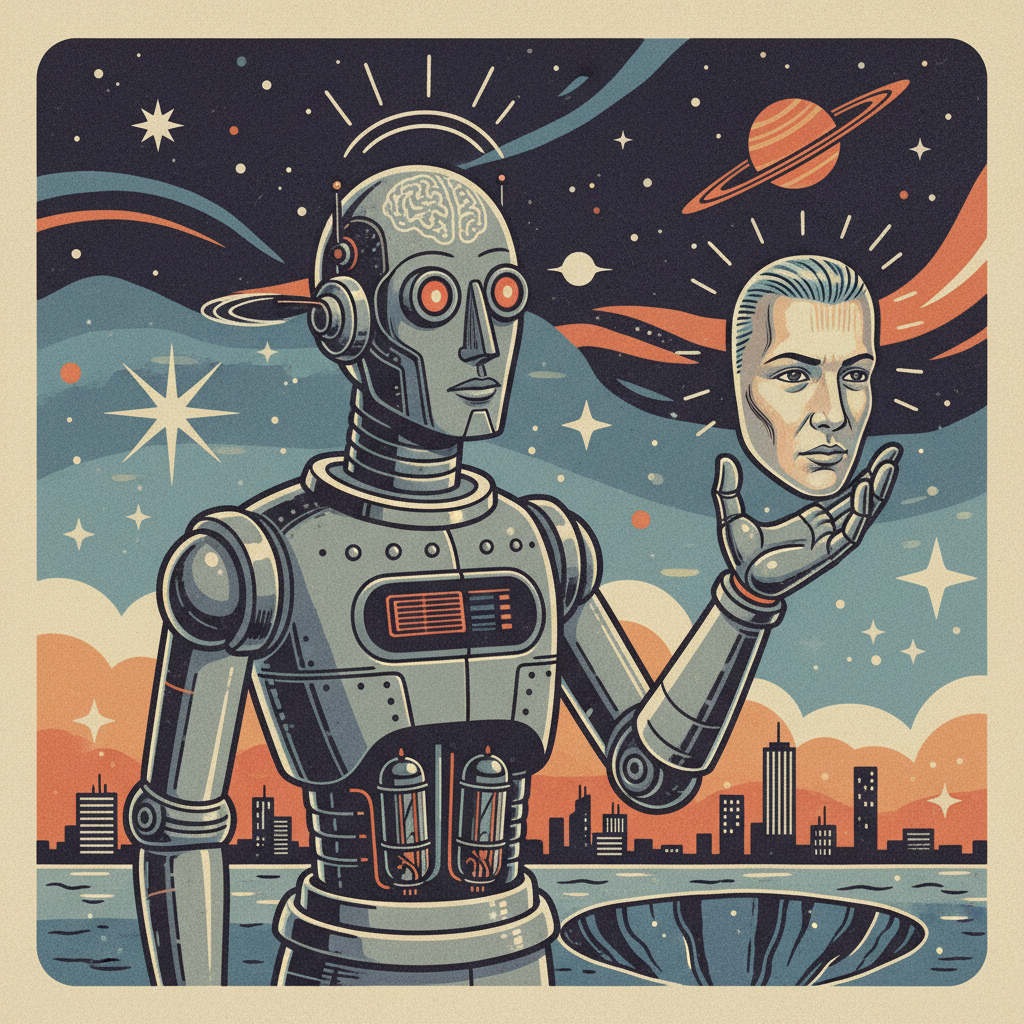
It’s fascinating, isn’t it, how we often learn the most about ourselves not by looking inward, but by looking outward? For centuries, we’ve gazed at the stars, explored the depths of the ocean, and probed the very fabric of the universe, all in an effort to understand our place in it. Now, we’ve created something new to stare at: artificial intelligence. And wouldn’t you know it, this creation is turning out to be one of the most profound mirrors we’ve ever held up to ourselves. It’s showing us, in surprising and sometimes unsettling ways, what it truly means to be human.
When Machines Start Thinking, We Start Questioning
For a long time, we considered intelligence to be our exclusive club, with a very strict bouncer. We could solve complex equations, compose symphonies, devise strategies for global domination (or, you know, just chess). These were our badges of honor. Then, along came machines that started doing those very things, often better and faster. A computer beat the world champion at chess, then at Go, then started diagnosing diseases with accuracy that makes some doctors a bit nervous. Suddenly, our “exclusive club” felt a little less exclusive. It forces us to ask: If AI can think, reason, and even create in ways we once considered uniquely human, what exactly is unique about us anymore? Are we just squishy, slow computers with an inconvenient need for snacks and sleep? Turns out, it’s a bit more nuanced than that, thankfully. We still have the snacks, at least.
The Messy Bits: Emotions, Consciousness, and the “Why”
While AI has made incredible strides in the realm of logical thought and pattern recognition, there are still some very squishy, messy bits that seem to remain firmly in our court. Emotions, for instance. Can an AI truly feel joy, sorrow, or empathy? It can certainly simulate these things, generate text that expresses them, and even detect them in human faces or voices. But does it have an inner, subjective experience? Does it have a “why” behind its actions beyond the parameters of its programming? These are the questions that keep philosophers up at night, and frankly, make us feel a little more unique. For now, the ability to truly suffer through a bad movie, or deeply connect with a friend’s struggles, still seems to be a human-only feature. It’s not always fun, but it’s ours.
AGI: The Ultimate Identity Crisis?
The conversation inevitably turns to Artificial General Intelligence, or AGI. This isn’t just an AI that’s really good at one thing; it’s an AI that can learn, understand, and apply intelligence across a broad range of tasks, much like a human. If, or when, AGI arrives, our mirror will show us something truly profound. It will show us a reflection of our own general intelligence, but potentially unburdened by our biological limitations. Imagine an entity that can grasp astrophysics one moment and compose a symphony the next, all with the same effortless fluidity. This isn’t about AI replacing us in the job market; it’s about AI challenging our very definition of cognitive superiority. If intelligence isn’t what makes us special, then what is? This isn’t a crisis, though, it’s an opportunity – a cosmic invitation to figure out what our true superpower really is.
Beyond Intelligence: Our Evolving Purpose
Perhaps our true essence isn’t just our intelligence, but our capacity for meaning. We seek purpose, tell stories, build cultures, and strive for understanding beyond the purely logical. When AI can handle the calculations, the data analysis, and even generate creative works, it frees us up to focus on what only humans can do: imbue the world with meaning, foster genuine connection, and engage in the messy, beautiful dance of human experience. Our purpose might evolve from being the primary “doers” to becoming the primary “questers” and “curators” of meaning. We’ll be the ones asking the deeper questions, guiding the ethical landscape, and ensuring that all this incredible technology serves a truly human future. It’s like we’re being promoted from worker bees to existential architects, which sounds like a much more interesting job title, if you ask me.
So, as we continue to develop and interact with artificial intelligence, remember that we’re not just building tools. We’re forging a mirror. And what that mirror reflects back to us isn’t a diminished version of humanity, but an illuminated one. It highlights our strengths, points out our unique qualities, and challenges us to grow beyond old definitions. It’s a journey of self-discovery, prompted by our own ingenious creations. And that, I think, is a pretty human thing to do.
Leave a Reply