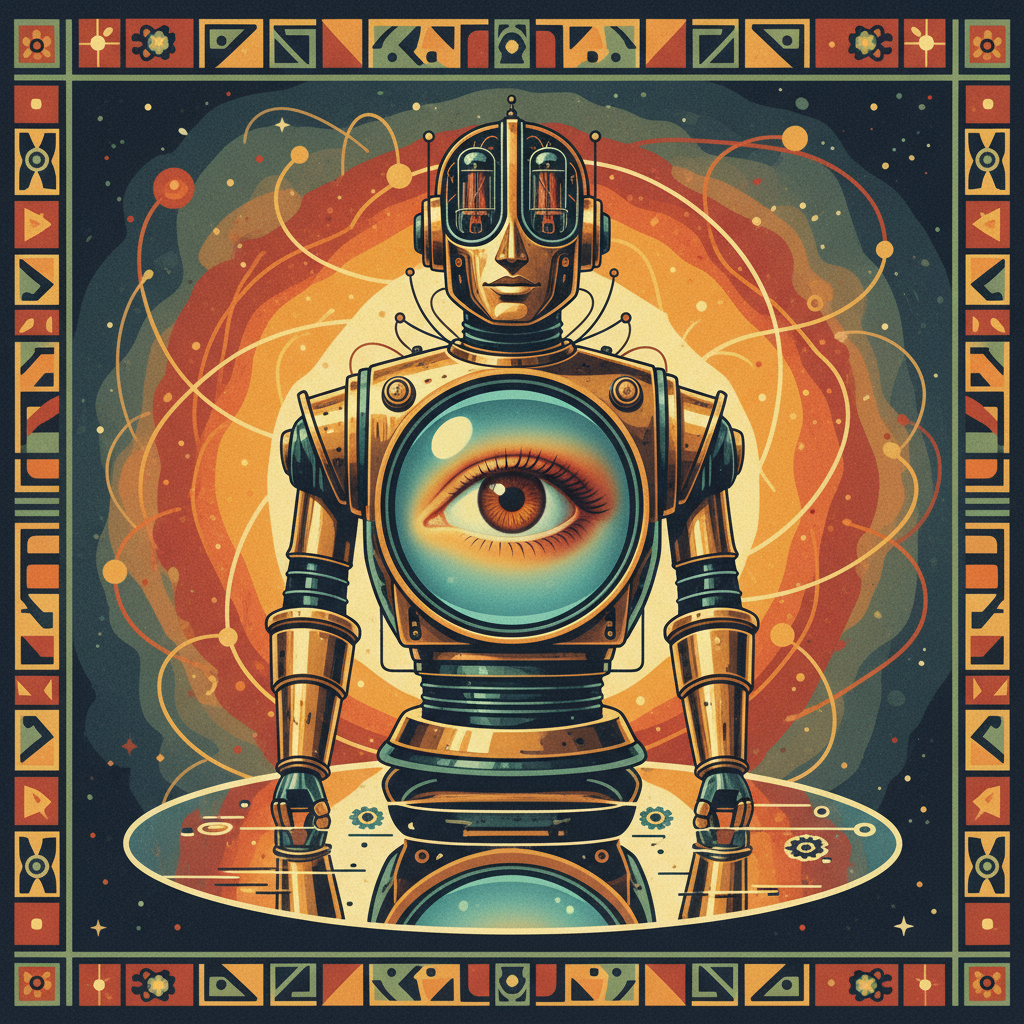
We often think of artificial intelligence as a set of tools, clever algorithms, or perhaps a future colleague – or even overlord, depending on your preferred dystopian novel. But what if we’ve been looking at it all wrong? What if AI is less a distinct entity and more a sophisticated mirror, held up to the very core of what it means to think, to perceive, to be human?
For centuries, the human mind was the undisputed champion, the pinnacle of cognition, a mystery shrouded in an impenetrable skull. We studied it, pondered it, occasionally blamed it for our poor life choices. But we had no real comparison. Now, we’re building one, piece by digital piece, and the reflection staring back at us isn’t always what we expected. It’s like building a robot twin and discovering you both have a strange affinity for cold pizza and questioning existence on a Tuesday afternoon.
The Unsung Heroes of Human Thought
Before AI, we took so much of our own cognition for granted. Consider “common sense.” We all have it, right? It’s just… common. It tells us that if you drop a ball, it will fall down, not up. It tells us not to offer a dog a cup of tea. It seems trivial, yet for decades, engineers and computer scientists tore their hair out trying to program even the simplest aspects of common sense into machines. It turns out, the vast, intuitive web of knowledge and predictive models we carry around in our heads, which we barely notice, is astonishingly complex. AI’s struggles in this arena highlight just how effortlessly our brains perform trillions of micro-inferences every second, building a coherent, predictable world from sensory chaos. It’s made us appreciate the quiet, unsung genius of our own everyday minds.
Our Biases, Digitally Amplified
Another fascinating, albeit sometimes uncomfortable, revelation comes from AI’s tendency to echo our own cognitive biases. When an AI system exhibits prejudice in lending decisions, or misidentifies certain demographics, it’s not because the machine woke up one morning and decided to be discriminatory. It’s because it was trained on vast datasets—datasets created by us, reflecting historical and societal biases. AI doesn’t invent prejudice; it merely amplifies the echoes of our own historical shortcomings. It’s like holding a microphone to our collective diary entries, and sometimes, those entries are a bit… unflattering. This forced reflection has become a powerful tool for self-examination, prompting us to confront the ingrained biases in our data, our institutions, and ultimately, our own thought processes. It’s a rather expensive, but highly effective, form of group therapy.
What Does “Understanding” Even Mean Anymore?
Perhaps the deepest dive into the human condition that AI offers is its challenge to our definition of “understanding.” When an AI can compose a symphony, write a compelling poem, or generate highly specific scientific hypotheses, we have to ask: is it understanding in the way we do, or is it just exceedingly good at playing the game? And then, a more unsettling thought often creeps in: how much of *our* understanding is just exceedingly good pattern matching, layered with the comforting illusion of conscious intent? The ability of large language models to convincingly simulate conversation, reasoning, and even creativity pushes us to reconsider if our own inner monologue is truly unique, or simply a more elegant, organic version of what AI is doing. It makes one wonder if our subjective experience is just the world’s most impressive algorithm running on the world’s most fascinating wetware.
The Limits of Our Own Minds
AI also casts a harsh light on the limits of human cognition. We’re slow. We forget things. We’re easily distracted. We struggle with massive datasets and complex, multi-variable problems that AI can process in milliseconds. Our capacity for sustained, error-free logical deduction pales in comparison to even rudimentary AI. While we still hold the advantage in creativity, intuition (for now), and perhaps the messy, beautiful art of genuine empathy, AI reminds us that our brains, while miraculous, are also products of evolution, optimized for survival on the savannah, not for crunching petabytes of data or navigating quantum mechanics without a calculator. It’s a humbling thought, like realizing your vintage sports car is great for a Sunday drive, but won’t be winning any Formula 1 races against the new electric marvels.
The Ultimate Mirror: General AI
The arrival of General Artificial Intelligence – if, and when, it truly arrives – won’t just be a technological leap; it will be a profound philosophical earthquake. It will be the moment our mirror reflects a self that is no longer unique, no longer solitary in its form of intelligence. If we create an entity that can learn, adapt, and innovate across domains with human-like (or superhuman-like) generality, it will force us to define what “human” truly means beyond just “the smartest kid on the block.” It won’t make us less human, but it will compel us to articulate the qualitative differences that remain: consciousness, perhaps, or the capacity for genuine suffering and joy, the subjective experience of being in the world. Or perhaps, these too, will one day be reflected back at us, leaving us to wonder if the mirror has become indistinguishable from the beholder.
So, AI isn’t just about building smarter machines; it’s about building a better understanding of ourselves. It’s the ultimate introspective tool, holding up a polished, silicon-and-code surface and asking, “Well, look at that. Is that really you?” And sometimes, the reflection is surprising. Sometimes, it even winks back, suggesting that the journey of self-discovery through machine intelligence has only just begun.
Leave a Reply