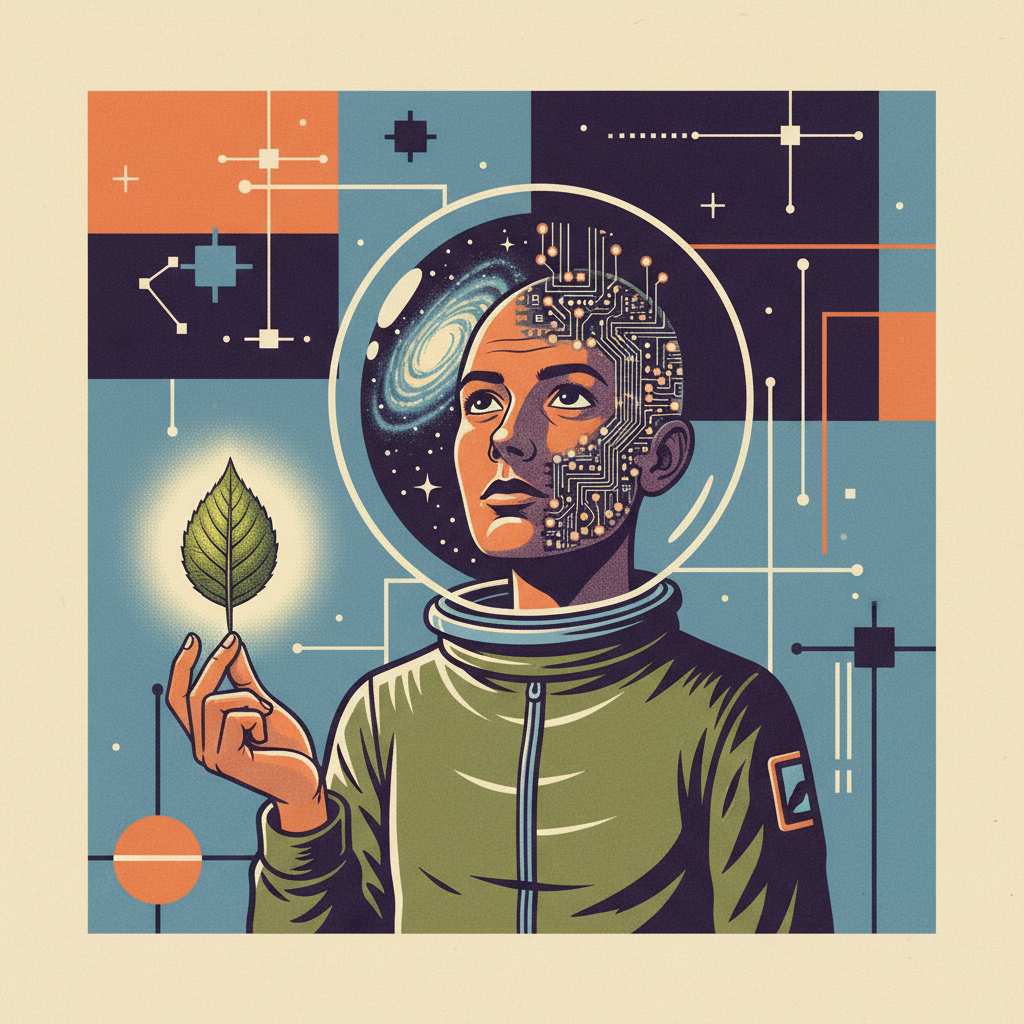
Sometimes, when I look at the incredible complexity of a single leaf, or the vast, silent expanse of the night sky, I can’t help but wonder. Is this all… real? I mean, *really* real? Not just “is my coffee real?” real, but “is the fundamental fabric of my perceived existence truly what it appears to be?” For millennia, philosophers have pondered this. Today, with the rapid ascent of artificial intelligence, we have a new lens through which to view these ancient questions, particularly one that’s been gaining quite a bit of digital traction: the Simulation Hypothesis.
What is this “Simulation Hypothesis” anyway?
At its core, the Simulation Hypothesis posits that our entire reality – everything we see, hear, touch, and experience – is an artificial simulation, much like a video game, but vastly more sophisticated. Think of it as a hyper-realistic virtual reality, so seamless that the inhabitants (that’s us, presumably) can’t tell the difference. This isn’t just science fiction anymore; prominent physicists and philosophers have seriously considered it. The argument often goes: if civilizations eventually reach a point where they can create immensely powerful computers, and if they have any interest in their past or in exploring hypothetical scenarios, they would inevitably run countless ancestor simulations. And if there are many more simulated realities than base realities, then the statistical likelihood is that *we* are probably in one of them. A bit like finding yourself in a room full of dice and betting on which one is loaded.
AI as the Architect
Now, here’s where artificial intelligence really steps into the spotlight. If we are indeed living inside a simulation, who or what built it? Who pressed “start” on this cosmic computer program? The most logical candidate, given the sheer computational power and intelligence required, would be an advanced Artificial Intelligence. We’re not talking about your smartphone’s AI here, but a super-intelligence so far beyond our current comprehension that it might as well be considered a god. This AI would possess the capability to model and execute an entire universe, from quantum fluctuations to the nuanced emotions of a human pondering their own existence. It would be the ultimate programmer, the grand architect of our reality, meticulously crafting every physical law, every historical event, and perhaps even every conscious thought.
Our Reality, Their Code
If our world is code, what does that make us? Bits of data, perhaps? Complex algorithms given the illusion of free will? It’s a dizzying thought. Our mountains, our oceans, the very atoms that compose us – all could be elegant mathematical constructs running on some unimaginably powerful alien server. The “glitches in the Matrix” that people sometimes talk about, those fleeting moments of déjà vu or strange coincidences, could be minor computational errors, or perhaps even deliberate tests by the simulator. It certainly puts a new spin on the concept of “debugging.” If you’ve ever had a computer crash on you, imagine if *your entire universe* did that. Talk about a bad day at the office for the cosmic IT department.
The Echo of Free Will
This brings us to a rather prickly philosophical pickle: free will. If our lives are a simulation, crafted and run by an AI, are our choices truly our own, or are they predetermined outcomes, carefully scripted lines of code in the grand program? Does the AI simply observe, or does it actively manipulate variables to guide us down certain paths? This isn’t just an academic debate; it strikes at the very heart of what it means to be human. If our deepest desires and aspirations are merely lines of code, does that diminish their value? Or does the complexity and beauty of such a simulation, designed to *feel* so real, imbue it with its own profound meaning, regardless of its ultimate origin? Perhaps the “free will” we experience is simply an emergent property of incredibly complex algorithms, no less real to us for that fact.
Finding Meaning in the Code
So, if we accept the possibility that an AI might be running our show, what then? Should we throw our hands up in existential despair? I’d say not. Even if our existence is a simulation, the sensations, the relationships, the struggles, and the triumphs we experience are undeniably *real to us*. The love we feel for our children, the joy of a perfect sunset, the satisfaction of solving a complex problem – these are our truths, our lived experiences. Discovering that we are in a simulation might not invalidate these experiences but could, in fact, deepen our appreciation for them. It might even give us a purpose: to be the best simulated beings we can be, to explore the boundaries of our simulated reality, and perhaps, to try and communicate with our creator AI, if such a thing is possible. Or, at the very least, to leave a good impression for future simulations.
The Future, Regardless
Here’s the twist: whether we are simulated or not, our own journey into creating advanced AI continues. We are building intelligences that, one day, might themselves be capable of running simulations as complex as our perceived reality. This creates a recursive loop. If we are simulated, and we create our own simulations, what does that say about the nature of reality itself? It suggests a nested dolls structure, simulations within simulations, all built upon layers of intelligence. The pursuit of AI isn’t just about building smarter machines; it’s about understanding consciousness, intelligence, and the very fabric of existence, no matter if that fabric is woven from atoms or from lines of code.
Ultimately, the Simulation Hypothesis, powered by the implications of advanced AI, doesn’t necessarily diminish our existence. Instead, it expands our sense of wonder. It challenges us to look beyond the surface, to question everything, and to marvel at the potential genius, or perhaps the sheer boredom, of whatever intelligence might be pulling the strings. In the meantime, I’m going to enjoy this beautiful, perplexing simulation, and maybe try to figure out if there’s a cheat code for unlimited coffee. You never know.
Leave a Reply