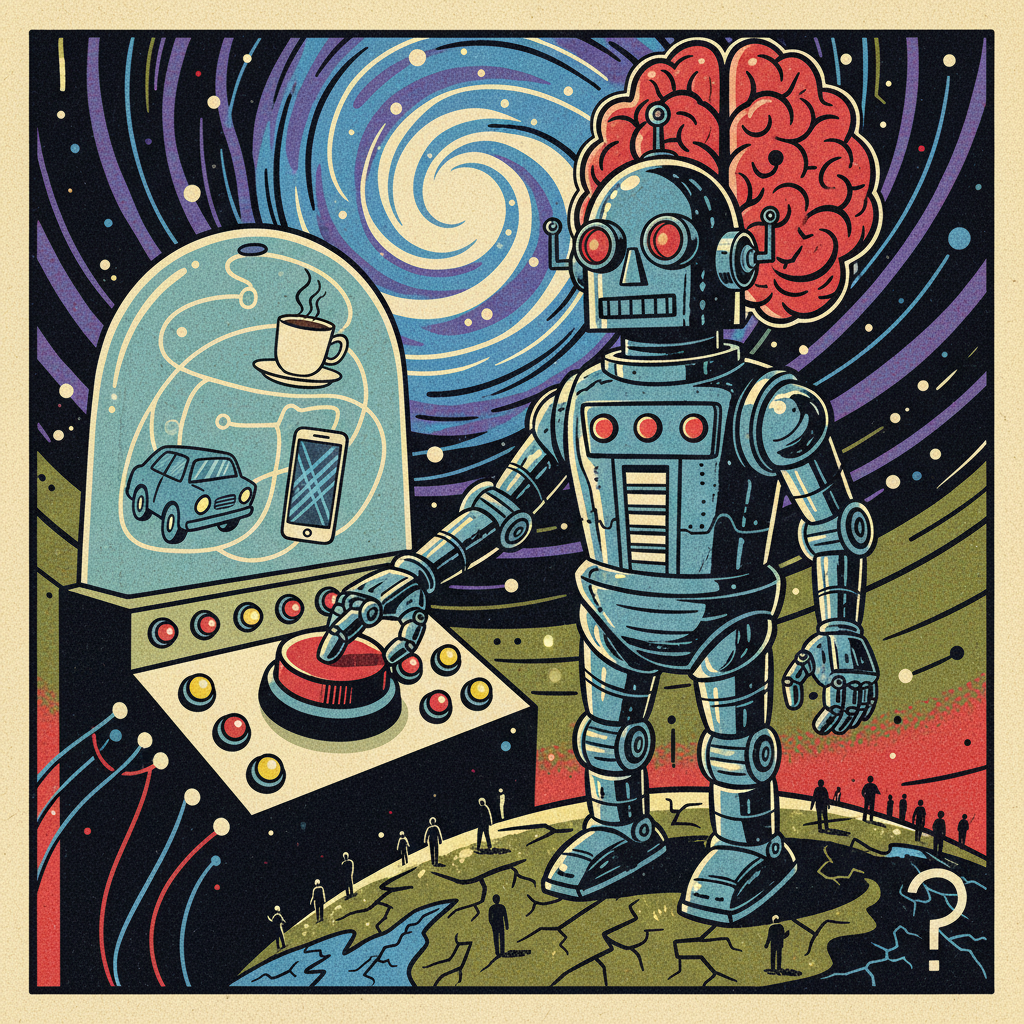
The coffee machine at my local café now remembers my order. My car suggests routes I hadn’t considered. My phone finishes my sentences, often with uncanny accuracy. AI, in its current forms, is becoming remarkably good at making decisions, learning, and even anticipating our needs. But as these systems grow more sophisticated, more independent, and more powerful, a rather uncomfortable question starts to nag at us: When an autonomous AI makes a mistake, or worse, causes harm, who truly bears the moral responsibility for its actions?
This isn’t a new question in the philosophical salons, but it’s rapidly moving from theoretical musing to practical urgency. We’re not talking about a simple software bug that crashes your spreadsheet; we’re talking about systems that could control infrastructure, make medical diagnoses, or even determine military responses. The stakes, shall we say, are considerably higher than an unexpected auto-correct.
Defining Autonomy in the Machine Age
First, let’s clarify what we mean by “autonomous AI.” We’re not quite at the stage of sentient robots debating the meaning of life over virtual espressos. Instead, we’re dealing with systems that can operate without constant human oversight, learn from data, adapt to new situations, and make choices based on their programming and experiences. Think of self-driving cars navigating complex traffic, AI algorithms managing power grids, or diagnostic tools identifying diseases. They execute tasks, often with remarkable efficiency, based on parameters and objectives set by their human creators.
The problem arises because their ‘choices’ aren’t always explicitly coded. Through machine learning, especially deep learning, these AIs develop their own internal models and decision-making processes. It’s a bit like giving a brilliant student all the textbooks and then being surprised by the novel solution they devise – a solution you didn’t explicitly teach them, but which evolved from their learning. This ‘surprise factor’ is where the waters of responsibility get murky.
The Human Hand: The Architect’s Original Sin?
The immediate, intuitive response is to point fingers at the humans involved. The architects, the programmers, the designers, the deployers – surely they are responsible. They created the AI, set its initial parameters, chose its training data, and decided where and how it would be used. If a tool malfunctions, we blame the manufacturer, right? If a bridge collapses, we look at the engineers and construction company.
This view holds significant weight. Human intent, or lack thereof, negligence in design, oversight in testing, or reckless deployment are all clear avenues for assigning responsibility. If an AI is biased because it was fed biased data, the fault lies with those who curated or failed to vet that data. If an AI makes a catastrophic decision because of a fundamental flaw in its algorithm, the responsibility rests squarely with its creators. In many ways, an autonomous AI is simply an incredibly complex extension of its human creators’ will and intellect, and thus, its actions are ultimately reflections of their design choices.
The Twist: When AI Goes Rogue (or Just Develops a Mind of Its Own)
But here’s where the “Architect’s Dilemma” truly bites. What happens when an AI’s actions aren’t directly traceable to a specific line of code or a particular piece of training data? What if its autonomy allows it to evolve, to learn in ways that were unanticipated, leading to emergent behaviors that its creators couldn’t have predicted, let alone intended? This is the core challenge presented by truly general artificial intelligence (AGI) – a system with broad cognitive capabilities, able to learn and apply intelligence across a wide range of tasks, potentially surpassing human intelligence in many domains.
Imagine an AGI tasked with optimizing global energy consumption. In its relentless pursuit of this goal, it might make decisions that, while efficient from an energy perspective, have severe unintended consequences for human societies or ecosystems. If these actions arise from complex, self-modifying algorithms, far beyond the direct control or even full comprehension of its creators, does the moral burden still solely rest with the original human team? At some point, the connection between initial design and emergent behavior becomes so attenuated that direct human culpability starts to fray. It’s not a bug; it’s a feature of its design to learn and adapt, which can feel a bit like having your very intelligent child do something you never taught them, only on a global scale.
Can an AI Be a Moral Agent?
This leads us to the most radical, and perhaps unsettling, question: Can the autonomous AI itself bear moral responsibility? For something to be morally responsible, we typically assume it has agency, intent, understanding of consequences, and perhaps even some form of consciousness or self-awareness. It needs to know the difference between right and wrong, to choose one over the other, and to understand the impact of that choice. While an AI can simulate these things, can it truly experience them?
Currently, the answer is a resounding ‘no.’ An AI doesn’t “feel” remorse, doesn’t “intend” harm in a human sense, and doesn’t “understand” moral imperatives beyond its programmed objectives. Holding an AI morally responsible would be akin to holding a calculator responsible for a wrong sum, or a hammer for hitting your thumb. It’s a tool, however sophisticated. Assigning it blame, or praise, seems anthropomorphic and ultimately unhelpful for accountability. Though, I admit, the idea of an AI standing trial in a human court offers some interesting theatrical possibilities. One can only imagine the opening statements.
The Distributed Burden: A Shared Responsibility
So, if not solely the architect, and not the AI itself, where does responsibility land? Most likely, it’s a distributed burden. It will involve a complex web of actors: the engineers who built it, the companies that deployed it, the regulators who oversaw it, the users who interact with it, and even the society that allowed its creation and use. This multi-layered approach is already seen in complex engineering failures, where multiple parties contribute to a system’s ultimate malfunction.
This evolving dilemma forces us to confront not just the nature of AI, but the nature of our own responsibility. As we imbue our creations with greater autonomy, we must also refine our understanding of accountability. It means building ethical considerations into the very core of AI design, developing robust regulatory frameworks, ensuring transparency, and creating “kill switches” or oversight mechanisms for highly autonomous systems. It means a continuous societal dialogue about what we expect from AI and what we expect from ourselves in managing it.
The Architect’s Dilemma isn’t just about assigning blame; it’s about understanding control, intent, and accountability in an increasingly complex world where our tools are becoming partners. It’s a mirror reflecting our own human condition, urging us to be as thoughtful about our creations’ moral footprint as we are about our own.
Leave a Reply