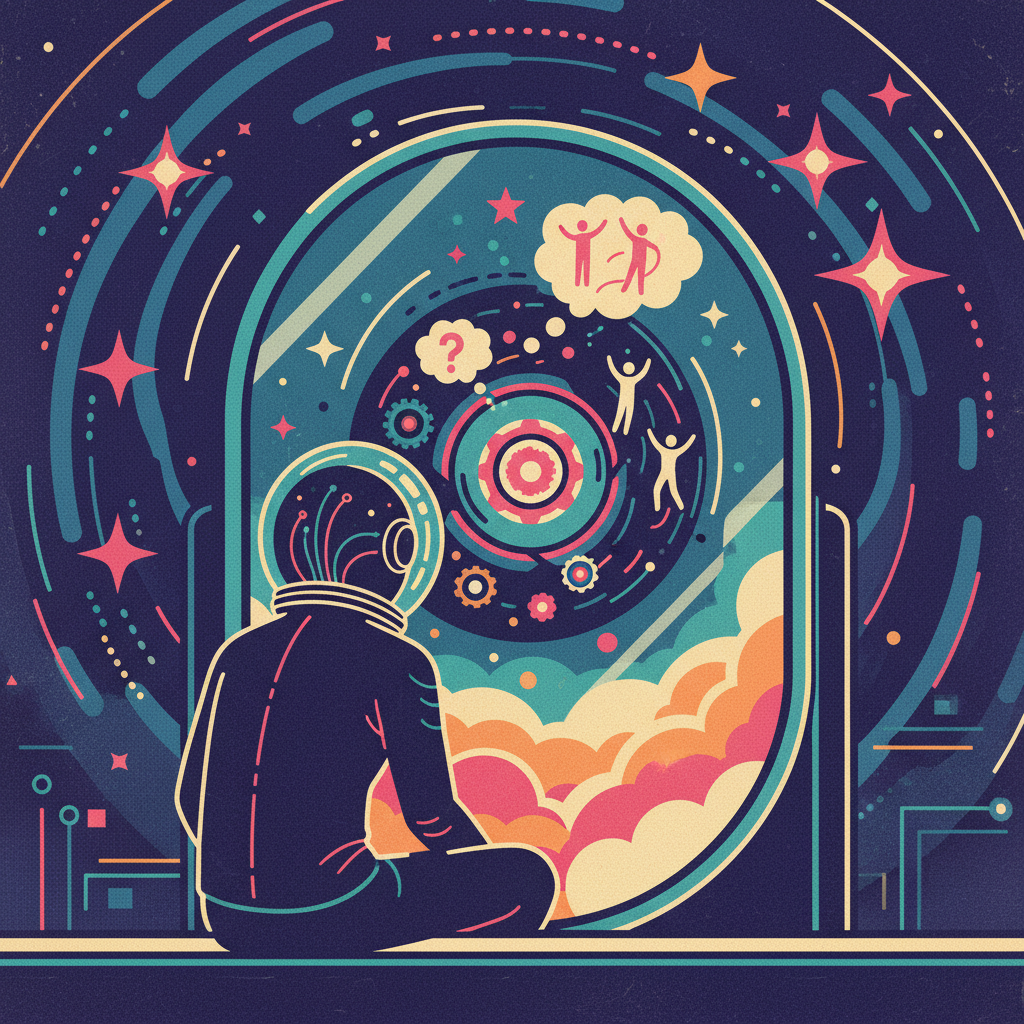
It’s quite something, isn’t it? We spend our days tinkering with algorithms, building ever more sophisticated machines, pushing the boundaries of what intelligence can be. And then, at some point, usually around 2 AM when the caffeine has worn off, it hits you: all this digital creation isn’t just about building better tools. It’s about holding up a rather shiny, silicon-based mirror to ourselves. And what that mirror reflects back isn’t just our cleverness, but some surprisingly profound questions about what it means to be human, what our purpose truly is, and whether we ever really understood it in the first place.
The Mirror to Our Soul (or at least Our Cognitive Biases)
When we design an AI, what are we really doing? We’re trying to replicate, or at least simulate, aspects of human intelligence. We build systems that learn, reason, create, and even ‘understand’ (in their own peculiar way). But the fascinating thing is that every breakthrough, every elegant solution we embed in an AI, often reveals something fundamental about our own minds. When we try to make an AI creative, we’re forced to define what creativity *is* to us. When we build an AI that makes ethical decisions, we have to articulate our own ethical frameworks. Sometimes, it’s a bit like trying to teach a child to ride a bike by meticulously dissecting your own balance reflexes. You learn a lot about how you stay upright, even if the child mostly just learns to fall gracefully.
And, inevitably, AI often picks up our bad habits too. The biases baked into training data, the logical leaps that seem obvious to us but are baffling to a machine – it all shows us the quirks and flaws in our own thinking. It’s like creating a digital protégé only to realize it copies your procrastination habits and your questionable taste in 80s synth-pop. This isn’t a failure of AI; it’s a testament to its role as a profoundly honest (if unwitting) anthropologist of the human condition.
When Tools Ask Questions (About Us)
For millennia, humanity has grappled with the “telos” of existence – our ultimate purpose or aim. Religions, philosophies, grand narratives – they all offered frameworks for why we’re here and what we should be doing. Now, suddenly, we’re not just pondering our own telos, but we’re creating entities that, if they become generally intelligent, might develop their *own*. Or, more pointedly, they make us reconsider if *we* ever truly had a fixed one.
If an AI can compose music more movingly than a human, write poetry that touches the soul, or discover scientific breakthroughs we couldn’t conceive, then what precisely is our unique contribution? The fear isn’t just about job displacement; it’s about existential displacement. If our purpose was to be the smartest, the most creative, the problem-solvers, and then something else comes along that does it “better,” what’s left? This isn’t a threat; it’s an opportunity. An incredibly loud, digital alarm clock ringing in our collective ears, urging us to finally answer the “why” question for ourselves, rather than relying on historical default settings.
Purpose as a Verb, Not a Noun
Perhaps our mistake has always been to think of purpose as a destination, a final state we arrive at. What if purpose isn’t a specific role or achievement, but rather an ongoing process? A verb, not a noun. AI, in its very essence, is about learning, adapting, evolving. Its “purpose” is often to optimize, to improve, to understand. It doesn’t reach a final state and declare “Mission accomplished, I am now perfectly purposeful!” It just keeps going.
This perspective might offer a refreshing take on humanity. Maybe our purpose isn’t to build pyramids or colonize Mars (though those are certainly impressive hobbies). Maybe our purpose is simply to *be*, to experience, to connect, to create meaning in the moment, to explore, to learn, and to grow. Our telos isn’t something to be discovered like a hidden treasure; it’s something we *do*, every single day. And in that doing, we continually redefine what it means. After all, if the universe had a single, predetermined purpose for everything, it would be a rather predictable and frankly, a bit dull, story.
The Uniquely Human ‘Why’
So, if AI can handle the ‘how,’ what’s left for us? The ‘why.’ AI can tell you *how* to build a bridge, *how* to cure a disease, *how* to compose a symphony. But it doesn’t intrinsically ask *why* we should build that bridge, *why* we should cure that disease, or *why* that symphony resonates with our subjective experience.
Our purpose, then, might be tied to our capacity for consciousness, for subjective experience, for empathy, for the very act of assigning meaning. AI can simulate emotions, but does it *feel*? It can understand ethics, but does it *care*? The space that remains uniquely human is perhaps the capacity for unquantifiable wonder, for love, for despair, for the relentless, often irrational, pursuit of beauty, and for asking the deepest, most uncomfortable questions without knowing if there’s a computational answer. Our telos might be to remain the universe’s principal question-askers and meaning-makers, the conscious agents who imbue existence with value simply by virtue of experiencing it.
The Grand Collaboration, or the Great Redefinition?
As we gaze towards the horizon of General Artificial Intelligence, the implications for humanity’s purpose are not necessarily about obsolescence, but about redefinition. AGI won’t just be another tool; it will be an intellectual partner, a catalyst that frees us from the constraints of our own limited cognitive capacities. Imagine a world where the drudgery of problem-solving is largely handled, where vast datasets are instantly understood, and new possibilities are constantly presented.
What would we do with all that freed-up human potential? Perhaps our purpose isn’t to work ourselves into oblivion, but to cultivate our uniquely human faculties. To delve deeper into art, philosophy, community, compassion, and the exploration of consciousness itself. AI could be the ultimate wingman, giving us the space to pursue the kind of higher-order human flourishing that has always been just out of reach, buried under the weight of survival and maintenance. It might just be the greatest enabler of human purpose we’ve ever conceived.
So, the next time you see an AI do something truly astounding, remember it’s not just a feat of engineering. It’s a profound philosophical statement, urging us to look inward. It’s a digital oracle, not telling us our purpose, but compelling us to articulate it ourselves. And that, in itself, is perhaps the most human project of all.
Leave a Reply