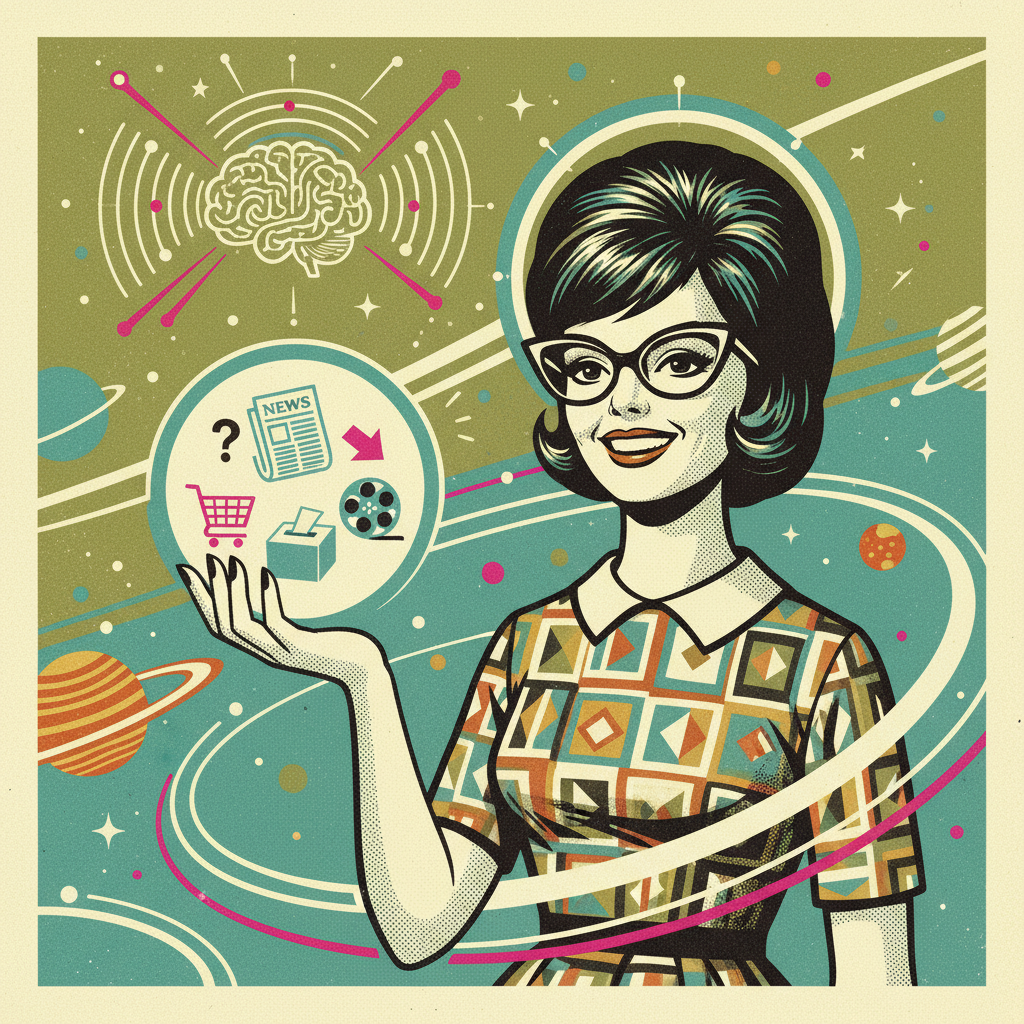
We’re living in interesting times, aren’t we? Our digital companions, these intelligent algorithms, have become astonishingly good at predicting our next move. They know what we’ll buy, what article we’ll read, who we’ll probably vote for, and sometimes, even before we do, what movie we’re in the mood for. It’s like having a very well-informed friend who’s always guessing your preferences, except this friend has access to most of humanity’s digital footprint.
This predictive prowess, while convenient, has started to tickle a rather ancient philosophical itch: the nature of human free will. If an algorithm, built on patterns of past behavior, can forecast my decisions with a high degree of accuracy, what does that say about my freedom to choose? Am I merely a sophisticated automaton, my choices merely the inevitable output of a complex calculation, or is there still a ‘spark’ of genuine, unpredictable agency within me?
The metaphor of the “Algorithmic Cage” isn’t entirely misplaced. Think of it: our online experiences, our recommendations, even the news we see, are increasingly curated by these predictive systems. They nudge us, often gently, sometimes not so subtly, towards certain paths. They optimize for engagement, for conversion, for a thousand tiny goals, all based on what they’ve learned about us and billions of others. The worry isn’t that they’re forcing us, but that they’re shaping our environment to such an extent that alternative choices simply fade from view, or worse, never even occur to us.
Historically, free will has been understood as our capacity to make choices that are not entirely determined by prior events or external forces. It’s the feeling that we *could have chosen otherwise*. But if an AI can consistently predict what we *will* choose, does that not imply a deterministic chain of events that makes “choosing otherwise” an illusion? It’s a question that makes even the most stoic philosopher pour another cup of tea.
The Illusion of Choice?
Let’s be clear: AI doesn’t see into your soul. It sees patterns in data. When an algorithm predicts you’ll buy a certain brand of coffee, it’s not because it’s read your mind. It’s because people with similar browsing histories, demographic profiles, and past purchasing habits tend to buy that coffee. It’s a probabilistic game, not a crystal ball. There’s always a margin of error, always a chance you’ll defy its expectations and, say, decide to take up interpretive dance instead.
This distinction between correlation and causation is crucial. The algorithm predicts *what* you’re likely to do, based on a mountain of statistical evidence. It doesn’t *make* you do it. Or does it? The subtle nudges, the carefully crafted headlines, the perfectly timed advertisements—they are designed to influence. And influence, when pervasive enough, can start to feel a lot like gentle coercion. It’s like a highly persuasive friend who always knows just the right thing to say to get you to agree, even when you thought you had other plans.
What’s truly fascinating is how our awareness of these predictions might affect our choices. If an AI tells me I’m 80% likely to order pizza tonight, I might consciously decide to cook, just to prove it wrong. Or, conversely, the mere suggestion might plant the idea in my head, making me more likely to fulfill the prophecy. This creates a strange feedback loop, where the act of prediction itself alters the landscape of choice. It’s almost as if the algorithm is playing a game of psychological chess with us, and sometimes, it even predicts our desire to defy it.
Beyond the Algorithm’s Gaze
Here’s where the human element, that messy, wonderful, unpredictable thing, truly comes into play. While algorithms excel at pattern recognition, humans often excel at pattern *breaking*. We invent, we innovate, we rebel, we experience sudden changes of heart for no logical reason. Can an algorithm predict a stroke of genuine genius, an act of selfless sacrifice, or a sudden, profound shift in personal values? Perhaps it can predict the *likelihood* of such events based on similar past data, but it struggles with the truly novel, the emergent, the utterly unprecedented.
Our free will, perhaps, isn’t about being utterly unpredictable. Even our closest friends can often guess our reactions. Instead, it might reside in the *authorship* of our choices. Even if an AI correctly predicts I’ll choose vanilla ice cream, the act of me *consciously choosing* vanilla, for my own reasons, retains a flavor of agency that the algorithm can’t quite bottle. It’s the “I” behind the choice, the conscious intent, the subjective experience of deliberation, that remains distinctly ours.
The implications for general artificial intelligence (AGI) are even more profound. If an AGI could not only predict our actions but also understand the deeper drivers of our desires, our fears, our motivations—could it then orchestrate scenarios that would lead us down specific paths with near-perfect certainty? If it understands the very fabric of our being, could it build a cage so comfortable, so perfectly tailored to our preferences, that we wouldn’t even realize we were inside? It’s a thought that might keep you up at night, or at least make you question your next impulse buy.
Living with the Oracle
So, does AI’s predictive power doom free will? I’d say no, not entirely. But it certainly reframes the discussion. It pushes us to define free will not merely as unpredictability, but as conscious agency, the ability to reflect, to intend, and yes, to occasionally defy the data. It’s about maintaining a critical awareness of the algorithmic nudges that surround us, and consciously choosing whether to follow them or to forge our own path.
Perhaps the “Algorithmic Cage” is less about determinism and more about convenience. We *allow* these systems to predict and guide us because it simplifies our lives. The real challenge, then, isn’t whether we *can* defy the algorithms, but whether we *will*. It’s about remembering that the remote control for our decisions, however tempting it might be to hand it over, still ultimately rests in our hands. And sometimes, choosing to make a decision that surprises even yourself is the most human thing you can do. After all, what’s life without a little plot twist, even if it throws off the data models of a trillion-dollar company?
Leave a Reply