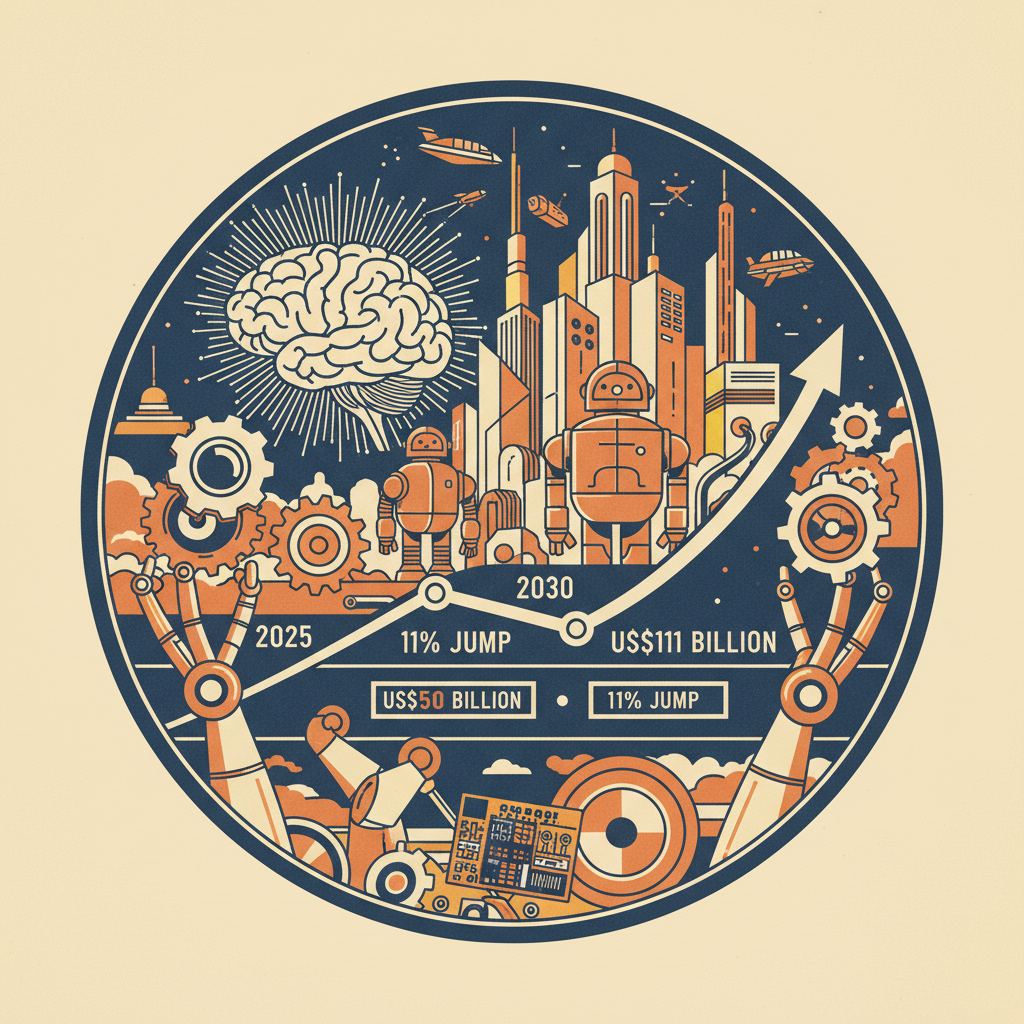
In the year 2025, humanity took another monumental step forward, witnessing an extraordinary surge in the realms of artificial intelligence and robotics. It was a time when the dreams of science fiction began to root themselves firmly in our reality, reshaping industries and hinting at a future brimming with intelligent machines. The global robotics market alone soared to nearly **US$50 billion**, marking a powerful 11% jump from the previous year. And this was just the beginning, with projections hinting at an astonishing **US$111 billion by 2030**, driven by an ever-quickening pace of innovation.
At the heart of this revolution were the mobile robots, the tireless workhorses of industry. They commanded a remarkable **US$30 billion** of the market in 2025, transforming warehouses and factories with their precision and efficiency. Imagine systems that could automatically store and retrieve goods, or machines that handled materials with seamless grace – this was their domain, set to expand to **US$75 billion** by 2030. Alongside them, the collaborative robots, or ‘cobots,’ emerged as true partners to humans. These adaptable machines, designed to work safely alongside people, saw their revenue climb rapidly, signaling a future where human ingenuity and machine capability blend effortlessly.
Yet, perhaps the most captivating vision of 2025 lay in the rise of humanoid robots. These figures, designed in our own likeness, captured the imagination and attracted unprecedented investment. Startups like Apptronik secured hundreds of millions, while others like Figure AI saw their valuations skyrocket. Investors weren’t just betting on technology; they were envisioning a future where robots could walk among us, assisting in homes and workplaces. It was a clear sign that what once seemed distant was now within reach, pushing the boundaries of what machines could be.
The Invisible Hand: AI’s Profound Impact
Behind every whirring gear and flashing sensor was the ever-expanding power of Artificial Intelligence. In 2025, AI wasn’t just a concept; it was a practical tool being wielded by an astonishing **90% of tech workers**. The very fabric of work was changing, with new jobs emerging that were explicitly AI-focused. While some tasks would undoubtedly be transformed by AI, the future promised a net gain: potentially **170 million new roles** created by 2030, far outweighing any displacements. AI’s reach was vast, from powering self-driving cars set to generate billions in revenue, to assisting a remarkable **66% of U.S. physicians** in healthcare, improving diagnostics and care.
For many business leaders, 2025 was celebrated as “the year AI became truly useful.” It was the moment when AI moved beyond experimental projects and became an integral part of daily operations. Employees using tools like Anthropic’s Claude reported astonishing productivity gains, completing more tasks and even discovering entirely new ways of working. This wasn’t just about doing things faster; it was about doing things smarter, unlocking unprecedented levels of efficiency and creativity.
Moments of Breakthrough and Discovery
The year was also marked by remarkable breakthroughs on the AI frontier. OpenAI unveiled GPT-5.2, pushing the boundaries of what large language models could achieve. Experts highlighted rapid advancements in how these models think and learn, hinting at a future where AI agents could operate in real-time with increasing sophistication. The quest for Artificial General Intelligence (AGI), a machine capable of human-level intelligence, saw significant milestones, with systems achieving impressive scores on complex reasoning benchmarks, even surpassing giants like Google’s Gemini 3 Deep Think in some areas.
Researchers delved deeper into multimodal AI, creating systems that could understand and generate content across various forms – text, images, sound – mirroring the richness of human perception. And as AI systems scoured the internet, their presence became undeniable, with specialized AI crawlers dominating web traffic, signaling their insatiable appetite for knowledge and data.
Navigating the Future: Hopes and Hurdles
As with any profound transformation, 2025 brought both immense optimism and sober reflection. Investors, while pouring billions into AI and robotics, acknowledged the potential for a “bubble,” yet firmly believed that such intense investment fuels groundbreaking innovation. The path forward wasn’t without its challenges. Some robotics startups, relying on earlier-generation AI, faced the risk of being outpaced as the technology rapidly evolved. Bringing humanoid robots safely into our homes and streets required careful thought, regulatory frameworks, and unwavering reliability to prevent malfunctions.
Yet, the prevailing sentiment was one of profound hope. The vision of ubiquitous robots, seamlessly integrated into our daily lives, felt closer than ever. AI’s practical benefits were already proving themselves in areas like marketing, boosting lead conversions and freeing up countless hours of manual work. The journey had just truly begun, promising a future where intelligence, both human and artificial, would continue to unlock new possibilities and reshape our world in ways we are only just beginning to imagine.
Leave a Reply