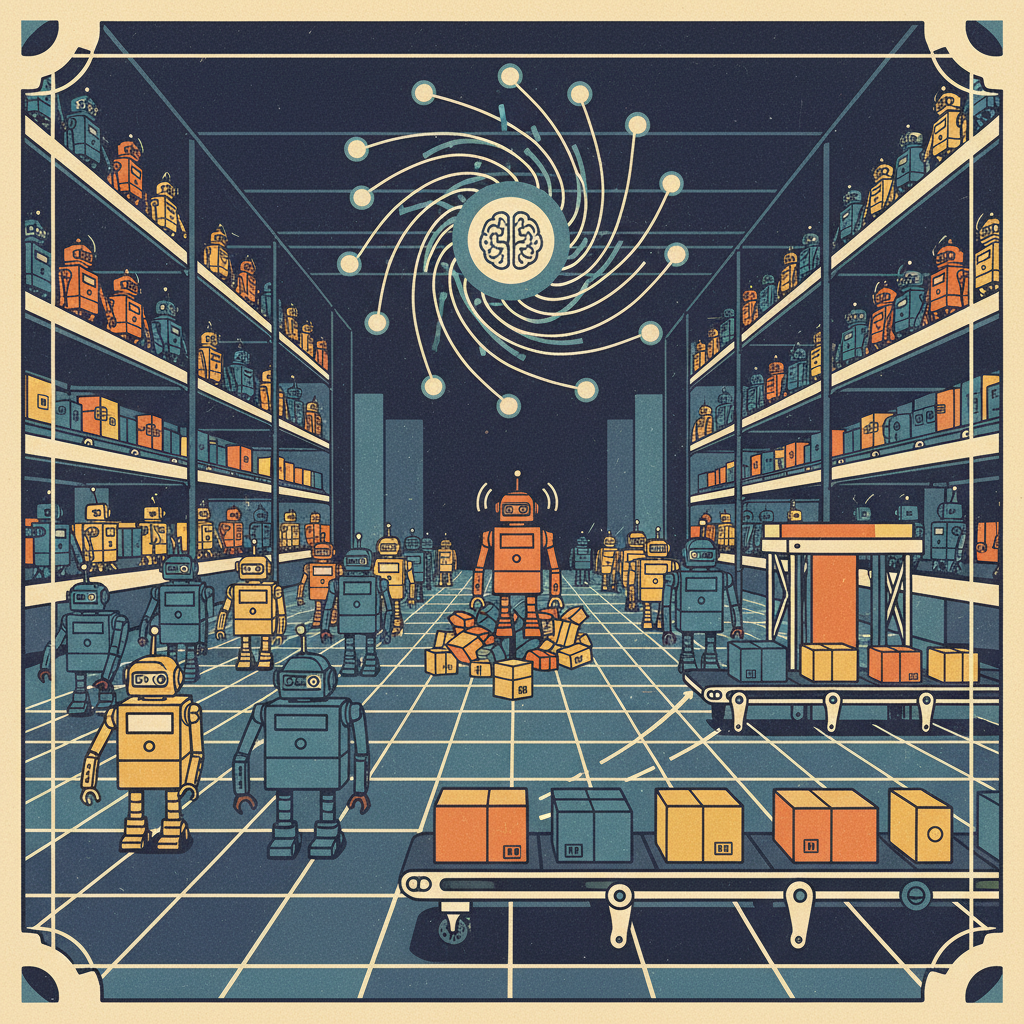
Imagine a world where hundreds of small, tireless machines hum and whir, moving precious goods. This is the heart of modern commerce – vast warehouses bustling with robots, working tirelessly to get packages to your doorstep. But imagine a traffic jam in this intricate dance, a single robot stuck, causing a ripple effect that slows everything down. This challenge, once a major bottleneck, is now being overcome by a truly groundbreaking innovation from MIT researchers, in collaboration with Symbotic. They’ve unveiled a brilliant new way for these robots to coordinate, guided by an intelligent system that ensures every move is perfect, boosting the flow of goods by a remarkable 25%. It’s like turning chaos into a meticulously choreographed ballet, all thanks to the power of artificial intelligence.
The Grand Challenge: Orchestrating a Robotic Ballet
Think about the sheer complexity of hundreds of robots all trying to navigate tight aisles simultaneously. Each robot has a task, a destination, and a deadline. In these high-stakes environments, even a tiny delay – a moment of hesitation or a near-miss – can throw the entire operation into disarray. Minor snags quickly snowball into significant inefficiencies, especially during peak seasons. Traditional planning methods often falter under such dynamic pressure, struggling to keep up with constant changes and unpredictable interactions, leading to bottlenecks and slower deliveries. The need for a smarter, more adaptive solution was clear: a master conductor for this robotic orchestra.
A Brilliant Mind at Work: How the AI Transforms Robot Traffic
This new system isn’t just an improvement; it’s a revolution in how machines cooperate. At its core lies a blend of two powerful ideas: deep reinforcement learning and a lightning-fast planning method. It’s like a computer brain that learns by trying, making mistakes, and improving – much like a human masters a skill.
Seeing the Future: Predicting and Preventing Jams
The most awe-inspiring part of this system is its ability to foresee problems before they happen. A special neural network – a digital brain – constantly watches every robot’s path and interactions. It can predict exactly where a traffic jam might form, and when it spots a potential bottleneck, it acts immediately. It steps in, assigning priorities to robots most at risk of getting stuck and gracefully rerouting them onto clearer paths. This means fewer stops, fewer collisions, and a smoother flow.
Mastering Scale: Managing Hundreds with Ease
To handle vast numbers of robots (hundreds or even thousands), the system uses a clever trick. It doesn’t manage every robot individually. Instead, it intelligently divides the warehouse into smaller, manageable zones, each with its own group of robots (say, 40 at a time). This allows the AI to make quick, real-time decisions for each group, reusing computations efficiently – like many choreographers working in harmony.
Precision Navigation: Guiding Every Step
Once priorities are set and potential jams avoided, another sophisticated algorithm takes over. It meticulously calculates the precise, efficient path for each robot. This means the system can adapt instantly to new challenges, whether it’s a sudden surge of new orders or a change in the warehouse layout. The result is truly impressive: in realistic simulations, this hybrid AI system delivered a 25% increase in packages moved per robot. It resolves traffic problems traditional systems couldn’t untangle, proving its remarkable effectiveness.
Ready for the Real World: Adapting to Any Environment
What makes this achievement even more profound is its ability to adapt. The researchers painstakingly trained this AI with custom simulations mirroring real-world warehouses. This rigorous training means the system isn’t confined to a single environment. It can step into any new warehouse, with varying robot counts or layouts, and immediately orchestrate traffic with the same high performance. It’s a testament to its robust design.
AI’s Broader Impact: The Intelligent Warehouse of Tomorrow
This MIT breakthrough is part of a larger, sweeping transformation happening in logistics. Studies reveal that artificial intelligence is rapidly becoming indispensable, with AI tools now embedded in 60% of warehouses globally. This isn’t just about robots; it’s about smart software for visibility and optimization. AI helps manage inventory perfectly, plans the most efficient delivery routes, and accurately predicts future demand. This intelligent automation drives massive productivity gains, with many warehouses seeing a return on investment within 2-3 years. Far from replacing people, it’s creating demand for new, highly skilled roles alongside these systems.
The Path Ahead: An Even Smarter Future
The journey doesn’t stop here. The brilliant minds behind this system are already looking to the future, envisioning even more sophisticated coordination. Their next step is to teach the AI not just how robots move, but which robot handles which order, further reducing congestion. The goal is to scale this intelligence to thousands of robots, creating truly seamless and resilient logistics for the massive warehouses powering our e-commerce world. As our demand for quick and reliable deliveries continues to grow, innovations like this promise a future where every package moves with effortless grace, guided by an unseen, intelligent hand.
Leave a Reply