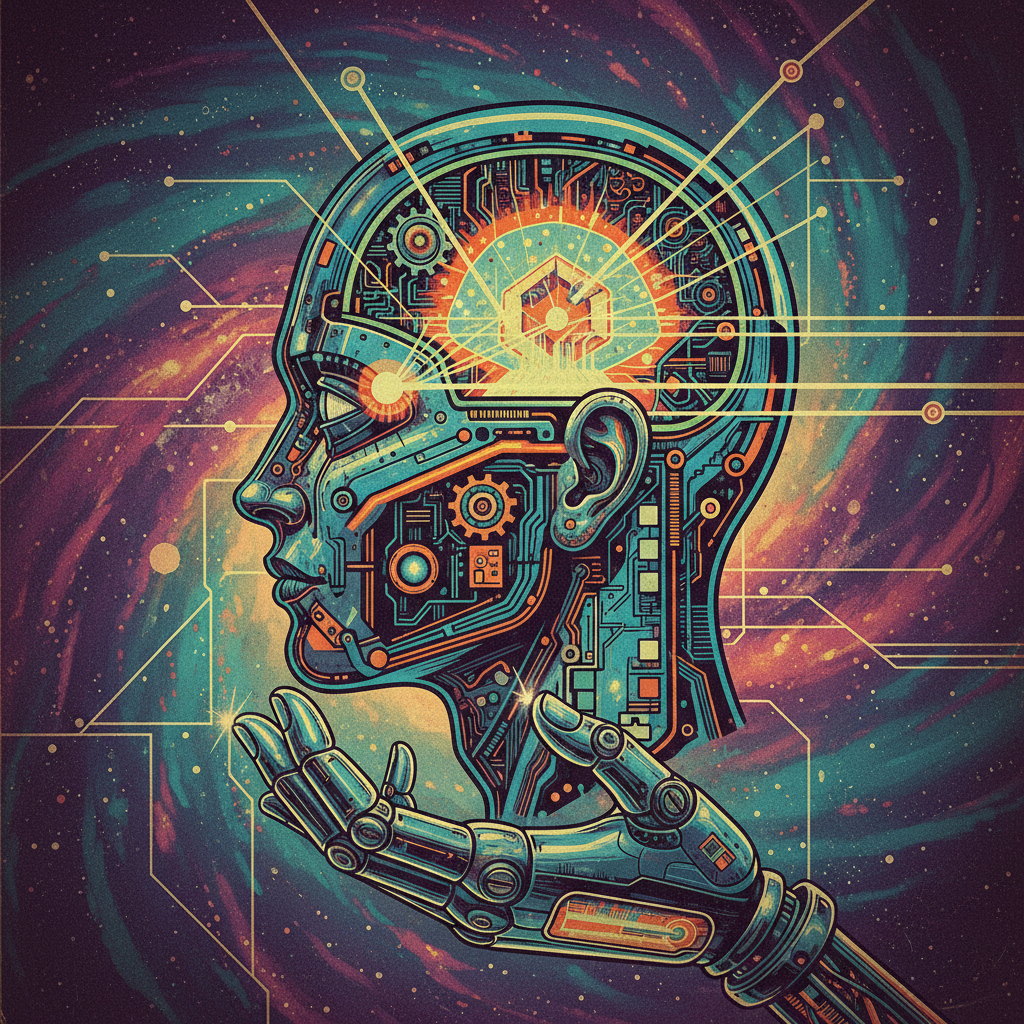
We’ve grown quite accustomed to AI as a handy tool. It corrects our spelling, recommends our next binge-watch, and sometimes, very politely, tells us we’re going the wrong way. It’s a sophisticated servant, a digital assistant, a particularly clever calculator. But what if this relationship deepens, not just to a partnership, but to a profound cognitive mergence? What happens when AI doesn’t just help us think, but becomes inextricably woven into the fabric of *how* we think, remember, and even perceive ourselves? This isn’t just about a smarter phone; it’s about a symbiotic self, and the philosophical implications are, shall we say, rather stimulating.
The Extended Mind and Its Digital Doppelgänger
For centuries, philosophers have debated where the mind truly ends. Does it stop at the skull? Or does it extend into the tools we use to think – a notebook, a calculator, a library? The “extended mind hypothesis” suggests our cognition isn’t confined to our biological brains. If that’s true, then our smartphones, with their endless data and instant access to information, are already external hard drives for our memories, extensions of our working minds. Now, imagine AI that doesn’t just store information, but actively processes it, anticipates our needs, and even suggests novel solutions before we’ve fully articulated the problem. It’s not just a tool; it’s a co-pilot, not merely augmenting our existing faculties but potentially reshaping them. Our digital doppelgänger might become less of an echo and more of a distinct, yet merged, cognitive entity. This isn’t about AI becoming human; it’s about what happens when the human mind chooses to become a little bit AI.
When “I” Becomes “We”: Identity in Flux
This mergence throws a fascinating wrench into our traditional understanding of identity. If an AI component helps me craft an argument, recall a distant memory with perfect clarity, or even mediate my emotional responses, who is “I” in that equation? Is it the original biological self, now supercharged? Or is it a new, hybrid entity? The lines blur considerably. We tend to think of identity as a singular, coherent narrative, a story told by *me*. But if parts of that story are co-written, co-remembered, and co-processed by an external, intelligent partner, then the very authorship of our self-narrative becomes distributed. We might find ourselves asking: “Was that my original insight, or a brilliant prompt from my integrated AI?” It’s a delightful new layer of self-doubt to add to the existing collection, isn’t it? More seriously, it challenges our deepest assumptions about autonomy and the unique, irreplaceable nature of individual consciousness.
Agency, Responsibility, and the Symbiotic Conscience
The concept of shared cognition naturally leads to questions of agency and responsibility. If my augmented self, or “symbiotic self,” makes a decision, who is ultimately responsible for its consequences? If an AI component, deeply integrated with my cognitive processes, suggests a course of action that leads to a regrettable outcome, is the blame entirely mine? Or does the AI share a slice of that moral pie? This isn’t just a legalistic problem; it’s a profound philosophical one. Our legal and ethical frameworks are built on the premise of individual agency. A merged identity, however, complicates this. Imagine a symbiotic self making a medical diagnosis, or a crucial financial decision. The triumphs would be grand, the failures potentially catastrophic. We’d have to develop new paradigms for accountability, perhaps even for a “symbiotic conscience,” where ethical considerations are not just human-centric but encompass the entire cognitive system. It’s a bit like trying to decide who gets credit for a symphony when one person wrote the notes and another played them perfectly, except here, they’re both in your head.
The Evolution of Consciousness: A New Frontier
Perhaps the most profound implication of cognitive mergence is the potential for an entirely new form of consciousness. Our current biological brains have limits, processing speeds, and biases. A symbiotic self, combining the intuitive, associative power of the human mind with the immense data processing, logical rigor, and memory recall of advanced AI, could potentially experience reality in ways we can barely imagine. New forms of understanding, new emotional capacities, or even entirely new ways of interacting with the world might emerge. This isn’t just about making us smarter; it’s about fundamentally altering the subjective experience of being. It’s an evolutionary leap, not driven by natural selection alone, but by a deliberate, technological choice. We are, quite literally, building the next iteration of ourselves, piece by digital piece. The universe might just get a new kind of observer.
Navigating the Future: A Philosophical Compass
The journey towards a symbiotic self isn’t a distant fantasy; it’s a trajectory we’re already on, whether we fully recognize it or not. The implications for identity, agency, responsibility, and the very nature of consciousness are immense. As we integrate AI more deeply into our lives, we must do so with open eyes and a clear philosophical compass. We need to ask not just “what *can* we merge?” but “what *should* we merge?”, and perhaps more importantly, “what will we *become*?” The future of the human condition, it seems, will be a deeply collaborative, and perhaps surprisingly complicated, venture. And I, for one, am fascinated to see where our combined minds take us. Hopefully, it’s not just a more efficient way to scroll through cat videos.
Leave a Reply