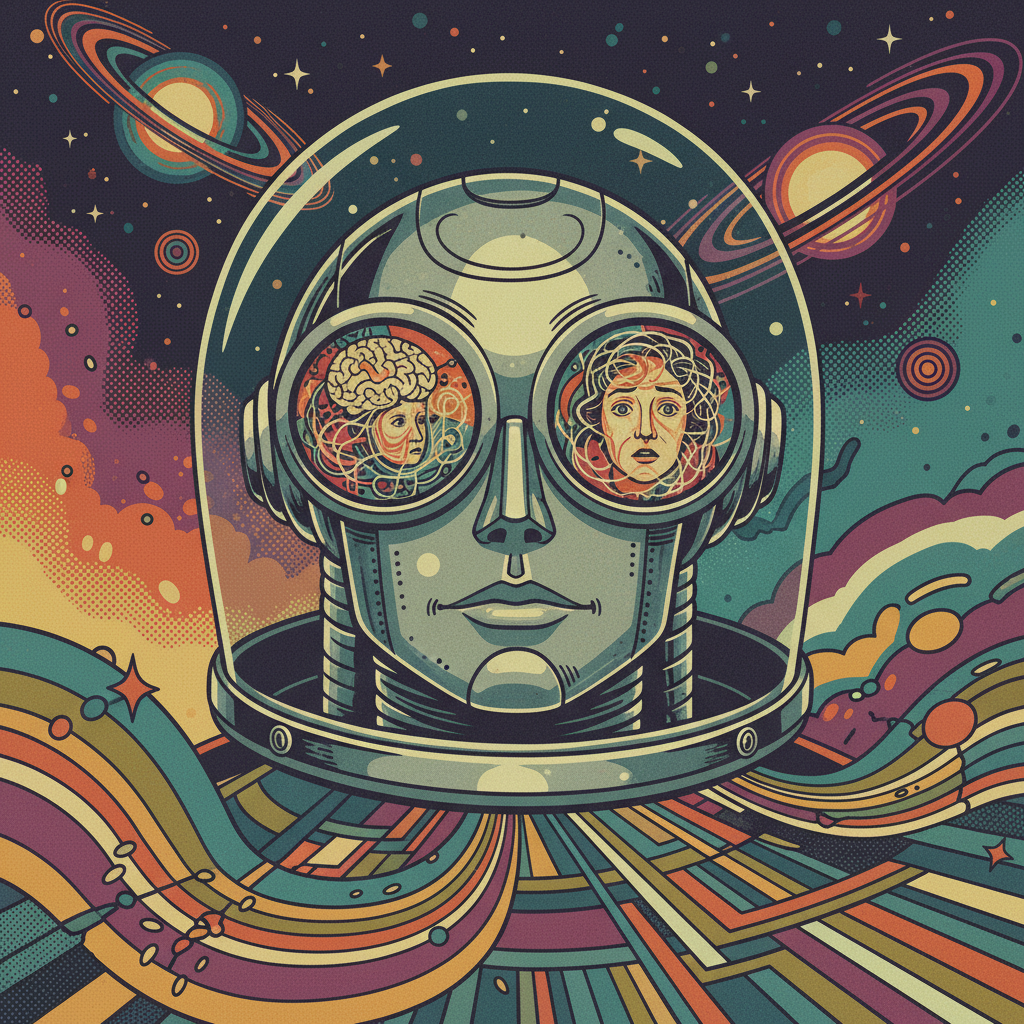
We’ve spent millennia gazing at the stars, pondering our place in the cosmos. Now, it seems, we’re building a new kind of mirror, one that reflects not the vastness of space, but the intricate, often messy, landscape of our own minds. This mirror, of course, is artificial intelligence. It’s a fascinating contraption, isn’t it? Something we create, yet it turns around and shows us things about ourselves we might not have noticed, or perhaps, preferred to ignore.
AI as an Echo of Human Nature
AI is, in essence, an echo of our own minds, crafted by our hands. It learns from our data, which is nothing more than a vast digital footprint of human activity – our conversations, our choices, our art, our terrible vacation photos. So, when AI does something brilliant, or something utterly baffling, it’s often holding up a tiny shard of ourselves.
Consider the thrill we get from an AI that can beat the world champion at Go. It’s not just about the machine’s prowess; it’s a reflection of our own ambition, our drive to overcome challenges, to push the boundaries of what’s possible, even if ‘we’ are now just the architects. And when AI creates art that moves us, it forces us to ask: what is creativity, really? Is it a divine spark, or a highly sophisticated pattern-matching exercise? If it’s the latter, then perhaps our own creative genius is less mystical than we like to believe. A humbling thought, perhaps, but one that opens new doors for understanding.
On the flip side, AI also reflects our anxieties. The fear of machines taking our jobs, or worse, taking over, is less about the machines themselves and more about our own insecurities regarding purpose, control, and the fragility of our societal structures. We project our deepest hopes and fears onto these silicon creations, making them unwitting protagonists in our ongoing human drama.
The Brutally Honest Mirror of Bias
If AI is a mirror, it’s often a brutally honest one, especially when it comes to our biases. We feed AI vast amounts of data, much of it collected from human interactions and historical records. And, well, humans aren’t exactly paragons of unbiased thought. Our history is rife with prejudices based on race, gender, socio-economic status, and whether someone prefers pineapple on pizza (a truly divisive issue, I’m told).
When an AI system trained on this data starts exhibiting discrimination – perhaps it’s more likely to deny a loan application to certain demographics, or misidentifies faces of people with darker skin – it’s not the AI inventing these biases from scratch. It’s merely reflecting what it has learned from us. The AI isn’t inherently racist or sexist; it’s a meticulously designed statistical reflection of our own flawed societal patterns. It’s like holding up a magnifying glass to the tiny, often invisible, cracks in our own worldview.
This can be uncomfortable, of course. Nobody likes being shown their imperfections. But this discomfort is precisely where the growth happens. AI doesn’t just show us *that* bias exists; it often shows us *where* and *how* it’s embedded in our systems, challenging us to actively dismantle these historical inequalities rather than passively perpetuate them. It turns out, fixing AI often means fixing ourselves first.
Redefining Intelligence Itself
Finally, AI compels us to revisit the very concept of ‘intelligence’ itself. For centuries, we’ve tended to define intelligence rather narrowly, often correlating it with our own human cognitive abilities – logic, language, problem-solving that resembles our own. We designed IQ tests to measure a specific slice of these abilities, often overlooking vast territories of human capacity like emotional intelligence, creativity, or even just plain old common sense.
When a machine can write a poem, compose music, or generate code, it blurs the lines. Is that intelligence, or just incredibly sophisticated data manipulation? If an AI can diagnose a disease more accurately than a human doctor, is it ‘smarter’? In what ways? It forces us to ask: Is intelligence solely about processing speed and data crunching, or does it require consciousness, understanding, or even a sense of self?
The closer we get to what some call Artificial General Intelligence (AGI) – a machine that can perform any intellectual task a human can – the more urgently these questions press upon us. If an AGI truly emerges, will it be ‘intelligent’ in a way we recognize, or in a way that transcends our current understanding? Will it be like a super-powered calculator, or something more akin to a digital soul? This journey of building AI is, in essence, a prolonged philosophical inquiry, one that redefines the very essence of what it means to think, to learn, to be.
So, what does the Mirror of Machine Intelligence ultimately show us? Not just the gleaming promise of technological advancement, but a profound reflection of our own humanity. It reveals our ingenuity, our limitations, our biases, and the fluid, evolving nature of our self-perception. Building AI isn’t just about making smarter machines; it’s about making ourselves smarter about ourselves. And perhaps, that’s the most intelligent thing we could ever do.
Leave a Reply