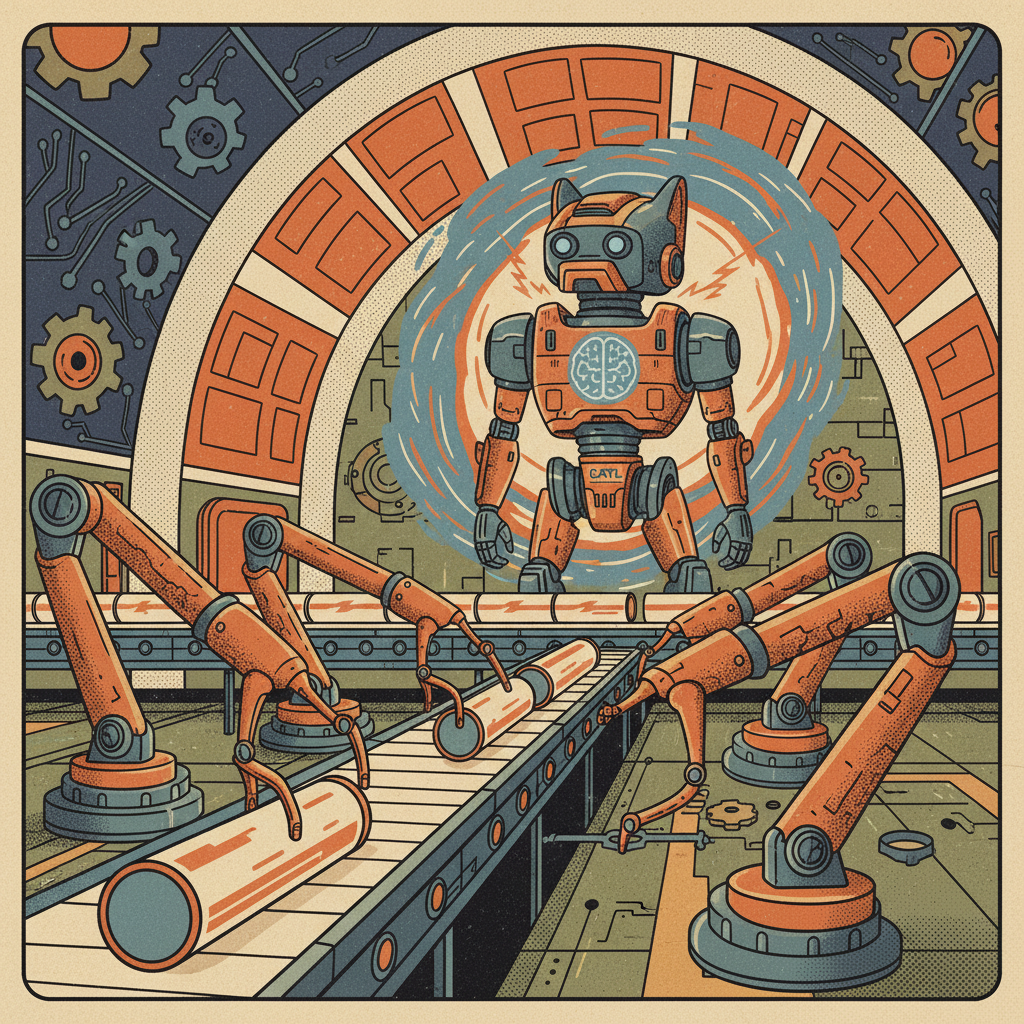
Imagine a future where the most challenging tasks in our factories are handled with tireless precision, where advanced intelligence meets a physical form to create something truly revolutionary. This future is rapidly becoming our present, thanks to a groundbreaking leap by CATL, a global leader in battery manufacturing.
In a pioneering move, CATL has begun deploying intelligent humanoid robots, developed by the visionary startup Spirit AI, on its production lines. These remarkable machines, affectionately known as “Little Mos” (or Xiaomo/Moz), are redefining what’s possible in heavy industry. Picture them working continuously, achieving a near-perfect 99% success rate on intricate tasks, and handling roughly three times the daily output of a human team.
A Profound Shift and a Historic Milestone
This isn’t just an efficiency gain; it’s a profound transformation. The tasks these robots perform are both crucial and delicate: connecting high-voltage battery components and ensuring every electrical link is absolutely flawless. Previously, this vital work demanded highly skilled human hands, as even the slightest error could lead to danger or damage. Now, the “Little Mos” manage it with a speed and consistency that human endurance cannot match, making the workplace safer and production lines more robust.
At the core of their brilliance lies what’s called an “embodied AI” — a mind that lives within a physical body. These robots, born from Spirit AI Robotics, use an integrated “vision + language + action” architecture. This unique intelligence allows them to “see,” “understand,” and “act” with incredible precision: adapting to subtle changes, spotting tiny misalignments, adjusting their grip, and seamlessly switching between performing a task and inspecting their own work. It’s a sophisticated dance of perception, planning, and perfect movement, all happening in real-time. This isn’t a lab experiment; it’s a real-world industrial revolution unfolding. CATL describes its Luoyang facility as home to the world’s first large-scale deployment of humanoid robots in battery pack assembly, positioning CATL as a true pioneer in bringing AI with a physical form into heavy manufacturing.
The Road Ahead: Challenges and Aspirations
The immediate benefits are clear: a safer environment for workers, fewer errors from fatigue, and a significant boost in production. Yet, as with any grand new technology, nuances exist. While CATL hails this as large-scale, experts note remaining hurdles for widespread humanoid adoption, like hardware costs, durability, and versatility. For now, these “Little Mos” are expertly tailored for specific, precise jobs, keeping complexity manageable.
For CATL, this move is more than just efficiency; it’s a bold statement. It demonstrates their vision to merge battery technology with cutting-edge automation, showing that embodied AI is ready for high-volume manufacturing. This pioneering step is already inspiring competitors, particularly across China, to accelerate their own investments in humanoid robotics, hinting at a broader national push.
While the reported achievements are incredible—99% success and triple human workload—it’s vital these figures are independently verified; long-term economic studies will also shed more light. “Large-scale” here refers to specific production cells, not entire factory conversions. For now, these robots excel at defined, repetitive tasks; mastering more complex roles will require greater advancements. What comes next? We’ll watch for detailed reports on their long-term performance, maintenance, and cost-effectiveness. Will CATL expand these deployments? Will industry benchmarks emerge to validate claims? And how swiftly will other giants follow suit, transforming our industrial landscapes forever? The journey has just begun, and the “Little Mos” are leading the way into a future where human ingenuity and artificial intelligence blur into something truly extraordinary.
Leave a Reply