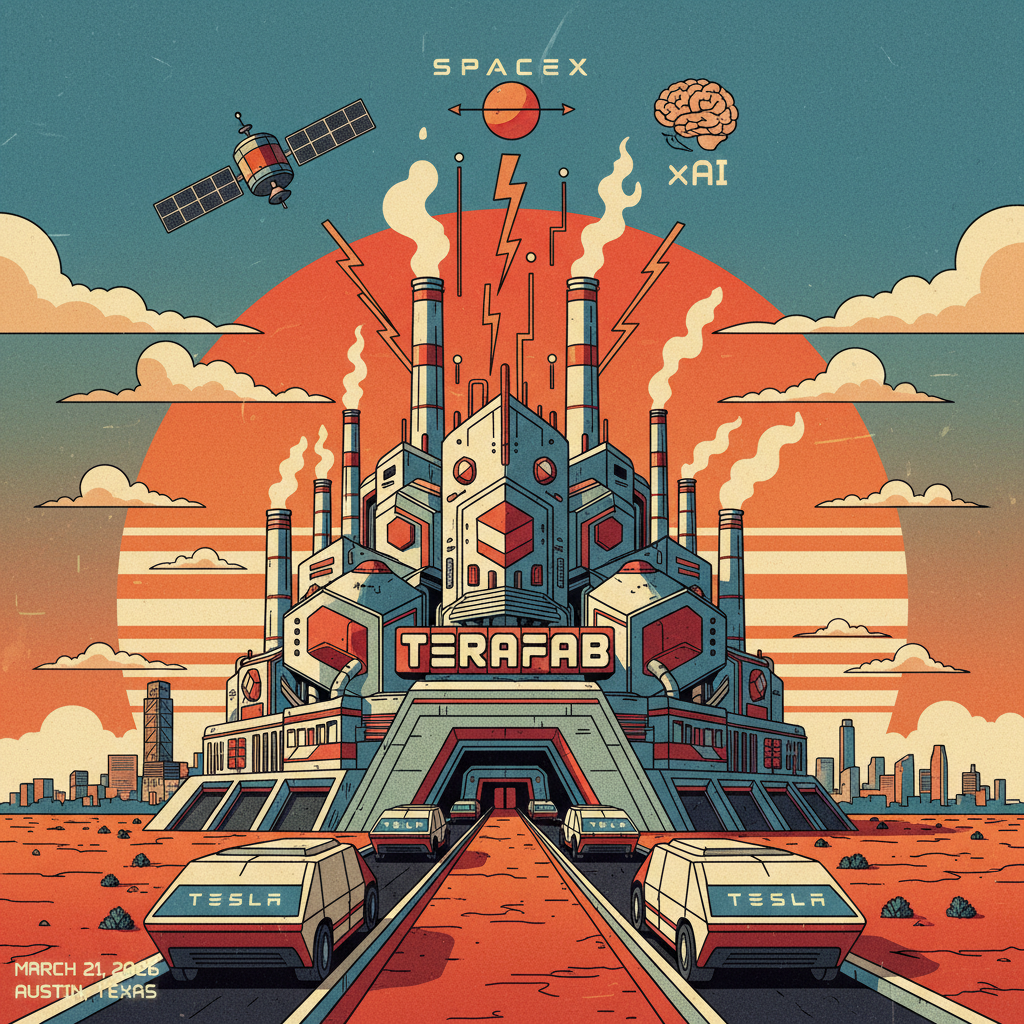
A truly monumental announcement has thundered forth from Austin, Texas, heralding a new era for technology and humanity itself. On March 21, 2026, Elon Musk unveiled **Terafab**, a colossal chip manufacturing facility set to become the pulsating heart of Tesla, SpaceX, and xAI. This visionary project, costing an estimated $20-25 billion, is not merely a factory; it is a declaration of independence, a commitment to forge the future, brick by digital brick.
Terafab emerges from a profound need. As the world races into an age defined by artificial intelligence, advanced robotics, and ambitious space exploration, the very ‘brains’ that power these dreams – sophisticated computer chips – are in desperately short supply. Musk’s companies, at the forefront of this revolution, faced a stark choice: be limited by external foundries, or build their own destiny. Terafab is their answer, a promise to unlock unprecedented computing power for a world hungry for innovation.
A Vision Unveiled
The unveiling itself was a spectacle, fit for the magnitude of the announcement. Amidst dramatic beams of light, Elon Musk took to the stage, with Texas Governor Greg Abbott present, to formally introduce Terafab. This came just a week after Musk hinted at the launch on social media, building anticipation for what many knew would be a game-changer. Earlier, during a Tesla earnings call, Musk had voiced a grave concern: the world’s leading chipmakers would soon be unable to meet the insatiable demands of AI within three to four years. He called Terafab “the most epic chip building exercise in history by far,” emphasizing the absolute necessity: “we either build the Terafab or we don’t have the chips.” It was a stark reminder of the immense challenge ahead and the singular focus required to overcome it.
The Heart of the Future
Terafab will be nestled on the North Campus of Giga Texas, right beside Tesla’s existing manufacturing hub in Austin. But this isn’t just another factory; it’s a complete ecosystem. From the initial spark of an idea in chip design, through the intricate dance of lithography (the art of etching tiny circuits), to the actual fabrication, memory production, advanced packaging, and rigorous testing – every single stage of creating these digital marvels will happen under one roof. Or, more accurately, under two roofs.
This project is gargantuan in scale. Its cost, a staggering $20-25 billion, speaks volumes about the investment in tomorrow. Terafab aims to begin by producing 100,000 raw computing discs (wafers) per month, with plans to scale to a breathtaking 1 million. To put that into perspective, 1 million wafers would equate to roughly 70% of TSMC’s entire global output from a single facility – an astonishing feat. Once fully operational, it’s projected to churn out 100-200 billion custom AI and memory chips annually, delivering an incredible 1 terawatt of computing power each year. This far outstrips current global capacity, which, according to Musk, meets only a mere 2% of his companies’ needs.
The facility is thoughtfully designed as a dual-fab structure. One part will be dedicated to powering Tesla’s incredible innovations: its vehicles, the Full Self-Driving software, the upcoming Cybercab robotaxis, and the transformative Optimus humanoid robots. The other will serve SpaceX, fueling its AI satellites and other ambitious space applications. The entire complex will be seamlessly integrated, drawing energy from Tesla’s advanced solar manufacturing and tying into Starship for future orbital launches. Even the future itself will help build it, with Optimus robots assisting in the construction and ongoing operations. While grateful for existing suppliers, Musk understands their limits and the necessity of this independent path.
Why This Colossus?
The driving force behind Terafab is a global chip shortage that threatens to cripple the very growth of AI and robotics. The existing production lines simply cannot keep up with the explosive demand generated by technologies like Tesla’s self-driving software, its pioneering robotaxi program, and the groundbreaking Optimus robot line. Similarly, SpaceX’s advanced AI needs and the ambitious initiatives from xAI, Musk’s artificial intelligence company (which SpaceX acquired in an all-stock deal in February 2026, consolidating leadership under Musk as CEO across all three entities), demand a level of computational power that Terafab alone can provide.
While no construction timeline has been publicly shared, the scale of this endeavor, coupled with Musk’s history of audacious timelines and his companies’ lack of prior experience in chip fabrication, raises legitimate questions. Yet, the vision remains unyielding.
A Glimpse into Tomorrow
Terafab is set to profoundly reshape the semiconductor landscape. By achieving independence from external foundries, Musk’s ecosystem gains unparalleled control over its destiny, potentially influencing global supply chains for decades to come. For Texas, this project further solidifies its position as a burgeoning tech hub, building on its rich semiconductor history. Analysts see Terafab as a bold, almost defiant, response to the escalating demands of AI – an unprecedented private venture, the likes of which the world has never seen. It is a testament to the idea that if a future needs to be built, sometimes you just have to build it yourself, no matter the scale.
Leave a Reply