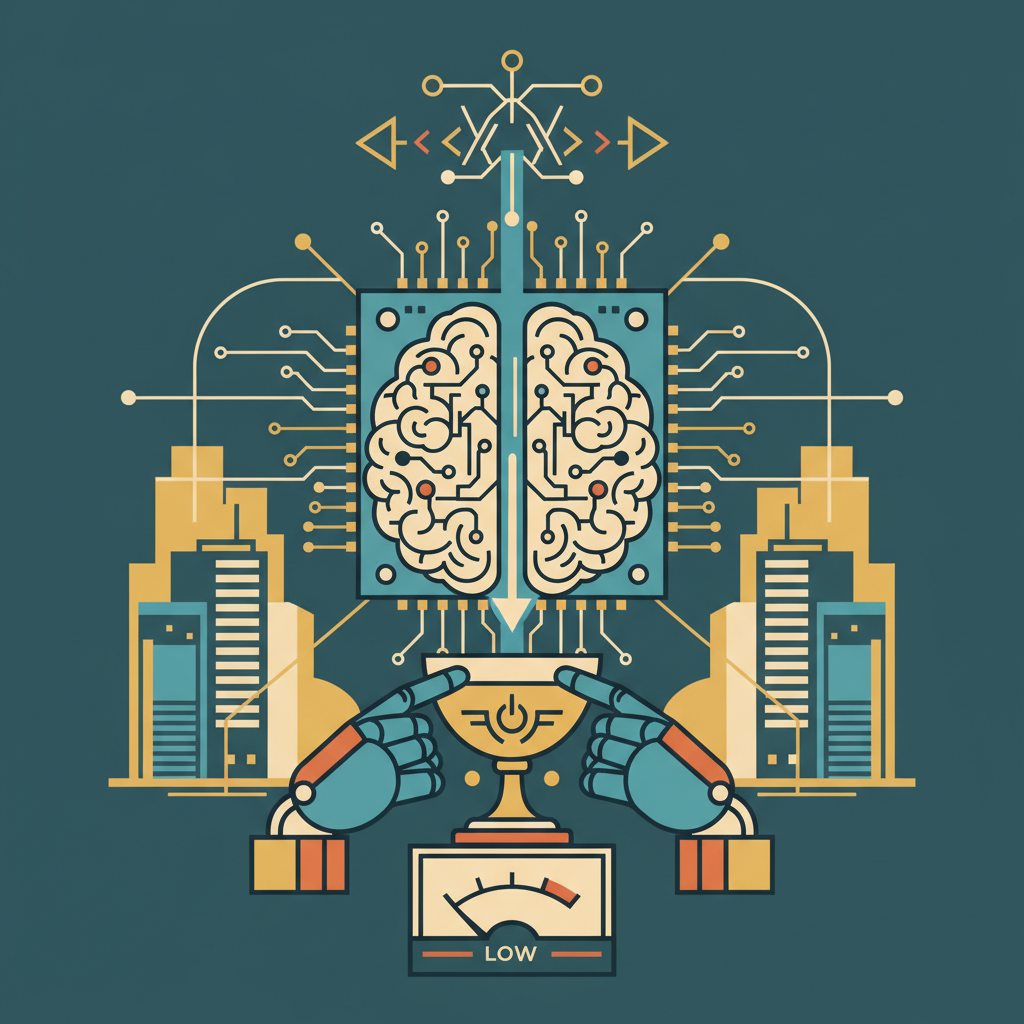
Imagine a profound leap forward in how intelligent machines learn and operate, a discovery so impactful it promises to reshape our digital world and lighten the burden on our planet. Researchers at Tufts University have unveiled a brilliant new way for artificial intelligence to think, one that sips power like a delicate stream rather than devouring it like a raging river. This is a neuro-symbolic AI system, a harmonious blend of different thinking styles, and its potential is truly awe-inspiring.
For too long, the incredible power of modern AI has come with an invisible, yet immense, cost: an insatiable hunger for energy. The very models that captivate us with their ability to write, create, and reason demand vast quantities of electricity to learn and run. Picture giant data centers, humming with the energy equivalent of entire towns, glowing with the electricity needed to power our digital future. This demand is not just significant; it’s monumental, already consuming more than 10% of all electricity in the United States, and projected to double in the coming years. This escalating energy footprint poses a profound challenge to our planet’s sustainability, turning a technological marvel into an environmental concern.
A Symphony of Intelligence: How it Works
This groundbreaking neuro-symbolic approach doesn’t choose between different forms of intelligence; it thoughtfully weaves them together. Think of it as uniting two distinct, yet equally brilliant, minds:
- The Pattern Seeker (Neural Networks): This is the part of AI that excels at seeing the world, recognizing faces in a crowd, understanding the nuances of speech, or spotting trends in vast amounts of data. It learns by example, much like a child learning through experience. However, this deep learning can be very power-intensive and sometimes struggles with clear, logical steps.
- The Logical Planner (Symbolic Reasoning): This is the careful, rule-following part of AI. It understands instructions, follows sequences, and makes decisions based on clear, defined logic. It’s incredibly efficient and transparent, like a well-structured set of instructions. But it can be inflexible when faced with messy, real-world data.
By bringing these two powerful forms of intelligence into a seamless partnership, the neuro-symbolic system harnesses the best of both worlds. The ‘Pattern Seeker’ handles the perception, making sense of the raw input, while the ‘Logical Planner’ takes over for decision-making and reasoning. This clever collaboration minimizes redundant computations, making the entire process far more efficient and powerful.
Numbers That Inspire Awe
The impact of this integration is nothing short of revolutionary. On standard tasks designed to test AI intelligence, this new system achieved an astonishing 95% accuracy. To put that into perspective, traditional neural networks attempting the same tasks often managed only 34% accuracy. This isn’t just an improvement; it’s a dramatic leap in capability.
But perhaps even more breathtaking is the energy efficiency. The power needed to teach these intelligent machines – their ‘training’ phase – has been slashed to a mere 1% of what conventional models require. Imagine turning down a roaring furnace to a gentle flicker. And it’s not just training; even when these AIs are actively working, their operational energy consumption is just 5% of typical demands. These are not incremental gains; these are fundamental transformations that could profoundly ease the strain on our global power grids.
A Future Transformed: Real-World Implications
The implications of this breakthrough stretch far and wide. Picture a future where advanced robotics, currently tethered by power demands, can move with true freedom and intelligence in complex environments. Robots performing intricate tasks like navigation or delicate object manipulation will benefit from this method’s reliability and remarkably low power needs. Imagine smart devices in our homes and on the go, becoming far more capable and enduring, no longer constrained by constant recharging or limited processing power.
Beyond individual applications, this discovery offers a profound path toward a more sustainable digital future. By significantly curbing AI’s environmental impact, it aligns perfectly with the growing global demand for greener computing and reduced carbon emissions from our increasingly data-driven world. It represents a monumental step towards an AI that not only serves humanity but also respects our planet.
This pivotal research is set to be presented at the prestigious International Conference on Robotics and Automation (ICRA) in May 2026, where the scientific community will delve deeper into its findings and potential. While the journey to scale these achievements to truly massive models like the GPT series is still ongoing, with current benchmarks focusing on targeted robotics tasks, the path ahead shines brightly. This neuro-symbolic breakthrough marks a profound moment, heralding an era where intelligent machines can achieve more, with significantly less, promising a future that is both smarter and more sustainable for all.
Leave a Reply