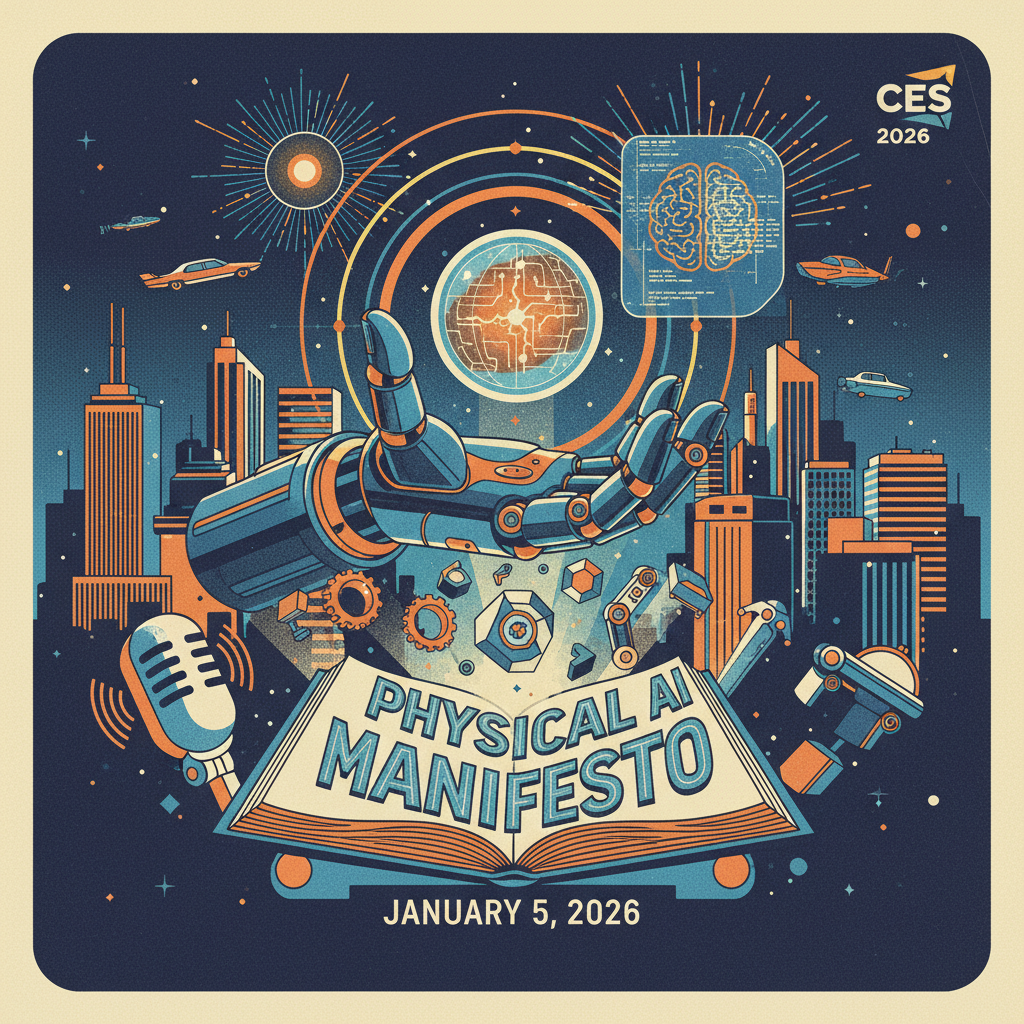
A profound declaration echoed across the technological landscape at CES 2026: NVIDIA CEO Jensen Huang announced that the world has arrived at its “ChatGPT moment for physical AI.” This wasn’t merely an update; it was the unveiling of a future where machines will not just process data, but truly understand, reason, and act within our physical world. On January 5th, a new chapter began, promising to reshape autonomous systems and robotics as we know them.
The Heart of the New Intelligence: Rubin and Alpamayo
At the core of this monumental shift are two pioneering platforms: Rubin and Alpamayo. Imagine the gates of advanced AI being flung open to more creators and industries. That’s the promise of **Rubin**, NVIDIA’s first “extreme-codesigned, six-chip AI platform.” Now in full production, Rubin isn’t just powerful; it’s revolutionary in its efficiency. It dramatically slashes the cost of AI computations, making large-scale AI deployment far more economical than ever before. This breakthrough removes a critical barrier, allowing the dream of widespread AI adoption to become a tangible reality for countless applications.
But what good is efficiency without intelligence? This is where **Alpamayo** enters the scene, described as “the world’s first thinking reasoning autonomous AI.” This isn’t just another model; it’s a dedicated family of reasoning models designed with autonomous vehicles in mind. Unlike previous systems that handled data in separate steps, Alpamayo processes information from the very moment a camera sees something to the instant a vehicle needs to react. It’s an end-to-end intelligence, empowering vehicles to make complex, real-time decisions, navigating our world with an unprecedented level of understanding.
Physical AI: Bringing Intelligence to Life
This revolution isn’t confined to screens or data centers. **Physical AI** marks a fundamental paradigm shift, moving intelligence beyond the purely digital realm. These systems are designed to be “grounded in the physical world,” seamlessly integrating NVIDIA’s technologies for training, inference, and real-world application. The key to this miraculous bridge between the digital and physical lies in a sophisticated process: systems learn and hone their skills in richly detailed virtual environments, then, once perfected, they are unleashed to interact with reality itself.
At the very center of this grand endeavor is **Cosmos**, NVIDIA’s open world foundation model. Think of Cosmos as the universal language interpreter for the physical world. It learns from an immense tapestry of internet-scale video, real driving and robotics data, and intricate 3D simulations. Cosmos creates a unified understanding of our world, harmonizing language, images, 3D models, and the very actions machines take. This profound comprehension allows physical AI systems to perform essential skills like generating new solutions, reasoning through complex scenarios, and planning precise movements through space.
Witnessing the Future: Real-World Applications
The impact of physical AI is not a distant dream; it’s already materializing across diverse sectors. Jensen Huang revealed a groundbreaking partnership with **Mercedes-Benz**, integrating NVIDIA’s advanced driver assistance software into the new CLA model. Public demonstrations have already shown this vehicle gracefully navigating the intricate streets of San Francisco, adeptly avoiding pedestrians and executing turns with remarkable precision. It’s a glimpse into a future where our vehicles aren’t just transport, but trusted, intelligent companions.
Beyond our roads, the robotics world is being fundamentally transformed. Global industry leaders are embracing NVIDIA’s robotics stack to introduce a new generation of AI-driven robots. Esteemed partners like Boston Dynamics, Caterpillar, Franka Robotics, Humanoid, LG Electronics, and NEURA Robotics are at the forefront. **Caterpillar**, for instance, is expanding its collaboration to infuse advanced AI and autonomy into heavy construction and mining equipment, promising safer and more efficient operations. This broader ecosystem is moving beyond single-task, hard-to-program machines, ushering in an era of “generalist-specialist” robots capable of rapidly learning and mastering multiple complex tasks.
The Path Ahead for Autonomous Vehicles
While the vision for autonomous vehicles is clear and compelling—Huang confidently stated, “I have no doubt that this will become one largest robotics industries”—the journey requires patience and perseverance. NVIDIA’s plans to trial a robotaxi service are set for 2027, a realistic acknowledgment that widespread autonomous vehicle adoption remains some years away. Yet, Huang’s long-term aspiration burns bright: a future where “eventually every car and every truck will operate autonomously,” promising unparalleled safety and efficiency.
NVIDIA’s strength in this endeavor lies in its unparalleled simulation capabilities. While the company may not have the largest real-world autonomous vehicle training data sets, it compensates by generating vast quantities of highly realistic simulated data. The current frontier in achieving full autonomy involves the seamless processing of real-time video with minimal delay, all while sophisticated models run efficiently on compact, power-friendly hardware. The 2026 keynote firmly positions NVIDIA at the intersection of three critical domains: accelerated computing, artificial intelligence, and physical robotics. It’s a convergence that is not just evolving technology, but fundamentally reshaping how machines will interact with the very fabric of our physical world, a marvel to behold.
Leave a Reply