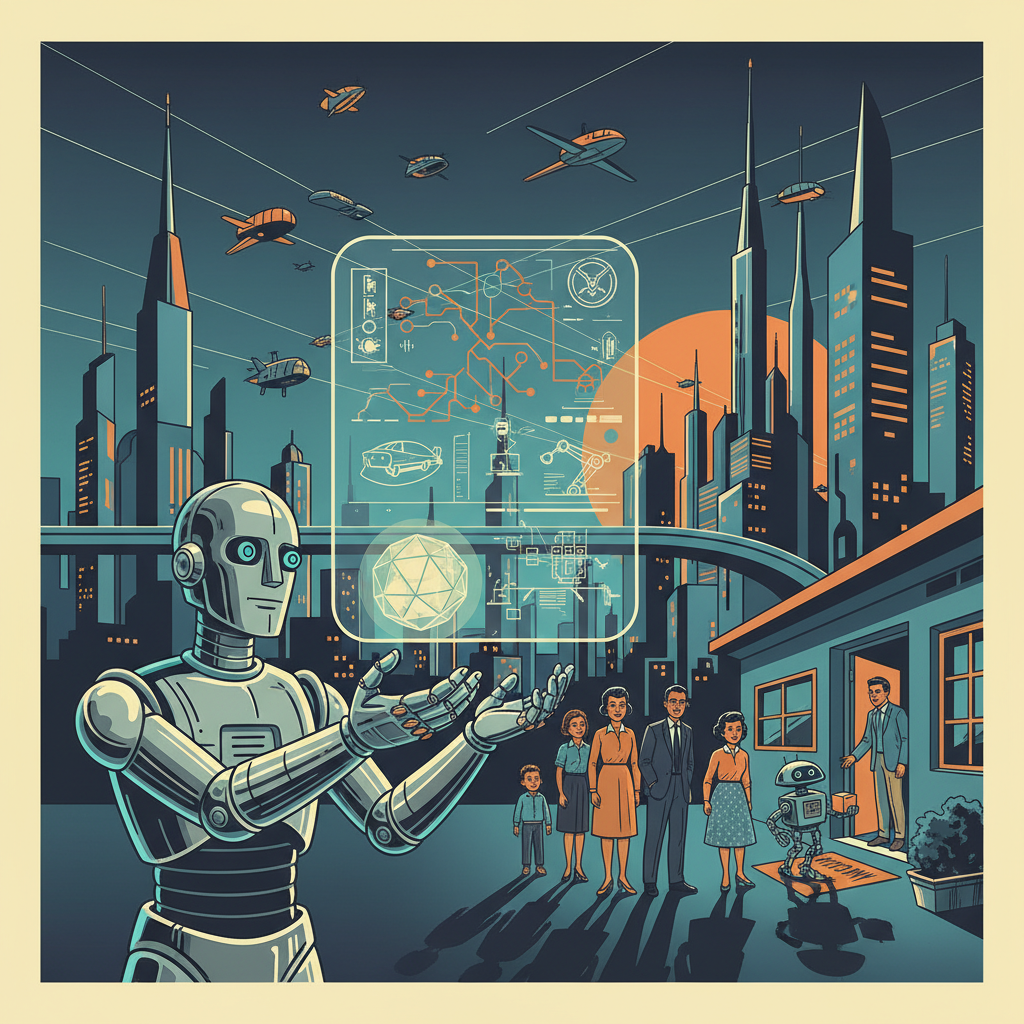
January 2026 will forever be etched in history as a month when the world witnessed a profound shift. It was a time when the dreams of science fiction began to take their first confident steps into our reality. Across the globe, from bustling tech conferences to quiet research labs, AI and robotics weren’t just making headlines—they were building a new future, moving from the drawing board to our very doorsteps.
This wasn’t just about faster computers; it was about intelligence gaining a body. It was about robots learning to understand and interact with our complex physical world. The grand stage for much of this unveiling was CES 2026, where the spotlight shone brightly on remarkable hardware innovations and powerful new alliances, all signaling a breathtaking acceleration toward a future where AI and robots are an integral part of our daily lives.
Nvidia’s Vision: Bringing Intelligence to Life
At the heart of many of these advancements was Nvidia, a company pushing the boundaries of what’s possible. They introduced breakthroughs that enable what’s called “physical AI.” Imagine an artificial intelligence that doesn’t just process data on a screen, but truly understands its surroundings—using cameras and sensors to see, hear, and feel, then reasoning about the laws of physics to perform intricate tasks in the real world. This is physical AI, and Nvidia’s technology is making it a reality.
Partnerships blossomed, showcasing this new era. Boston Dynamics unveiled updated versions of their awe-inspiring Atlas humanoid robots, now powered by Nvidia’s advanced processors and simulation platforms. These robots demonstrated enhanced movement, an incredible ability to learn new tasks, and a level of autonomy that was once unthinkable. From Caterpillar’s self-driving construction machines to robots designed for factories, warehouses, and even homes by companies like Franka Robotics, Humanoid, LG Electronics, and NEURA Robotics, the promise of intelligent machines was everywhere.
Nvidia also introduced Alpamayo, an open AI model designed to give autonomous vehicles human-like decision-making abilities. This aligns perfectly with predictions that 2026 will be the year of practical “agentic AI”—systems capable of independently handling complex, multi-step tasks, much like a highly efficient human intern.
Humanoid Robots: A Step Closer to Us
CES 2026 truly became a spectacle of humanoid achievements. Hyundai Motor Group’s Atlas robot made its public debut, not just as a marvel of engineering but as a recipient of a top robotics award. Hyundai revealed ambitious plans to integrate Atlas into industrial settings, highlighting its multi-directional joints, its astonishing ability to learn a new task in just one day, and its self-charging capability, promising continuous operation for production lines. This vision of a hyper-efficient future even boosted Hyundai’s share price, reflecting widespread optimism.
But Atlas wasn’t alone. 1X’s Neo robots shifted their focus from flashy announcements to real-world deployments, embarking on customer deliveries for homes and workplaces. UBTech’s Walker S2, with over a thousand units already produced, captured attention with Airbus’s plans to test them in aircraft assembly—a clear sign that humanoids are not just for factories, but for the most intricate manufacturing environments. With orders reaching hundreds of millions of dollars, the scale of this revolution is undeniable.
Investor confidence soared, underscored by Mobileye’s acquisition of Mentee Robotics for a staggering $900 million. Videos from CES showed these machines performing incredible feats, with Elon Musk predicting “shockingly human” capabilities. Witnessing Hyundai and Boston Dynamics robots parking, charging, and interacting with their environment offered a powerful glimpse into the world that is rapidly unfolding.
The Power Behind the Progress: Chips and Consolidation
Beneath the surface of these remarkable robots lies a fierce battle for the very “brains” of AI. Nvidia further solidified its dominance by acquiring Groq’s powerful inference technology for an astonishing $20 billion. This strategic move extends Nvidia’s control from training AI models to enabling them to perform real-time, instantaneous “thinking” with incredible energy efficiency. This acquisition is hailed as one of the largest in the semiconductor world since the AI boom, showing just how crucial this real-time processing capability is.
Amidst these seismic shifts, established players like Teradyne, a leader in industrial automation, are scrutinizing their strategies, recognizing that their future growth hinges on adapting and gaining market share in this rapidly evolving robotics landscape.
Beyond the Machines: AI’s Broader Canvas
The impact of AI in January 2026 extended far beyond the realm of physical robots. Agentic AI, those independent “intern” systems, continued to prove their worth, with enterprises eagerly anticipating significant returns on investment. In the world of science, AI became a powerful partner: Google DeepMind’s AlphaEvolve, powered by their Gemini AI, started generating new algorithms, while AI lab assistants began automating complex experiments, accelerating discovery.
Globally, competition intensified, with Chinese open-source AI models demonstrating reasoning capabilities that rivaled leading Western models. Funding poured into the sector, with Anthropic eyeing a staggering $350 billion valuation, fueled by impressive revenue growth. Microsoft pushed the boundaries even further, exploring hybrid quantum-AI for drug discovery and materials science, hinting at a future where computing power reaches unprecedented levels.
However, the “AI Wild West” era of unchecked generative tools began to draw to a close as regulations tightened around deepfakes and the use of certain AI models. This move signals a growing understanding of the need to responsibly manage these powerful technologies.
A Glimpse into Tomorrow
These monumental developments firmly establish 2026 as a breakout year, where the immense power of AI software is seamlessly blending with the practical capabilities of robotics hardware. While concerns about the impact on the workforce, such as those expressed by Hyundai autoworkers, rightly persist, the overarching narrative is one of profound economic integration and transformative change.
We stand at the precipice of a future where intelligent machines are not just tools, but active participants in shaping our world. January 2026 was not just a month of technological advancements; it was a testament to human ingenuity, unveiling a vision of tomorrow that is both inspiring and awe-inducing.
Leave a Reply