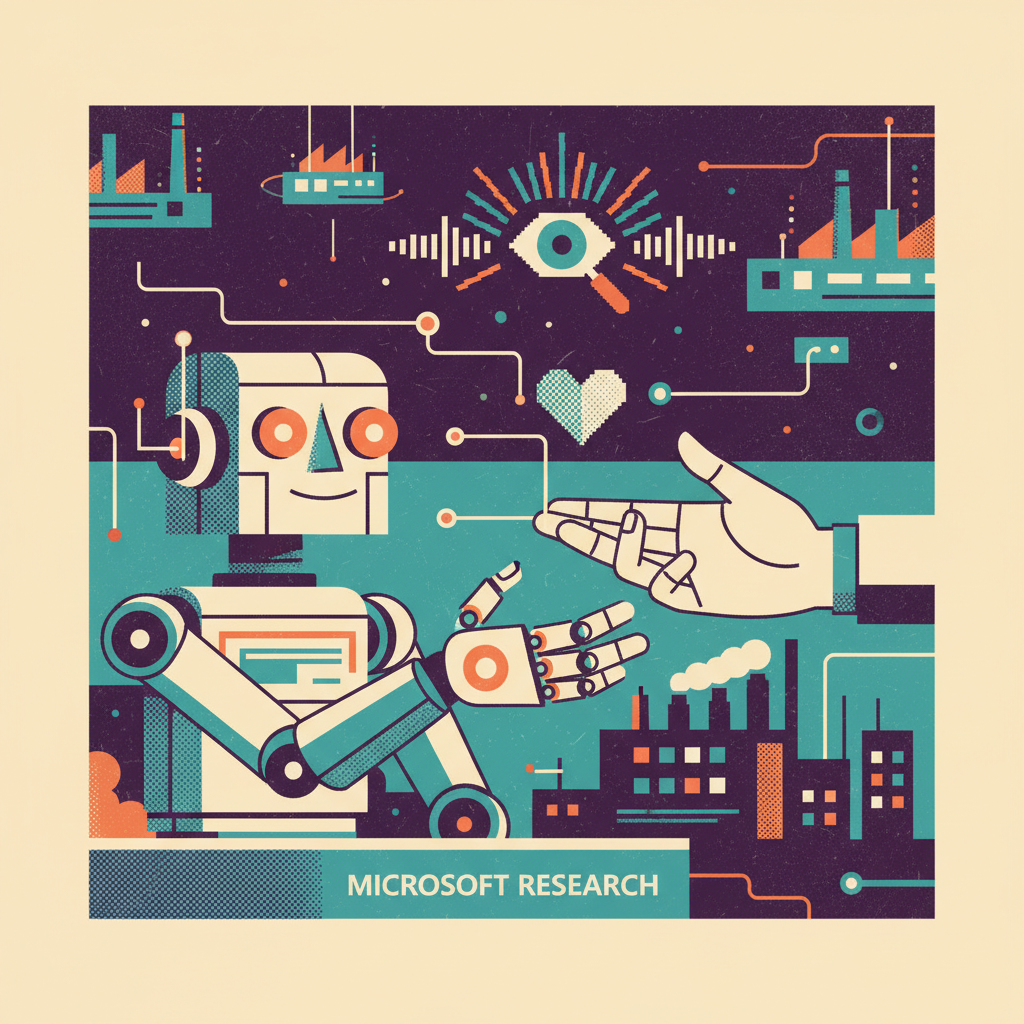
Imagine a future where robots aren’t just tireless machines confined to factories, but intelligent partners capable of understanding you, seeing the world, and even feeling with a gentle touch. This long-held dream is now taking a significant leap forward, thanks to a remarkable new development from Microsoft Research.
They’ve unveiled Rho-alpha, a pioneering “master brain” for robots, the first of its kind from Microsoft’s advanced Phi series. Rho-alpha empowers robots to interpret natural language instructions – just like you’d speak to a person – and then combine what they see with what they feel through touch, to execute surprisingly complex tasks with two hands, even in dynamic, unpredictable environments.
## Beyond the Factory Walls: A New Era of Adaptability
For decades, robots excelled only in highly controlled factory settings, following rigid scripts for repetitive tasks. But ask them to find a tool in a cluttered space or gently insert a delicate plug where vision might be obscured, and they falter. Traditional robots lack the adaptability for our messy, real world.
Rho-alpha fundamentally changes this. It takes “vision-language-action” (VLA) models – systems that see, understand language, and act – and adds a crucial dimension: touch. This makes it a “VLA+” model. Imagine a robot that not only sees a plug and understands “insert the plug behind the desk,” but can *feel* when it’s aligned correctly or encountering an obstruction, adjusting its movements instantly. This sense of touch is profound, enabling precise tasks like inserting cables, packing a toolbox, or manipulating switches, knobs, and wires using both arms. Microsoft sees Rho-alpha as a vital step toward “physical AI,” where smart systems truly perceive, reason, and act as collaborators with humans in the physical world.
## Learning Like Never Before: Virtual Worlds and Human Guidance
How does Rho-alpha learn such advanced skills? Its innovative training pipeline largely occurs within a sophisticated virtual universe. This digital playground, powered by Nvidia’s Isaac Sim, generates vast amounts of “synthetic data” through reinforcement learning. It’s like a robot practicing millions of scenarios in a hyper-realistic simulation, making mistakes and learning from them without ever needing real-world objects. This clever approach overcomes the immense challenge of gathering enough diverse real-world data.
Learning doesn’t stop once deployed. Rho-alpha continuously improves through human feedback. If the robot makes a mistake, a human operator can intuitively guide its actions using 3D input devices to correct errors. This “human-in-the-loop” process allows the robot to adapt to new situations and even learn personal preferences over time, refining its skills much like a student learns from a teacher.
## The Intelligent Core: How Rho-alpha Thinks and Acts
At its core, Rho-alpha’s architecture is ingeniously designed. It separates the “big picture” thinking – understanding commands and task planning (derived from Phi language models) – from the rapid, precise movements of its motors. This split means that for quick, delicate tasks, especially those relying on touch, the robot doesn’t have to wait for its larger brain to process every tiny detail. It can react instantly to tactile feedback, which is crucial when vision is blocked or when handling slippery objects. This sophisticated separation significantly improves upon earlier models that struggled with such real-world complexities.
## The Future Unfolds: Availability and Impact
This groundbreaking technology is now becoming accessible. Microsoft is launching Rho-alpha through its Research Early Access Program, inviting robotics manufacturers and developers to test it on their hardware. A detailed technical paper is forthcoming, and broader access will follow through the Microsoft Foundry platform. With ongoing evaluations on advanced dual-arm setups and humanoid robots, Microsoft is poised to fundamentally transform human-robot collaboration, bringing us closer to a future where intelligent machines are truly our partners.
Leave a Reply