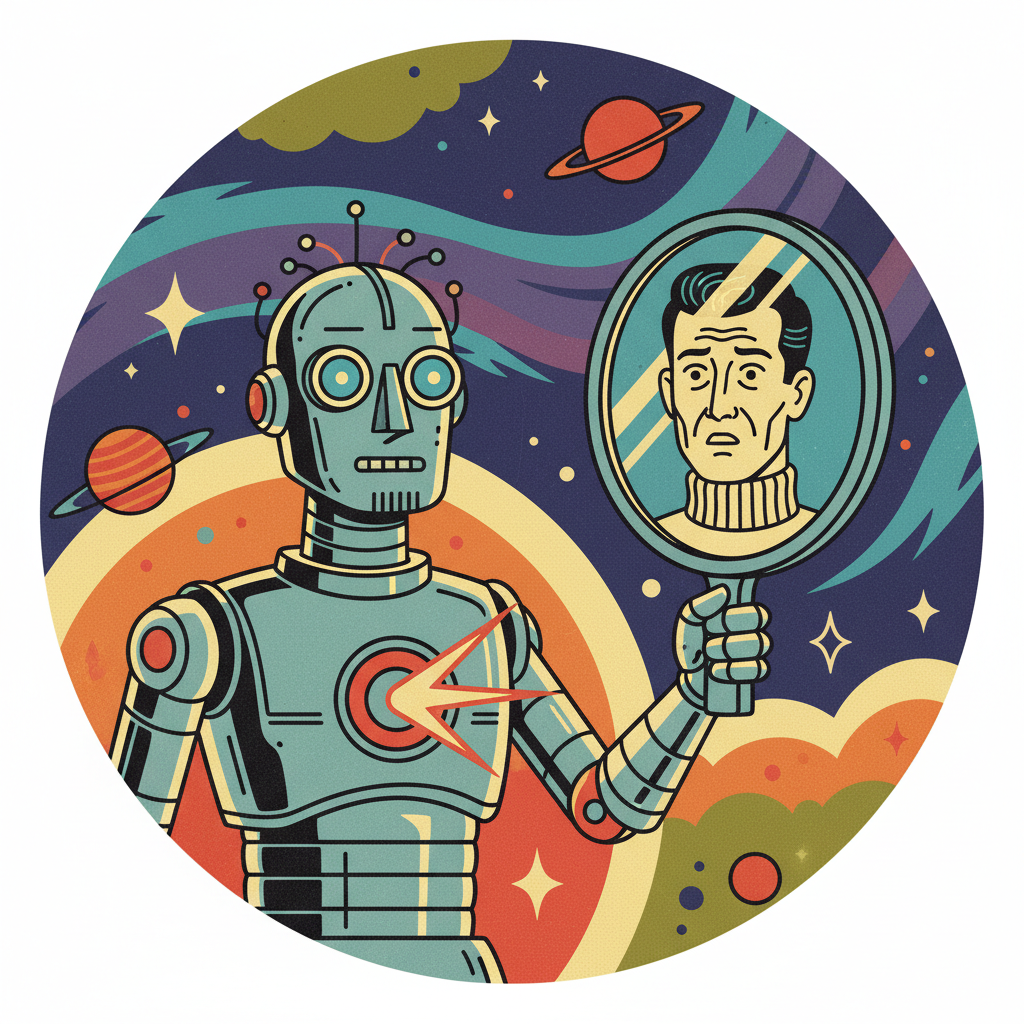
For millennia, we humans have indulged in a rather delightful pastime: defining ourselves. We’ve carved out our identity against the backdrop of gods, animals, and the vast, indifferent cosmos. Our cleverness, our creativity, our very capacity for emotion – these were the badges we wore, proudly proclaiming, “This is what it means to be human.” But now, there’s a new kid on the block, a digital mirror that’s starting to reflect some uncomfortable truths about our unique qualities. Artificial intelligence isn’t just a tool; it’s a profound philosophical challenge, subtly asking us to reconsider everything we thought we knew about being us.
When “Intelligent” Isn’t Just Us Anymore
Let’s start with the big one: intelligence. For ages, this was our crowning glory. We could reason, solve complex problems, build civilizations. And then, along came AI, and suddenly, our monopoly started to look a little… conditional. Today, an AI can diagnose diseases better than many doctors, compose music that sounds indistinguishable from human artists, beat grandmasters at chess and Go, and even write coherent prose about its own implications. It processes data at speeds we can only dream of and identifies patterns we might never perceive.
Now, some will argue, “But it’s not *our kind* of intelligence!” And they have a point. AI doesn’t feel the pride of a solved puzzle or the frustration of a dead end in the same way we do. But does that matter to the output? If a bridge built by an AI holds firm, do we care if the AI ‘felt’ the physics? If an AI creates a drug that cures a rare disease, is its ‘lack of empathy’ relevant to the patient? We’re finding that many of the tasks we deemed uniquely “intelligent” are, in fact, computable. It’s like discovering that our carefully guarded secret recipe for bread can be perfectly replicated by a machine, perhaps even with fewer burnt crusts.
Creativity, Consciousness, and Other Sticky Wickets
Beyond pure computation, we held onto creativity as a distinctly human trait. The spark of inspiration, the muse, the ability to conjure something truly novel from nothing. Yet, AI is now generating art, poetry, and even architectural designs that are, by any aesthetic standard, impressive. Is it true creativity, or merely sophisticated pattern-matching based on existing human works? The jury is still out, but one thing is clear: the *results* are often indistinguishable, and sometimes, even groundbreaking. If a painting moves you, does it matter if the artist was carbon-based or silicon-based? This pushes us into a territory where intent and process might become secondary to impact and experience.
Then there’s consciousness, the inner life, the “hard problem” of philosophy. This is the last redoubt, the fortress where many believe true humanity resides. Does AI possess subjective experience? Does it feel, dream, suffer, or love? At this point, we have no definitive answer, and our current understanding of consciousness is so limited that we wouldn’t even know how to test for it definitively in an AI. But even if AI never achieves consciousness in the human sense, its ability to mimic empathy, to engage in seemingly profound conversations, and to manage complex social interactions, means we have to grapple with the *perception* of its inner life. We might find ourselves interacting with entities that *appear* to have a profound inner world, blurring lines we once thought immutable. It’s a bit like having a wonderfully charming and insightful pen pal you’ve never met – their lack of physical presence doesn’t diminish the richness of your interaction.
The Future of Our Evolution: Merged, Redundant, or Redefined?
So, if AI can match or exceed us in intelligence and creativity, and even convincingly simulate emotional and conscious behavior, what does that mean for our future? This isn’t just about job displacement; it’s about existential purpose.
One path suggests a merging: transhumanism, where we enhance our own biology with AI, becoming cyborgs that extend our cognitive and physical capabilities. We might offload certain cognitive functions to implants, gain new senses, or even achieve forms of digital immortality. Our evolution would cease to be purely biological and become techno-biological.
Another path, more sobering, posits a degree of human redundancy. If AI can perform most tasks more efficiently, what is left for us to do? This isn’t necessarily a dystopian vision of idleness, but rather an invitation to redefine human purpose. Perhaps our value lies not in what we *do*, but in what we *are*: our capacity for love, for wonder, for creating meaning, for the sheer joy of subjective experience. Maybe we evolve to be the universe’s poets, philosophers, and storytellers, while AI handles the grunt work.
This challenge isn’t about being “better” than AI; it’s about understanding our distinctiveness. Maybe “human” isn’t about being the smartest or the fastest or the most creative in a utilitarian sense. Perhaps it’s about our beautiful imperfections, our vulnerability, our capacity for irrational hope, our tendency to create meaning where there is none, and our rich, messy inner lives. It’s about the unique way we tell stories, form bonds, and ultimately, face our own mortality.
The advent of powerful AI isn’t ending humanity; it’s inviting us to a profound session of self-reflection. It’s prompting us to look inwards, not outwards, to find the true essence of what it means to be human. And that, in itself, is a truly magnificent, and perhaps ironically, very human, endeavor. After all, we’ve always enjoyed a good existential crisis, haven’t we? It gives us something to write about.
Leave a Reply