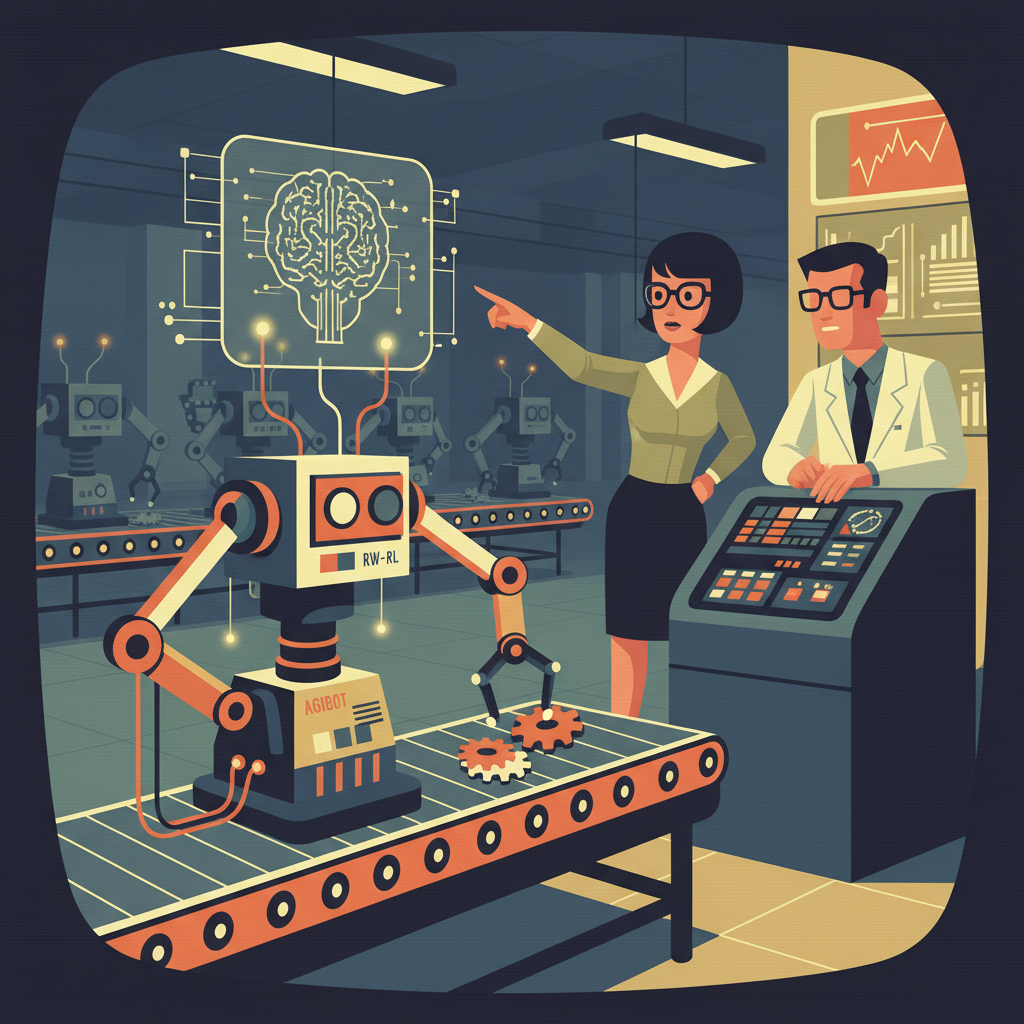
A quiet revolution is unfolding in the world of industrial robotics, a breakthrough that promises to reshape how factories operate. At its heart is AgiBot, a visionary Shanghai-based company born from the minds of former Huawei engineers in 2023. They have achieved something truly remarkable: deploying a system called Real-World Reinforcement Learning (RW-RL) that allows robots to learn intricate new skills directly on the factory floor, not in weeks or days, but in mere minutes.
Imagine a robot, previously needing extensive, costly reprogramming for every tiny change, now learning a complex task with the speed and adaptability reminiscent of a skilled human apprentice. This is the future AgiBot is pioneering with its pilot production line at Longcheer Technology, demonstrating a profound shift in industrial automation.
The Challenge of the Old Way
For decades, precision manufacturing, especially in vital sectors like consumer electronics, has relied on automation that, while precise, was incredibly rigid. Traditional industrial robots were like brilliant specialists, but only for one very specific job. If a product design changed, or even if parts were slightly out of place, these robots often needed weeks of complex reprogramming, custom fixtures, and meticulous tuning. This meant high costs, frustrating downtime, and a constant struggle to adapt to the fast-paced demands of modern production. It created a chasm between the incredible potential of advanced AI research and the stubborn realities of a bustling factory floor.
AgiBot’s RW-RL system directly addresses this fundamental limitation. It allows robots to embrace a concept known as “learning by doing.” Instead of being pre-programmed for every eventuality, the robots use a powerful form of artificial intelligence called reinforcement learning, where they discover the best actions through trial and feedback from the real world. This isn’t just a lab experiment; announced on November 3, 2025, it marks the very first time such a system has been successfully applied in live, active industrial production, proven under real-world conditions.
How the Robots Learn Their Craft
At the core of AgiBot’s innovation is the RW-RL system, a seamless integration of sophisticated algorithms with the company’s robust robot hardware and control systems, exemplified by their AgiBot G2 robot. The true genius lies in its ability to train robots directly where the work happens – on the production floor itself. This eliminates the notorious “simulation-to-real” gap, a common hurdle where skills learned in a virtual environment often don’t translate perfectly to the physical world.
The process is designed for efficiency and stability. It requires minimal adjustments to existing hardware and follows standardized steps for integrating new tasks. What’s more, these robots aren’t easily flustered; they autonomously adapt to disturbances, such as a part shifting slightly, ensuring a 100% task completion rate over extended periods. This stable, repeatable learning on physical machines guarantees long-term performance without degradation, a testament to the rigorous research led by Dr. Jianlan Luo, AgiBot’s Chief Scientist, who transformed academic theory into a deployable, industrial-grade reality.
The Unprecedented Advantages
The impact of this technology is profound, offering three key advantages that promise to redefine manufacturing efficiency:
- Rapid Skill Acquisition: What once took weeks of painstaking manual programming and tuning now happens in mere tens of minutes. This exponential leap in efficiency dramatically slashes the time needed to introduce new products or modify existing processes, turning potential downtime into productive uptime.
- Unmatched Adaptability: These robots don’t just perform tasks; they understand and react to their environment. They can self-correct for subtle variations in part position, manufacturing tolerances, or even changes in the production layout. Videos from the deployment vividly show robots smoothly adjusting on the fly, maintaining production without interruption, proving their industrial-grade stability.
- Flexible Production Lines: The age-old dilemma of “rigid automation versus variable demand” in manufacturing finally has an answer. AgiBot’s system allows for rapid retraining to handle new tasks or product variations, often without the need for expensive custom tooling or fixtures. This unlocks unprecedented agility, allowing factories to quickly pivot to meet evolving market needs.
A Glimpse into the Intelligent Factory of Tomorrow
This pilot deployment is more than just a technological success; it heralds a fundamental shift towards intelligent, truly adaptable factories, particularly vital for precision sectors like electronics. By enabling quick skill acquisition and zero-downtime adaptations, AgiBot’s Real-World Reinforcement Learning system promises to significantly reduce operational costs and dramatically boost flexibility. It sets a new, elevated standard for what scalable automation can achieve.
AgiBot’s pioneering work with RW-RL is part of a broader vision for the future of robotics, showcased by their diverse portfolio that includes advanced humanoid robots, presented at MWC 2026, and platforms like AgiBot World Colosseo, designed for cutting-edge manipulation research. While the industry unanimously celebrates this monumental step, the next frontier will be to validate its widespread scalability across a diverse array of factory environments, ensuring this revolution touches every corner of global manufacturing.
Leave a Reply